





Starting 1 July 2026, Indonesia, Vietnam, Thailand, and Malaysia will require mandatory IFRA Standard Version 51 or higher compliance declarations for all imported leave-on and rinse-off fragrance ingredients used in personal care and household products. This regulatory shift directly affects importers, formulators, and global suppliers operating across ASEAN markets — particularly those engaged in cross-border trade of fragrance compounds, aroma chemicals, and pre-blended functional fragrances.
Event Overview
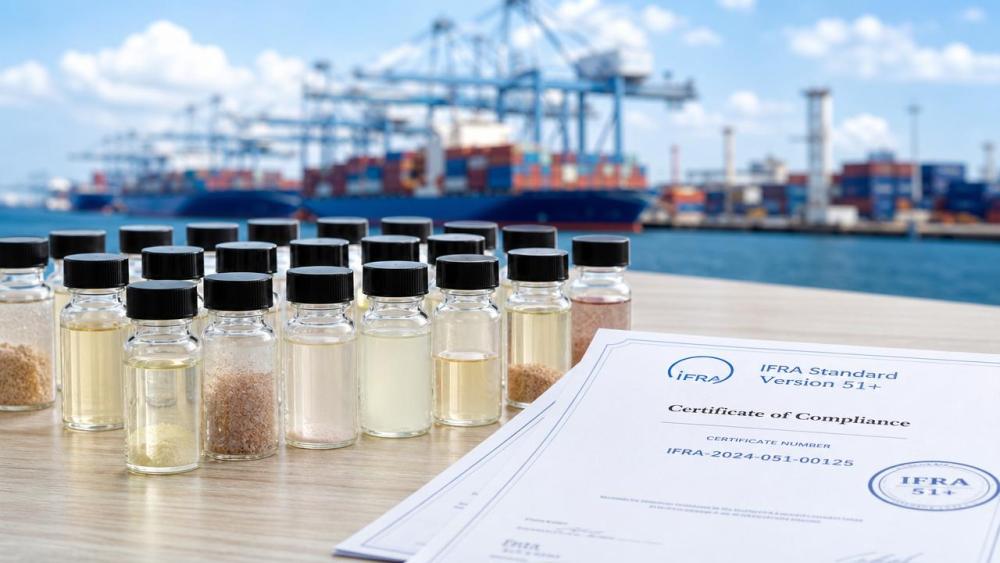
On 29 May 2026, the ASEAN Fragrance Council issued a joint initiative confirming that, effective 1 July 2026, four ASEAN member states — Indonesia, Vietnam, Thailand, and Malaysia — will implement a mandatory declaration and documentation requirement for imported fragrance ingredients classified as leave-on or rinse-off. Under this measure, customs authorities will reject clearance for any such product lacking a valid IFRA Certificate demonstrating compliance with IFRA Standard Version 51 or later.
Industries Affected
Direct Importers and Trading Companies
Importers handling fragrance ingredients into the four countries will face immediate procedural impact: customs submission now requires verified IFRA 51+ certification as a prerequisite for entry. Non-compliant shipments risk delays, rejections, or forced re-exportation — increasing landed cost and supply chain uncertainty.
Raw Material Suppliers and Global Fragrance Houses
Suppliers issuing IFRA Certificates must ensure their documentation reflects Version 51 or newer standards — including updated restrictions on specific allergens, impurity thresholds, and usage limits per product type. Legacy certificates referencing IFRA 49 or earlier will no longer be accepted for these markets, requiring internal alignment across technical, regulatory, and commercial teams.
Contract Manufacturers and Formulators
Companies blending or incorporating fragrance into finished products (e.g., shampoos, lotions, detergents) must verify upstream compliance before procurement. Failure to do so may result in non-conforming finished goods, especially where fragrance is a declared ingredient subject to post-market surveillance or labeling review.
Distribution and Logistics Service Providers
Third-party logistics providers and customs brokers supporting fragrance imports will need to update document-checking protocols. Their role shifts from administrative support to active compliance gatekeeping — verifying certificate validity, version date, scope alignment (leave-on vs. rinse-off), and signatory authority prior to filing.
Key Considerations and Recommended Actions
Monitor official implementation guidance
While the ASEAN Fragrance Council announced the policy, national customs and health authorities (e.g., BPOM in Indonesia, FDA Thailand) have yet to publish detailed procedural notices. Companies should track updates from each country’s competent authority — particularly regarding acceptable certificate formats, verification mechanisms, and transitional arrangements.
Review current fragrance portfolio against IFRA 51 requirements
Analysis shows that IFRA 51 introduces stricter limits on several widely used materials (e.g., certain oakmoss derivatives, coumarin in rinse-off applications). Suppliers and users should prioritize assessment of high-volume or high-risk ingredients — especially those with narrow safety margins under prior versions.
Distinguish between policy announcement and operational readiness
Observably, the 29 May 2026 announcement serves as formal notice, but enforcement capacity (e.g., digital verification systems, trained customs officers) may vary by country. Businesses should not assume uniform rollout — instead, prepare for phased adoption and potential early audits in priority ports or sectors.
Update procurement and contract terms ahead of July 2026
Current more appropriate action is to revise supplier agreements to include IFRA 51+ compliance warranties, certificate validity clauses, and liability provisions for non-conformance. Internal procurement workflows should embed automatic checks for certificate version and expiry before purchase order release.
Editorial Perspective / Industry Observation
This initiative is best understood not as an isolated technical update, but as a coordinated signal of ASEAN’s growing regulatory convergence in cosmetic ingredient safety. From industry perspective, it reflects increasing alignment with EU-level expectations — though without full harmonization of enforcement infrastructure. Analysis shows it functions primarily as a market access filter rather than a comprehensive safety framework; its immediate effect lies in documentation rigor and supply chain transparency, not in new toxicological assessments. Continued observation is warranted on whether additional ASEAN members join the initiative, and whether mutual recognition of IFRA certifications emerges among participating countries.
Conclusion
As of mid-2026, this mandate represents a defined, enforceable change in market entry conditions — not merely advisory guidance. Its significance lies in shifting compliance responsibility upstream: from finished-product marketers to ingredient suppliers and importers alike. It is more accurately interpreted as an operational checkpoint than a scientific milestone. For stakeholders, the most constructive stance is proactive documentation alignment — treating IFRA 51+ certification as a non-negotiable trade document, comparable in necessity to CoA or MSDS, beginning well before July 2026.
Source Disclosure:
Main source: ASEAN Fragrance Council Joint Initiative Announcement, dated 29 May 2026.
Note: National implementing regulations, customs procedures, and enforcement timelines remain pending publication by individual ASEAN member states and are subject to ongoing monitoring.
Related News
- Can biomimetic peptides in cosmetics reduce the look of wrinkles?Oct 17, 2026Cosmeceutical Formulator
- How to assess a bio-based thickener manufacturer's batch consistencyOct 16, 2026Food Rheology Expert
- Verifying halal status of hydrocolloid ingredients in the Middle EastOct 15, 2026Food Rheology Expert
- How to interpret active matter on a surfactant specification sheetOct 14, 2026Prof. Elian Thorne
Related News
- 00
0000-00
Can biomimetic peptides in cosmetics reduce the look of wrinkles? - 00
0000-00
How to assess a bio-based thickener manufacturer's batch consistency - 00
0000-00
Verifying halal status of hydrocolloid ingredients in the Middle East - 00
0000-00
How to interpret active matter on a surfactant specification sheet - 00
0000-00
Which Natural Hydrocolloid Works Best in Acidic Cosmetic Formulas?
Industry Global
Weekly Insights
Stay ahead with our curated technology reports delivered every Monday.