





When Powder Stops Flowing, Quality Has Already Started to Move
A garlic seasoning may still look acceptable after a short period in storage, yet the first signs of deterioration are often already present: a weaker opening aroma, small soft lumps near the bag seam, powder that bridges in a hopper, or a less uniform dose during blending. These changes are closely connected. Moisture affects particle surfaces and flow, while the same storage conditions can accelerate the loss of volatile compounds responsible for the characteristic garlic note.
For quality and food-safety teams, the issue is not limited to whether a powder is visibly clumped. Storage conditions influence receiving decisions, line reliability, batch consistency, complaint investigations, and the amount of material that must be reworked or discarded. A practical control program needs to distinguish between product moisture, the humidity around the package, package integrity, and moisture introduced after opening. Treating all of these as one problem often leads to ineffective corrective actions.
Dry seasoning powders are particularly sensitive because their large surface area allows them to exchange moisture with the surrounding air quickly once protective packaging is compromised or repeatedly opened. The risk can be highest during routine handling rather than long-term warehouse storage: sampling, partial-bag use, shift changes, cleaning activity near ingredient staging areas, and return of unfinished material to inventory.
Why Moisture Changes Aroma and Flow at the Same Time
Garlic-derived powders contain flavor-active compounds that are susceptible to time, oxygen, temperature, and storage conditions. Moisture does not necessarily create an immediate sensory defect by itself, but it can support reactions and physical changes that make aroma retention more difficult. A powder exposed to humid air may absorb water at the particle surface, become tackier, and form contact points with neighboring particles. Small agglomerates then become more likely, especially where compression occurs during stacking or transport.
As particles stick together, the powder becomes less predictable in feeders, augers, sachet lines, and dry-blend systems. Operators may respond by increasing vibration, breaking clumps manually, or changing feeder settings. These actions can restore short-term movement, but they do not resolve the underlying condition. Excessive agitation may also create more fines, increase dust, or produce uneven dosing.
The relationship is not identical for every material. Particle size distribution, oil content, carrier ingredients, processing history, and anti-caking systems all influence moisture sensitivity. A coarse granulated ingredient may resist visible caking longer than a fine powder, while still losing handling consistency. Conversely, a very fine product may appear compacted even when the root cause is compression, rather than excessive moisture. Quality teams need evidence before assigning cause.
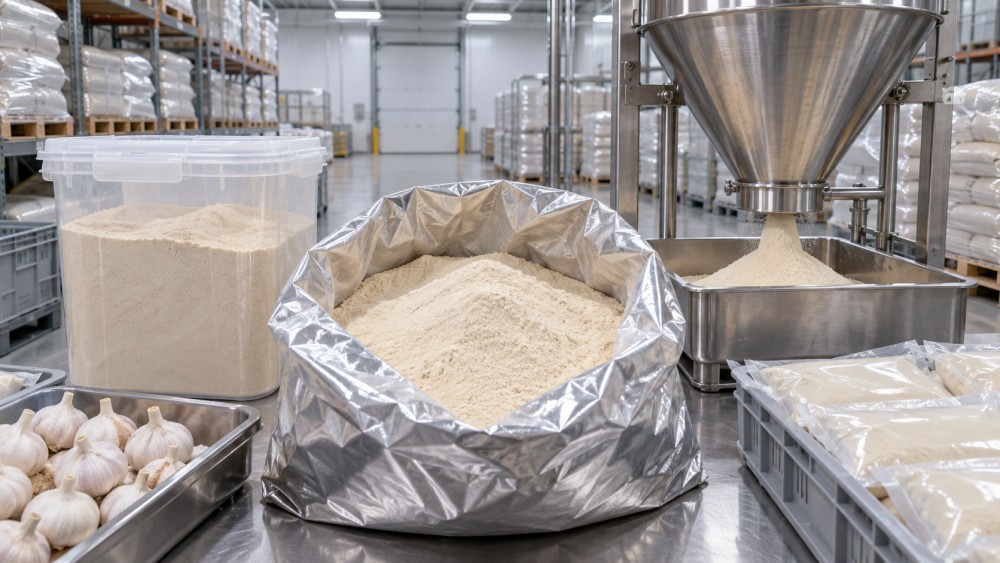
Separate the Main Failure Modes During Investigation
“Caking” is a useful description, but it is not a diagnosis. A complaint or in-process deviation should be evaluated by where the defect appears, how quickly it develops, and whether the condition is isolated to certain lots, locations, or handling steps.
This distinction matters because a flow aid cannot correct a warehouse condensation problem, and a better outer carton will not solve poor partial-bag handling on the production floor. If the defect appears only after the bag is opened, the receiving specification may be adequate while internal material-control procedures need revision. If unopened units show the same issue, investigation should extend to transport, storage, packaging performance, and supplier release data.
Use Moisture Measurements in Context
Moisture content is useful, but it should not be treated as a stand-alone predictor of stability. Two powders with similar measured moisture can behave differently because their ingredients bind water differently. Water activity can provide additional insight into the availability of water for reactions and microbial concerns, while equilibrium behavior helps explain why a dry powder may gain moisture after exposure to humid air. The relevant acceptance limits must be product-specific and should be established through validated specifications, supplier documentation, shelf-life work, and process experience.
Sampling is equally important. A sample drawn from the center of a newly opened bag may not represent material near a closure, a damaged corner, or an outer pallet layer exposed to changing warehouse conditions. When investigating an issue, collect material from the affected zone and an apparently unaffected zone where possible. Compare physical appearance, odor, flow behavior, and laboratory results using documented methods. Retain the original packaging for examination rather than transferring all evidence into a clean container.
For incoming materials, teams commonly benefit from a layered review: certificate or release documentation, visual packaging inspection, lot traceability, sensory screening where appropriate, and targeted testing based on risk. A single moisture result that passes an internal limit does not rule out damage caused by transient humid exposure, especially if odor and flow observations suggest a handling problem.
Control the Storage Environment Before Opening the Package
Dry storage is not simply a matter of keeping ingredients away from direct water. Humid air, temperature swings, and contact with cold surfaces can all create conditions that challenge powder stability. Warehouses and staging rooms should be evaluated for the actual conditions experienced by the product, not just the building’s nominal setpoint. A pallet placed near a loading door, exterior wall, steam source, washdown area, or uninsulated roof may encounter a different environment from the rest of the room.
Temperature cycling deserves special attention. When a sealed package moves between cold and warm environments, condensation can develop on external surfaces. If the package has weak seals, punctures, or an imperfect closure, moisture may enter over time. Even without direct ingress, repeated cycling can affect package materials and encourage handling errors, such as opening a cold bag before it has equilibrated to the room.
Good practice usually includes clean, dry storage areas; separation from wet-process zones; pallets that keep bags off the floor; protection from damaged shrink wrap; and a documented response to leaks, roof damage, or flooding. Storage layout should allow staff to inspect lower bags and outer pallet faces, where damage is easily missed. Inventory rotation should also reflect both manufacture or packing date and the condition of partially used materials.
Partial Bags Create the Most Common Operational Weak Point
An unopened, correctly packaged powder has a defined barrier system. Once opened, that system is replaced by employee practice. A bag folded over without a secure closure, a scoop left inside, or material held beside a humid production line can change the condition of the contents well before the next use.
For this reason, procedures for opened ingredients should be explicit rather than assumed. They may address the maximum time material can remain exposed, approved reclosure methods, identification of the opening date and operator, use of clean dedicated utensils, and whether a partial bag may return to dry storage. Repacking into a suitable food-contact container can be appropriate when it preserves protection and traceability, but transferring powder into an unmarked bin introduces a different risk: loss of lot identity, allergen-control confusion, and inability to investigate a later defect.
When selecting or approving a seasoning ingredient, quality teams should consider how it will actually be handled after receipt. The flavor profile, intended application, and physical form all affect storage expectations. Guidance on seasoning powder flavor profiles and uses can help frame this review, particularly when evaluating how garlic powder will behave in a dry blend, snack coating, sauce base, or other finished-food system. The storage plan should match the real production environment rather than an idealized warehouse condition.
Packaging Inspection Should Go Beyond “Bag Intact”
A package may appear intact at a glance while still providing inadequate protection after distribution. Inspection should look for pinholes, abrasion points, crushed corners, incomplete heat seals, powder traces around closures, and distortion caused by compression. Outer packaging damage does not always mean the inner liner has failed, but it should trigger a closer check instead of automatic acceptance.
Procurement and quality specifications can define the packaging configuration expected for the route and storage period. Relevant questions include whether an inner liner is present, how it is sealed, whether the closure can be effectively reclosed after sampling, and how units are protected during palletized transport. The most suitable arrangement depends on order size, consumption rate, climate exposure, and the customer’s own handling controls. A format that works for rapid, full-bag consumption may be unsuitable for a site that uses small quantities over several weeks.
Receiving personnel also need a clear escalation path. If packaging is damp, punctured, or shows signs of contamination, simply placing it in a dry room may conceal rather than resolve the risk. Material should be segregated until the appropriate quality review determines whether further inspection, testing, or disposition is needed.
Practical Controls for Production and Warehouse Teams
- Map exposure points: Follow the material from receiving through sampling, storage, weighing, dispensing, and return-to-stock. Identify every point where ambient air, water, or unsuitable utensils can contact the powder.
- Monitor conditions where decisions are made: Review humidity and temperature near ingredient staging, not only at a central building sensor. Investigate recurring seasonal or shift-related changes.
- Keep dry and wet activities apart: Avoid staging open powders near washdown, steam, cooling operations, or doors that remain open during wet weather.
- Set a defined response for caking: Determine when sieving is permitted, when material must be held, and when a physical defect requires laboratory or sensory review. Reworking should not become a routine substitute for root-cause correction.
- Train on package handling: Forklift damage, overstacking, dragging bags, and poor resealing can all undermine otherwise sound specifications.
- Trend deviations by location and lot: Repeated issues in one warehouse zone may indicate environmental control problems; repeated issues across unopened lots may point toward transport or packaging concerns.
Safety Review Requires More Than a Flowability Decision
Loss of flow is often treated as a quality inconvenience, but visible moisture exposure can also prompt a food-safety assessment. The appropriate response depends on the nature and extent of the exposure, product characteristics, packaging status, time involved, and the site’s hazard analysis. Damp external cartons may require a different decision from a torn inner liner with wet powder. If contamination, foreign material, pest activity, or an unverified water source is involved, the concern extends beyond texture and aroma.
Quality and safety functions should align on quarantine criteria, documentation, sampling authority, and disposition decisions before an event occurs. This prevents production pressure from driving inconsistent decisions when an ingredient is needed urgently. A clear record of lot number, storage location, package condition, photographs where permitted, and handling history also supports supplier communication and internal corrective action.
Build Storage Controls Around the Actual Risk
Reliable aroma and flow depend on a chain of controls rather than a single moisture test or a stronger bag. Product characteristics, package barrier, warehouse conditions, transport exposure, stock rotation, and open-bag discipline all interact. The most effective programs focus on where protection is lost: a compromised seal, a humid staging area, an untrained reclosure practice, or a pallet location exposed to temperature swings.
For garlic powders and related seasoning materials, early detection is usually less disruptive than responding after feeder performance and sensory quality have both changed. Inspect packages closely, investigate patterns rather than isolated symptoms, and make storage rules specific enough that warehouse and production teams can apply them consistently.
Related News
- Garlic Powder Storage: Managing Moisture to Protect Aroma and FlowSep 23, 2026Food Preservation Scientist
- Why Garlic Powder Behavior Changes Across Dry Seasoning FormulasAug 12, 2026Food Preservation Scientist
- India BIS Enforces Disclosure Rule for Imported Freshness BlendsJun 27, 2026Food Preservation Scientist
- Olfactory Engineering in Pet Food: How to Improve Palatability Without ReformulatingJun 23, 2026Food Preservation Scientist
Related News
- 00
0000-00
Verifying halal status of hydrocolloid ingredients in the Middle East - 00
0000-00
How to interpret active matter on a surfactant specification sheet - 00
0000-00
What Quality Checks Should You Run on Fragrance Ingredient Suppliers? - 00
0000-00
How to assess a flavor chemistry manufacturer's batch consistency - 00
0000-00
What drives fragrance ingredients price changes in bulk orders?
Food Preservation Scientist
Weekly Insights
Stay ahead with our curated technology reports delivered every Monday.