





On June 27, 2026, the Bureau of Indian Standards (BIS) began enforcing a mandatory disclosure requirement for imported compound food preservatives declared as “Blended Freshness Agents.” Products in this category must now be accompanied by a quantitative component analysis report issued by a CNAS- or CMA-recognized laboratory, covering Nisin, ε-PL, the proportion of natural organic acids, and residual solvents, or they will not be cleared through customs. For importers, ingredient suppliers, manufacturers, and logistics operators serving the India market, the immediate concern is no longer only product composition itself, but whether compliance documents can withstand border review in time for delivery.
What the New Requirement Clearly Includes
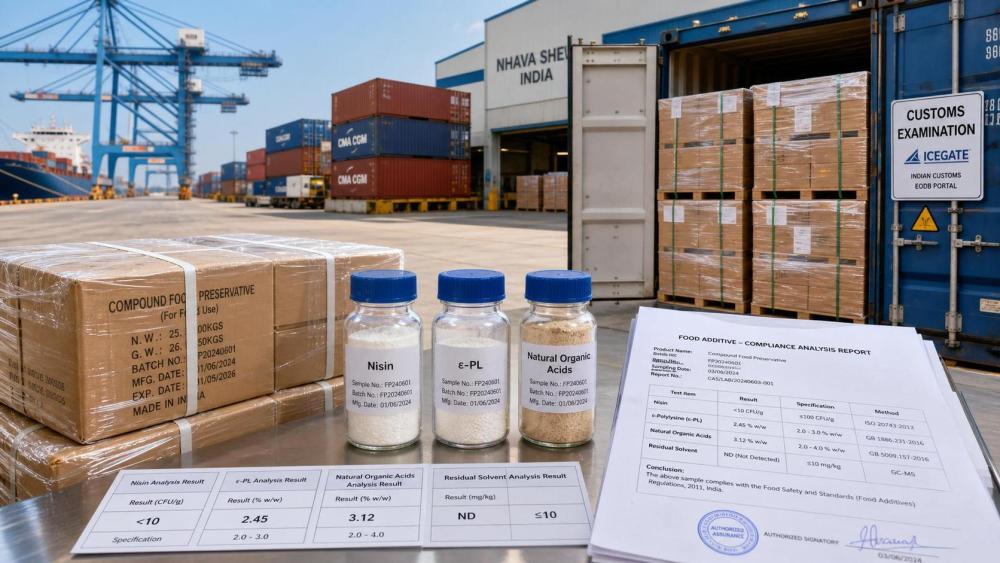
According to the information provided, BIS has implemented this rule from 2026-06-27 for imported blended preservative products declared as “Blended Freshness Agents.” The required supporting document is a third-party quantitative composition analysis report from a CNAS- or CMA-recognized laboratory.
The report must include the composition and proportion details for Nisin, ε-PL, natural organic acids, and residual solvents. If the required report is not submitted, the goods will not be released for customs clearance.
The same information also states that the measure has already affected cargo flow at Mumbai Port, where more than 12 related shipments have been delayed over the past three days.
Where the Pressure Is Likely to Appear First
Import transactions are now tied more tightly to laboratory documentation
From an industry perspective, direct trading companies and importers are likely to feel the impact first because customs release now depends on whether the declared product is supported by the specified third-party analysis report. The operational pressure is concentrated in pre-shipment document preparation, customs filing consistency, and delivery scheduling.
What deserves closer attention is whether products marketed or declared under blended freshness or compound preservative descriptions can be matched cleanly with the required analytical breakdown before cargo arrival.
Suppliers of compound preservative formulations face a higher documentation threshold
For upstream suppliers, the issue is not only formulation design but also whether the product can be presented in a form that satisfies the new disclosure requirement. Analysis shows that products sold as blended systems may now face closer scrutiny at the point where commercial naming, composition disclosure, and test documentation intersect.
The business impact is likely to show up in sample testing arrangements, batch documentation readiness, and the coordination needed between exporters and recognized laboratories.
Manufacturers and downstream buyers may see delivery disruptions rather than formula changes first
For processors, brand owners, and other end users purchasing imported preservative blends, the first visible effect may be shipment uncertainty rather than an immediate change in ingredient use. If inputs are delayed at port, the pressure shifts to procurement timing, inventory planning, and substitute sourcing discussions.
Observably, the rule matters even for companies that are not the importer of record, because customs delays can still affect production continuity and contracted delivery windows.
Logistics and customs service providers will need closer document validation
Supply chain service providers, including customs brokers and freight coordinators, may need to strengthen document checks earlier in the shipment cycle. The key issue is whether the cargo description, supporting laboratory report, and submission package remain consistent enough to avoid detention or rework at the port stage.
In practical terms, the new rule increases the compliance value of document review before arrival, not only at the moment of clearance filing.
What Companies Should Watch Now
Check whether product declarations trigger the rule
Companies shipping to India should first review whether any imported item is being declared as “Blended Freshness Agents.” This is a practical threshold issue because the requirement, as provided, is tied to that declared product category.
Verify laboratory qualification and report scope before shipment
The current requirement explicitly refers to CNAS- or CMA-recognized laboratories and specifies the composition items that must be covered. Businesses should therefore focus on whether the testing provider meets the stated recognition condition and whether the report clearly addresses Nisin, ε-PL, natural organic acid ratios, and residual solvents.
Prepare for timing risk in ongoing deliveries
Given that more than 12 related shipments were reportedly delayed at Mumbai Port within three days, companies with near-term cargo exposure should pay attention to whether existing shipments already in transit carry the needed documentation. The operational issue is not abstract compliance planning, but whether current delivery commitments can still be met.
Separate confirmed rules from possible future interpretation
Analysis shows that companies should distinguish between what is already explicit and what still requires monitoring. The confirmed part is the clearance requirement and the report content described in the provided information. What still needs observation is how consistently the rule will be applied across shipments, declarations, and operational scenarios.
Why This Looks Like More Than a Short-Term Port Issue
Observably, this development should not be read only as a temporary customs bottleneck. It also signals that ingredient transparency and third-party verification are becoming central to cross-border market access for this product category.
At the same time, it would be premature to describe it as a fully settled long-term regime based only on the current information. Analysis shows that the industry still needs to watch how the requirement is interpreted in live trade flows and whether further official clarification changes document expectations or enforcement rhythm.
How to Read the Current Signal
At this stage, it is more appropriate to understand the BIS move as an immediate compliance rule with clear short-term operational consequences and a possible longer-term regulatory signal for imported blended food preservative products. The immediate fact is straightforward: without the specified third-party analysis report, clearance will not proceed.
The broader industry meaning is narrower but important. This is a document-and-disclosure issue that can directly affect shipment timing, supplier readiness, and procurement continuity. It should be tracked as an active market-access development rather than treated as a routine filing change.
Basis of This Article
This article is based on the user-provided news title, event date, and event summary concerning the BIS enforcement measure effective on 2026-06-27. The analysis above separates confirmed facts from editorial observation and does not extend beyond the information provided.
For this type of development, relevant source categories would typically include official notices, company disclosures, industry association updates, authoritative media reporting, and standards-related documents. A specific official source link was not provided in the input, so continued verification is still necessary.
Follow-up attention should remain on any further official wording, implementation clarification, and port-level enforcement developments related to “Blended Freshness Agents” and the required CNAS/CMA laboratory analysis reports.
Related News
- Garlic Powder Storage: Managing Moisture to Protect Aroma and FlowSep 23, 2026Food Preservation Scientist
- Why Garlic Powder Behavior Changes Across Dry Seasoning FormulasAug 12, 2026Food Preservation Scientist
- India BIS Enforces Disclosure Rule for Imported Freshness BlendsJun 27, 2026Food Preservation Scientist
- Olfactory Engineering in Pet Food: How to Improve Palatability Without ReformulatingJun 23, 2026Food Preservation Scientist
Related News
- 00
0000-00
What drives fragrance ingredients price changes in bulk orders? - 00
0000-00
How to assess a food antioxidants distributor’s traceability practices - 00
0000-00
How minimum order quantities shape private label ingredient sourcing costs - 00
0000-00
What drives personal care ingredient price volatility in sourcing - 00
0000-00
What drives micelles price differences in cosmetic formulations?
Food Preservation Scientist
Weekly Insights
Stay ahead with our curated technology reports delivered every Monday.