





For quality control and safety teams, molecular sensory analysis is becoming a faster, more reliable way to screen fragrance quality before products reach the market. By connecting aroma perception with molecular data, it helps identify off-notes, batch inconsistencies, and compliance risks earlier—supporting smarter decisions, stronger quality assurance, and more efficient fragrance development in today’s demanding FMCG landscape.
In fragrance-driven FMCG categories such as personal care, household cleaning, air care, food-adjacent applications, and cosmetic actives, a delay of even 24–72 hours in quality release can disrupt production schedules, increase rework, and raise the risk of non-conforming batches reaching downstream partners. For teams responsible for release decisions, supplier approval, and safety review, molecular sensory analysis offers a practical bridge between traditional panel assessment and instrument-led screening.
For an intelligence platform like FFAI, which monitors flavors, fragrances, active ingredients, preservatives, thickeners, and surfactant systems across the global FMCG supply chain, this approach matters because sensory performance is no longer separate from compliance, formulation stability, or commercial value. A fragrance that smells acceptable on day 1 but shifts after 3 weeks, after heat exposure, or after surfactant interaction can create both quality and regulatory headaches.
Why Molecular Sensory Analysis Matters in Modern Fragrance Quality Control
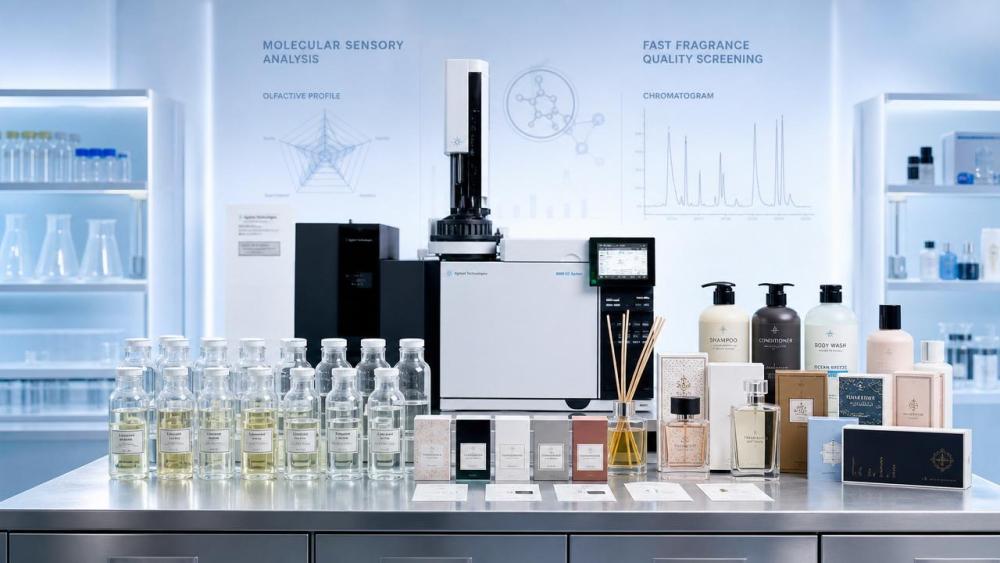
Molecular sensory analysis combines chemical profiling, sensory mapping, and risk-oriented interpretation. In practical terms, it helps QC and safety teams compare what a fragrance contains, how it is perceived, and whether that perception remains stable across time, matrix, and storage conditions. This is especially useful when hundreds of fragrance lots move through multi-site FMCG production every month.
Conventional sensory review still has value, but human evaluation alone can be slow and variable. A trained panel may need 6–12 assessors, multiple rounds, and controlled conditions to reach a reliable conclusion. Molecular sensory analysis shortens the first screening stage by flagging unusual peaks, oxidation markers, dilution anomalies, or known high-impact odorants before a panel invests time in detailed assessment.
Key pressure points for QC and safety teams
- Faster lot release demands, often within 1–3 working days
- Higher supplier variability across natural extracts and compounded fragrance bases
- Greater sensitivity to allergen disclosure, IFRA alignment, and restricted substances
- Matrix interactions with surfactants, antioxidants, thickeners, and cosmetic actives
- Rising clean-label and safety expectations in global FMCG markets
Where faster screening creates real value
In many operations, only 10%–20% of incoming fragrance lots require deep investigation. The challenge is identifying them early. Molecular sensory analysis supports triage by separating routine lots from lots that need full sensory review, reformulation checks, or supplier escalation. That can reduce unnecessary panel workload while improving detection of borderline quality issues.
This matters across FFAI-covered sectors. In food-adjacent aroma systems, oxidation can distort top notes quickly. In shampoos and body washes, surfactant micelles may suppress or delay fragrance lift. In anti-aging cosmetics, peptides, solvents, and preservatives can subtly alter odor character over 2–8 weeks. Faster screening protects not just smell, but product consistency and market readiness.
Three core outcomes
- Earlier detection of off-notes such as rancid, sulfuric, phenolic, or burnt nuances
- Better lot-to-lot consistency control across seasonal or supplier-driven raw material shifts
- Stronger support for release, hold, reject, and corrective action decisions
The table below shows how molecular sensory analysis complements, rather than replaces, conventional fragrance quality methods used by quality and safety teams.
The operational takeaway is clear: molecular sensory analysis works best as an early-warning layer. It improves speed and consistency in the first screening cycle, then directs human expertise to the lots, formulas, or interactions that actually justify deeper review.
How Molecular Sensory Analysis Works Across FMCG Fragrance Systems
The strength of molecular sensory analysis lies in combining multiple evidence streams instead of relying on a single test. In most FMCG environments, a useful workflow has 4 stages: intake profiling, odor-impact mapping, matrix compatibility screening, and release-risk interpretation. Depending on product category, the full cycle may take from a few hours to 2 working days.
Stage 1: Build a molecular fingerprint
At intake, teams record a reference profile for the approved fragrance. This may include chromatographic pattern consistency, peak-area relationships, marker compound windows, and known oxidation or degradation signals. For natural essential oils, acceptable variation bands may be broader, often within a pre-defined range such as ±10% to ±20% for selected marker peaks, depending on season and origin.
Stage 2: Link molecules to perceived odor impact
Not every molecular deviation matters equally. A small change in a high-impact sulfur compound can be more critical than a larger change in a low-impact background component. This is why molecular sensory analysis focuses on odor-active materials, threshold-sensitive compounds, and top/middle/base note balance instead of total composition alone.
Examples of odor-risk signals
- Trace oxidation products that create cardboard, fatty, or stale impressions
- Solvent imbalance affecting fragrance lift in aerosol or liquid systems
- Thermal stress markers after exposure to 40°C–50°C accelerated storage
- Base note shifts after contact with surfactants or emulsifiers for 7–14 days
Stage 3: Test the formula matrix, not just the neat fragrance
A fragrance may pass in concentrated form and still fail in application. That is common in detergents, shampoos, creams, and functional foods, where preservatives, hydrocolloids, antioxidants, or active compounds can alter release and perception. Testing in both neat and finished-product matrices gives QC teams a more realistic screening result.
For example, in a sulfate-free shampoo with amino acid surfactants, fragrance blooming may differ from a standard anionic base. In a luxury anti-aging cream, peptides and humectants may mute certain top notes over 4–6 weeks. Molecular sensory analysis helps detect these category-specific risks before a product moves to scale-up.
Stage 4: Convert findings into release decisions
Data only becomes valuable when tied to action thresholds. Strong systems use a practical decision tree: pass, conditional pass, hold for sensory review, hold for supplier clarification, or reject. This creates a disciplined process that supports both speed and audit readiness.
The following framework can help quality and safety teams define a usable release logic for fragrance screening.
This kind of decision table helps standardize judgment across sites, shifts, and product categories. It also supports stronger internal communication between procurement, formulation, QC, and regulatory teams.
Selection Criteria for QC Managers and Safety Leaders
Choosing a molecular sensory analysis approach is not only a technical decision. It is also a workflow, cost-control, and risk-management decision. For B2B buyers in fragrance, cosmetic ingredients, household care, and food-related applications, the best setup is usually the one that fits sample volume, decision speed, regulatory burden, and matrix complexity.
1. Match the method to sample throughput
A site screening 20 lots per month has different needs from one screening 200. Lower-volume teams may prioritize flexible, service-based testing with 48-hour turnaround. Higher-volume teams may need internal workflows, standard operating windows, and weekly trend dashboards to avoid release bottlenecks.
2. Check matrix coverage
If your fragrance portfolio spans perfumes, detergents, shampoos, creams, and food-adjacent systems, the method must account for different release mechanisms. A profile that works well for an alcoholic fine fragrance may not predict behavior in a thickened emulsion or hydrocolloid-rich system.
3. Integrate compliance screening
For safety managers, speed means little without compliance relevance. Screening should support ingredient review against fragrance allergens, restricted materials, contamination concerns, and market-specific documentation. This becomes more important when exporting to multiple regions with different disclosure and cosmetics notification expectations.
Four questions to ask before implementation
- Which 5–10 odor defects create the highest complaint or rejection risk in our portfolio?
- What is our current average decision cycle for fragrance release?
- How many lots require unnecessary full panel review each month?
- Which matrices most often distort fragrance performance after filling or storage?
A practical supplier or partner evaluation matrix can make procurement and implementation discussions more disciplined.
For many B2B buyers, the best value is not the most complex analytical package. It is the setup that reduces preventable holds, improves sensory consistency, and creates a repeatable release process across multiple product lines.
Implementation Risks, Common Mistakes, and Practical Next Steps
Even strong teams can lose value from molecular sensory analysis if they treat it as a purely lab-based task. The method works best when QC, formulation, procurement, and regulatory teams share the same reference standards, escalation triggers, and acceptance language. Without that alignment, data accumulates but release decisions remain inconsistent.
Common mistakes to avoid
- Using broad compositional similarity as proof of sensory equivalence
- Ignoring matrix testing for surfactant, emulsion, or thickened systems
- Applying one tolerance band to both natural and synthetic fragrance systems
- Skipping accelerated aging screens such as 2-week heat or light challenge tests
- Failing to connect analytical flags with panel-confirmed odor outcomes
A practical 5-step rollout plan
- Identify the top 3 product categories where fragrance inconsistency creates the highest business risk.
- Define approved reference profiles and review the last 6–12 months of deviation cases.
- Run pilot screening on incoming lots and on finished-product matrices in parallel.
- Set action thresholds for pass, hold, and reject decisions with QC and safety sign-off.
- Review the first 30–60 days of results and refine tolerance windows by category.
What success looks like
A successful program does not eliminate human sensory review. Instead, it makes human review more targeted. Teams should expect clearer batch classification, fewer emergency investigations, better supplier conversations, and stronger traceability. Over time, that supports more consistent end-product experience in fragranced consumer goods and adjacent ingredient systems.
For organizations tracking trends across flavors, fragrances, active ingredients, preservatives, thickeners, and surfactants, molecular sensory analysis also creates a richer intelligence base. It helps explain why some formulas remain stable under stress while others drift in performance, and why some premium ingredients justify their sensory value in the final market.
Molecular sensory analysis is no longer a niche concept for advanced fragrance houses alone. For QC personnel and safety managers working in complex FMCG supply chains, it is becoming a practical tool for faster screening, better consistency control, and more confident compliance-focused decision-making. When paired with matrix testing, defined thresholds, and cross-functional interpretation, it can reduce release uncertainty without sacrificing product experience.
If your team is evaluating more efficient fragrance quality screening, FFAI can help you connect molecular sensory insights with formulation, compliance, and market requirements across food-adjacent, personal care, household, and cosmetic ingredient systems. Contact us to discuss your application scenario, request a tailored evaluation framework, or explore more solution insights for fragrance quality and safety management.
Related News
- Garlic Powder Storage: Managing Moisture to Protect Aroma and FlowSep 23, 2026Food Preservation Scientist
- Why Garlic Powder Behavior Changes Across Dry Seasoning FormulasAug 12, 2026Food Preservation Scientist
- India BIS Enforces Disclosure Rule for Imported Freshness BlendsJun 27, 2026Food Preservation Scientist
- Olfactory Engineering in Pet Food: How to Improve Palatability Without ReformulatingJun 23, 2026Food Preservation Scientist
Related News
- 00
0000-00
What drives fragrance ingredients price changes in bulk orders? - 00
0000-00
How to assess a food antioxidants distributor’s traceability practices - 00
0000-00
How minimum order quantities shape private label ingredient sourcing costs - 00
0000-00
What drives personal care ingredient price volatility in sourcing - 00
0000-00
What drives micelles price differences in cosmetic formulations?
Food Preservation Scientist
Weekly Insights
Stay ahead with our curated technology reports delivered every Monday.