





In freshness agents, olfactory engineering shapes first impression, perceived hygiene, and repeat acceptance. A good scent suggests cleanliness and stability. A poor one signals harsh chemistry, weak quality control, or sensory mismatch.
Across food-adjacent FMCG, home care, personal care, and air management products, olfactory engineering must connect aroma design with formulation science. It also must respect regulation, substrate behavior, packaging, and storage realities.
This matters strongly in the broader ingredient economy observed by FFAI. Freshness systems are no longer judged by scent alone. They are evaluated by safety, diffusion profile, compatibility, emotional response, and lifecycle performance.
Understanding olfactory engineering in freshness agents
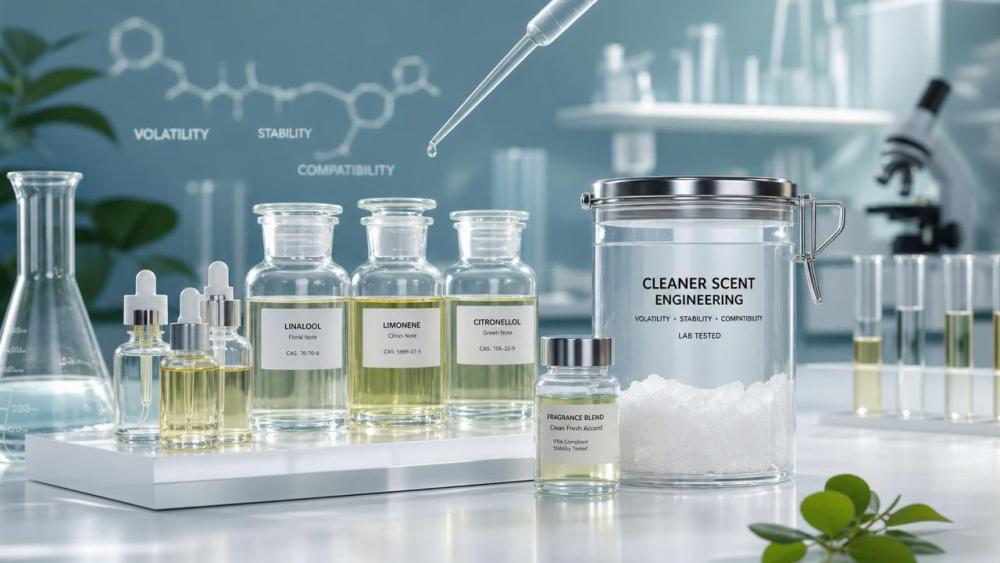
Olfactory engineering is the deliberate design of scent performance through molecular selection, accord structure, release control, and use-context testing. In freshness agents, it governs how “clean” or “fresh” is recognized over time.
A freshness agent may contain volatile top notes, masking materials, fixatives, encapsulation aids, solvents, and stabilizers. Each component affects evaporation speed, perception sequence, and interaction with active ingredients.
The most common mistake is treating fragrance as a decorative afterthought. Effective olfactory engineering starts earlier, beside preservative systems, surfactants, antioxidants, pH design, and packaging specification.
In practical terms, olfactory engineering answers five questions:
- What scent signals freshness in the target category?
- How does the scent evolve during storage and use?
- Which ingredients suppress, distort, or amplify the accord?
- Does the scent align with safety and compliance limits?
- Can the formula stay pleasant under temperature, light, and oxygen stress?
Current industry signals shaping freshness design
Freshness expectations are changing across the comprehensive industry landscape. Clean-label thinking, sensory transparency, and premium positioning now influence fragrance decisions as much as cost and intensity.
Several market signals are especially relevant to olfactory engineering:
For FFAI-style intelligence work, this shift confirms that olfactory engineering must be connected to chemistry, market language, and end-use behavior. Freshness cannot be designed only in a fragrance lab.
Common design mistakes in olfactory engineering
Mistake 1: Overbuilding the top note
Many freshness agents rely too heavily on bright citrus, aldehydes, or minty impact. The opening feels impressive, but the scent collapses quickly and leaves an empty or chemical after-smell.
Balanced olfactory engineering needs a middle and base architecture. Freshness should transition smoothly, not disappear after the first evaporation wave.
Mistake 2: Ignoring matrix interactions
Surfactants, solvents, preservatives, antioxidants, and thickeners can reshape volatility and odor character. A scent tested alone may smell very different inside the final system.
Olfactory engineering should include compatibility screening across pH range, ionic strength, and processing conditions. This is especially important in complex FMCG formulas.
Mistake 3: Confusing masking with freshness
Masking unpleasant raw-material notes is necessary, but heavy masking does not automatically create a true fresh profile. It can produce thickness, sweetness, or sensory fatigue.
Good olfactory engineering removes conflict first, then builds a believable freshness identity. The goal is coherence, not perfume overload.
Mistake 4: Misreading cultural freshness codes
Freshness is not universal. Some markets link it to laundry musk, others to green herbs, watery florals, camphor-like coolness, or near-odorless cleanliness.
Without local insight, olfactory engineering may create technically elegant accords that fail commercially. Perception mapping should be done before final optimization.
Mistake 5: Weak stability planning
Oxidation, hydrolysis, heat exposure, and light can flatten freshness notes or create off-odors. Packaging headspace and material migration also affect the final sensory result.
Strong olfactory engineering uses accelerated aging, oxygen exposure checks, and package interaction studies. Stability must be measured, not assumed.
Mistake 6: Poor release timing
Some freshness agents smell excellent in bulk concentrate but fail during actual use. Others bloom too late, after the moment when reassurance is most needed.
Olfactory engineering should match release timing to user contact points, such as opening, spraying, rinsing, drying, or post-application persistence.
Mistake 7: Neglecting compliance and safety boundaries
A high-performing accord can still become unusable if allergen thresholds, category restrictions, or claims language are not considered early. Reformulation later is costly and slow.
This is where regulatory intelligence becomes part of olfactory engineering. Compliance should shape scent architecture from the first brief.
Business value of getting olfactory engineering right
When olfactory engineering is well executed, freshness agents do more than smell pleasant. They support trust, strengthen formula positioning, and reduce sensory complaints during market expansion.
The operational benefits are concrete:
- More stable scent perception across transport and storage conditions.
- Better alignment between product claims and actual use experience.
- Lower risk of off-notes caused by oxidation or interaction.
- Stronger premium feel without unnecessary dosage escalation.
- Easier adaptation to regional preferences and compliance frameworks.
For intelligence-driven platforms like FFAI, this reinforces a larger lesson. Sensory engineering, active performance, and regulatory planning should be stitched together, not managed in separate silos.
Typical application scenarios and scent priorities
Different product environments require different olfactory engineering strategies. Freshness agents cannot follow a single template across categories.
Practical recommendations for stronger design outcomes
A more reliable olfactory engineering workflow usually includes these steps:
- Define what “freshness” means by category, region, and sensory expectation.
- Test accord performance inside the real formula, not only in fragrance base.
- Evaluate top, heart, and dry-down separately under realistic use timing.
- Run stability checks under heat, light, oxygen, and packaging contact.
- Screen restricted materials and allergen exposure before scale-up.
- Adjust dosage based on perception efficiency, not on intensity alone.
It also helps to combine human sensory review with instrumental data. Headspace analysis, oxidation tracking, and panel feedback together give a fuller picture than either method alone.
Next-step direction for formulation planning
The central lesson is simple. Olfactory engineering in freshness agents succeeds when scent creation is treated as a technical system, not only a creative exercise.
By avoiding common design mistakes, freshness profiles become more believable, more stable, and easier to scale across global FMCG applications. That improves both sensory quality and formulation confidence.
A useful next move is to audit one existing freshness formula against scent structure, matrix compatibility, release timing, packaging interaction, and compliance readiness. That review often reveals the fastest path to better olfactory engineering.
Related News
- Garlic Powder Storage: Managing Moisture to Protect Aroma and FlowSep 23, 2026Food Preservation Scientist
- Why Garlic Powder Behavior Changes Across Dry Seasoning FormulasAug 12, 2026Food Preservation Scientist
- India BIS Enforces Disclosure Rule for Imported Freshness BlendsJun 27, 2026Food Preservation Scientist
- Olfactory Engineering in Pet Food: How to Improve Palatability Without ReformulatingJun 23, 2026Food Preservation Scientist
Related News
- 00
0000-00
Verifying halal status of hydrocolloid ingredients in the Middle East - 00
0000-00
How to interpret active matter on a surfactant specification sheet - 00
0000-00
What Quality Checks Should You Run on Fragrance Ingredient Suppliers? - 00
0000-00
How to assess a flavor chemistry manufacturer's batch consistency - 00
0000-00
What drives fragrance ingredients price changes in bulk orders?
Food Preservation Scientist
Weekly Insights
Stay ahead with our curated technology reports delivered every Monday.