





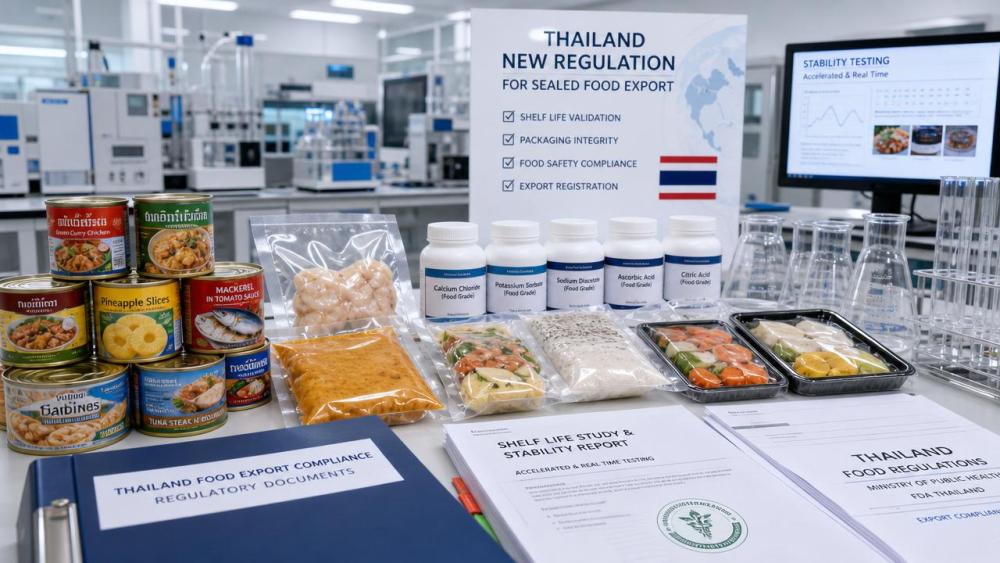
As of June 1, 2026, Thailand has formally enforced new rules for foods sold in sealed containers, raising compliance requirements for canned, vacuum-packed, and modified-atmosphere packaged products. The update is especially relevant for exporters of natural preservatives such as natamycin and ε-polylysine, as well as blended freshness agents and other food preservatives, because registration with the Thai FDA now depends on renewed stability testing and accelerated shelf-life validation data. For companies involved in formulation, export registration, labeling, and shelf-life support, this is not just a documentation issue but a direct market-access matter.
What the new Thai rule clearly requires
The confirmed information shows that Thailand began implementing the new sealed-container food rule on June 1, 2026. The rule strengthens requirements in three areas for canned foods, vacuum-packed foods, and modified-atmosphere packaged foods: microbial control, labeling, and shelf-life verification.
It is also confirmed that exporters of natural preservatives, including natamycin and ε-polylysine, together with suppliers of blended freshness agents and food preservatives, must resubmit stability test reports and accelerated shelf-life validation data. Without these materials, Thai FDA registration filing cannot be completed.
Where the impact is likely to be felt first
Exporters facing a registration bottleneck
From an industry perspective, direct export companies may feel the impact first because the issue is tied to Thai FDA registration filing. If the required test reports and validation materials are not ready, the disruption is likely to appear at the market-entry and filing stage rather than only at shipment stage.
What deserves closer attention is the timing of dossier preparation, internal document review, and communication with Thai-side registration processes.
Ingredient suppliers under greater evidence pressure
For suppliers of natural preservatives, blended freshness agents, and food preservatives, the new requirement may shift attention from product functionality alone to evidence quality. The key business impact is likely to center on whether existing technical files can support stability claims and shelf-life related use scenarios in a way that satisfies the updated registration expectation.
Food manufacturers reviewing packaging-linked compliance
Manufacturers using canned, vacuum-packed, or modified-atmosphere packaging may also need to pay closer attention because the rule explicitly strengthens microbial control, labeling, and shelf-life verification. Analysis shows that compliance is no longer only about the additive itself, but also about how the finished product, packaging format, and claimed shelf life align in regulatory submission and product presentation.
Service providers drawn deeper into validation work
Testing, regulatory, and documentation support providers may see higher demand in areas linked to stability reports, accelerated shelf-life validation, and filing readiness. Observably, the compliance burden may increasingly fall on the quality and completeness of technical support materials rather than on product descriptions alone.
Practical points companies should review now
Check whether existing test files are still usable
Companies exporting affected preservatives or freshness-related ingredients should first review whether their current stability testing materials match the newly enforced filing expectation in Thailand. The immediate issue is not whether documents exist, but whether they can be resubmitted in an acceptable form for registration.
Separate labeling work from shelf-life evidence work
The rule covers both labeling and shelf-life verification, and these should not be treated as the same task. In practice, companies may need to review whether product claims, usage statements, and shelf-life positioning remain consistent with the underlying validation materials prepared for filing.
Reassess lead times for Thailand-bound business
Because registration filing cannot be completed without the required reports and data, businesses may need to re-evaluate internal timelines for document collection, customer confirmation, and export scheduling. This is particularly relevant where sales commitments depend on filing completion.
Keep supplier and customer communication tightly aligned
Where multiple parties are involved, including ingredient suppliers, exporters, and downstream food manufacturers, communication gaps may become a practical risk. What deserves closer attention is whether all parties are working from the same understanding of which products are affected, which materials must be renewed, and what stage the Thai filing process has reached.
Why this looks like more than a short-term paperwork update
Analysis shows that this development is better understood as a concrete compliance tightening rather than a routine administrative adjustment. The reason is that the requirement connects technical evidence directly to Thai FDA registration filing, which gives documentation quality immediate commercial relevance.
At the same time, it would be premature to overstate the broader market outcome. Based on the confirmed information, the clearest takeaway is that exporters and related supply-chain participants now face a higher proof threshold for products tied to preservation, freshness maintenance, and shelf-life support in sealed food applications.
How the industry should read this development
At this stage, it is more appropriate to understand the new Thai rule as an implemented compliance change with practical effects on registration readiness, not merely as a signal for future discussion. For the industry, the main significance lies in the closer linkage between microbial control, labeling, shelf-life verification, and the supporting technical files behind preservatives and freshness-related ingredients.
A neutral reading is that the rule does not automatically define winners or losers, but it does raise the operational importance of valid testing, aligned documentation, and filing preparedness for Thailand-related business.
Basis of this article and what still needs verification
This article is based on the user-provided news title, event date, and event summary. The confirmed inputs are the June 1, 2026 implementation date, the strengthened requirements for microbial control, labeling, and shelf-life verification for sealed-container foods in Thailand, and the resubmission requirement for stability test reports and accelerated shelf-life validation data for relevant exporters.
For this type of industry update, source categories typically relevant for ongoing verification include official notices, company disclosures, industry association updates, authoritative media reports, and standard-related documents. A specific official source link was not provided in the input, so further verification remains necessary. Follow-up attention should focus on any subsequent official clarification, filing interpretation, or implementation detail affecting affected product categories and registration practice.
Related News
- Garlic Powder Storage: Managing Moisture to Protect Aroma and FlowSep 23, 2026Food Preservation Scientist
- Why Garlic Powder Behavior Changes Across Dry Seasoning FormulasAug 12, 2026Food Preservation Scientist
- India BIS Enforces Disclosure Rule for Imported Freshness BlendsJun 27, 2026Food Preservation Scientist
- Olfactory Engineering in Pet Food: How to Improve Palatability Without ReformulatingJun 23, 2026Food Preservation Scientist
Related News
- 00
0000-00
Can biomimetic peptides in cosmetics reduce the look of wrinkles? - 00
0000-00
How to assess a bio-based thickener manufacturer's batch consistency - 00
0000-00
Verifying halal status of hydrocolloid ingredients in the Middle East - 00
0000-00
How to interpret active matter on a surfactant specification sheet - 00
0000-00
How Do You Test Hydrocolloid Viscosity After Changing a Thickener?
Food Preservation Scientist
Weekly Insights
Stay ahead with our curated technology reports delivered every Monday.