





When a dry seasoning formula performs well in one product but clumps, fades, or tastes unbalanced in another, the problem is often traced back to interaction effects rather than a simple raw material defect. Garlic is a good example. Technical teams may approve one powder grade after a bench test, then see very different behavior during scale-up in snack coatings, instant noodle sachets, meat rubs, soup bases, or table seasonings. The change is not random. It usually reflects how garlic solids respond to moisture migration, fat level, particle size distribution, carrier choice, salt load, process heat, and packaging conditions.
For technical evaluators, this matters because garlic notes are highly recognizable. Small differences in release, persistence, or flowability can change whether a seasoning reads as fresh, roasted, sulfurous, sweet, harsh, or simply weak. A formula that looks stable in a lab cup may still fail on a filling line, during warehousing, or after blending with acidic and hygroscopic components.
Garlic performance starts with the matrix, not the ingredient name
One frequent mistake in seasoning development is treating garlic as a fixed input. In practice, garlic behavior is formula-dependent. A powder that works in a low-fat popcorn seasoning may not behave the same way in a high-salt instant soup base. Another grade may disperse cleanly in a fine table blend but show color separation in coarse BBQ rubs. The ingredient name remains the same, yet the working environment changes around it.
This is why evaluation should focus less on whether a sample is simply “good garlic powder” and more on how it functions inside the intended dry system. Many food factories now review seasoning inputs through broader quality checks that include not only sensory acceptance but also blend uniformity, particle compatibility, anti-caking performance, moisture control, and packaging stability. Those checks are often more predictive than a standalone aroma test.
Why the same garlic note shifts across formulas
Moisture affinity changes flow and flavor release
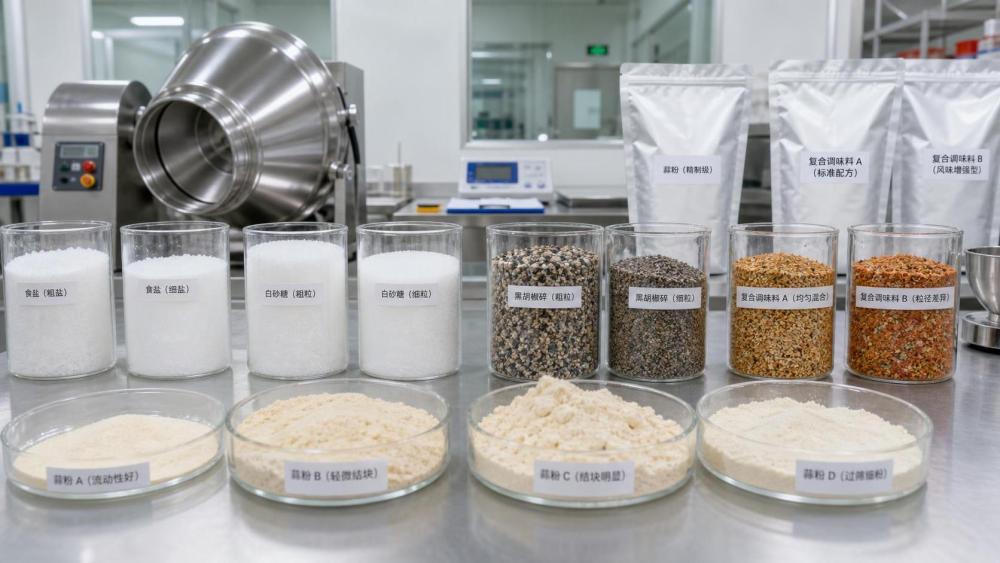
Dry seasonings are rarely truly dry in a practical sense. Salt, sugars, starches, hydrolyzed proteins, spice oleoresin carriers, and organic acids all influence water activity and local moisture pickup. Garlic-containing powders can absorb or exchange moisture with neighboring particles, especially in humid plants or after the pack is opened repeatedly. Once that happens, three issues often appear together: caking, loss of free-flow behavior, and a flatter top note.
In a seasoning blend with high hygroscopicity, the garlic fraction may become less mobile and less evenly distributed. The result is not only handling trouble. It can also create sensory inconsistency from one scoop or sachet to the next.
Particle size affects segregation more than many teams expect
A formula may be chemically correct and still fail physically. If garlic particles are much finer than salt, sugar, chili, dehydrated vegetable granules, or carriers, the blend can segregate during conveying, filling, and transport. Fine particles may settle, adhere to equipment surfaces, or cluster around other fine ingredients. A coarse grade may improve visual consistency in some rubs, while a finer grade may be better for adhesion in snack dusting systems.
Segregation risk rises when factories move from manual pilot blending to larger ribbon blenders, auger filling, or long internal transfer routes. Technical assessment should include post-blend sampling from multiple locations, not only a single top sample taken immediately after mixing.
Fat content changes perception and retention
Garlic flavor behaves differently in dry systems that will later contact oil, surface fat, or melted coatings. In fried snacks and some meat applications, lipid phases can round out sharp sulfur notes and extend flavor persistence. In very lean dry matrices, the same garlic may seem more aggressive at first impact but shorter in finish. This is one reason seasoning prototypes can taste balanced on a warm application trial yet seem thinner after cooling, holding, or packaging.
Where flavor retention is critical, teams sometimes compare standard garlic powder formats with custom seasoning system design rather than evaluating the garlic component in isolation. That approach is relevant in OEM dry blends where the surrounding ingredients, not just the garlic source, determine line performance and sensory stability.
Salt, acids, and savory boosters reshape the profile
Garlic rarely sits alone in seasoning formulas. It competes and cooperates with salt, monosodium glutamate or other umami contributors, yeast extracts, sugar, pepper, onion, citric acid, vinegar solids, cheese powders, and smoke notes. A blend with high acid may push garlic toward a sharper, more immediate profile. Heavy salt can suppress some nuances while making pungent edges feel cleaner or more exposed. Sweet elements may soften impact without increasing real garlic intensity.
For this reason, target dosage should not be set from an isolated tasting in warm water or plain starch. It should be evaluated in the actual formula matrix, at the actual application load, and after expected processing steps.
Thermal history can mute or distort the intended note
Some dry seasoning systems face more heat than buyers assume. There may be pre-blend warming, hot filling nearby, application onto warm substrates, or storage in hot distribution channels. Garlic volatiles are sensitive to that history. Even if the powder itself is stable enough for dry storage, repeated exposure to elevated temperature can shift the profile away from bright and fresh toward dull or cooked.
This matters in factories where seasoning is produced centrally and shipped to multiple plants. A sample approved from a recently opened bag may not represent how the blend performs after transport, staging, and several days on the line.
What technical evaluators should check before approving a formula
A practical review should connect ingredient quality with plant conditions. For food factories, seasoning powder checks are usually most useful when they move across four layers: incoming material, blending compatibility, line behavior, and packed-product stability.
These checks do not require elaborate research methods. What they require is realistic simulation. A seasoning that passes a fresh sensory panel but fails a simple hold test in factory humidity is not truly validated.
Common mismatch points between formula design and factory reality
Bench-top ratios ignore application rate
Many dry seasonings are screened at concentrations that are easier to taste in the lab than on the finished product. If the real coating rate is low, garlic may disappear behind salt and base seasonings. If the real rate is high, sulfurous notes may become dominant. The technical team should verify flavor at the exact use rate and on the real substrate surface, whether that is fried food, baked snack, noodle cake, breadcrumb system, or dry soup mix.
Packaging assumptions are too optimistic
A stable blend in a tightly sealed development pouch may not stay stable in larger commercial packs that are opened, resealed, and exposed to ambient air. Garlic-containing systems are often sensitive to package barrier performance and headspace control. If a formula is intended for foodservice or multi-use industrial packs, repeated opening should be part of the validation plan.
Anti-caking measures are treated as secondary
Teams sometimes focus heavily on flavor and overlook physical control measures until filling problems appear. Yet anti-caking design affects whether garlic is delivered evenly. Poor flow leads to feeder interruption, underfill, overfill, residue buildup, and operator intervention. All of those can change the actual dose entering the final product.
Technical reviewers should confirm whether anti-caking performance comes from ingredient selection, carrier balance, particle engineering, process control, or packaging strategy. If that answer is unclear, the blend may not be robust enough for scale.
How formula type changes the right evaluation method
Not every seasoning category stresses garlic in the same way.
- Fine table seasonings: usually demand good flow, low visible specking, quick flavor release, and resistance to humidity after opening.
- Snack dusting blends: need adhesion to oily or warm surfaces, controlled dustiness, and a flavor profile that survives packaging hold.
- Dry soup or noodle sachets: often require compatibility with salt-heavy matrices and acceptable flavor release after hydration.
- Meat rubs: may need particle-size coordination with coarse spices and stable appearance through transport and shelf display.
- Compound OEM seasoning systems: benefit from whole-formula review because garlic interacts strongly with savory bases, sweetness, acids, and flow agents.
Because of those differences, a certificate set alone rarely answers the practical question. The key issue is not whether the powder conforms to a generic description, but whether it stays functional in the exact commercial use case.
Questions procurement and technical teams should align on early
Commercial review often starts with price and lead time, while technical review starts with flavor and functionality. Problems emerge when those tracks remain separate. A lower-cost material that needs tighter humidity control, more rework, or added anti-caking support may not remain lower-cost after line losses are counted.
Useful alignment questions include:
- Will the blend be filled into small consumer packs, foodservice packs, or bulk industrial bags?
- What are the expected storage temperatures and humidity exposure points?
- Is the formula intended for immediate use, moderate turnover, or long warehouse cycles?
- Does the production line handle fine powders well, or is there a history of bridging and dusting?
- Will the seasoning contact oil, steam, or hot product surfaces during application?
- Is sensory consistency more critical than cost minimization, or is physical line performance the bigger risk?
These questions help determine whether the garlic component should be evaluated as a standard input or as part of a custom dry seasoning architecture.
What a robust approval process looks like
A sound process usually combines raw material inspection with small-scale blend testing, pilot line observation, and short stability review under realistic conditions. Technical evaluators should ask for retained samples from each stage, because flavor and flow issues are easier to diagnose when changes can be compared over time.
In many applications, the best decision is not to search for a universally superior garlic grade. It is to match garlic characteristics to the formula’s moisture behavior, particle system, application temperature, and pack format. Once those conditions are understood, failures that looked mysterious often become predictable: the powder was too fine for the blend, too exposed for the pack, too sharp for the acid system, or too unstable for the actual warehouse environment.
That is why garlic performance shifts across dry seasoning formulas. The ingredient carries its own flavor chemistry, but the final result is governed by the system around it. For technical teams, the most reliable path is to validate garlic inside the full manufacturing context, where quality checks cover not just taste but movement, storage, filling, and real-use consistency.
Related News
- Garlic Powder Storage: Managing Moisture to Protect Aroma and FlowSep 23, 2026Food Preservation Scientist
- Why Garlic Powder Behavior Changes Across Dry Seasoning FormulasAug 12, 2026Food Preservation Scientist
- India BIS Enforces Disclosure Rule for Imported Freshness BlendsJun 27, 2026Food Preservation Scientist
- Olfactory Engineering in Pet Food: How to Improve Palatability Without ReformulatingJun 23, 2026Food Preservation Scientist
Related News
- 00
0000-00
What drives fragrance ingredients price changes in bulk orders? - 00
0000-00
How to assess a food antioxidants distributor’s traceability practices - 00
0000-00
How minimum order quantities shape private label ingredient sourcing costs - 00
0000-00
What drives personal care ingredient price volatility in sourcing - 00
0000-00
What drives micelles price differences in cosmetic formulations?
Food Preservation Scientist
Weekly Insights
Stay ahead with our curated technology reports delivered every Monday.