





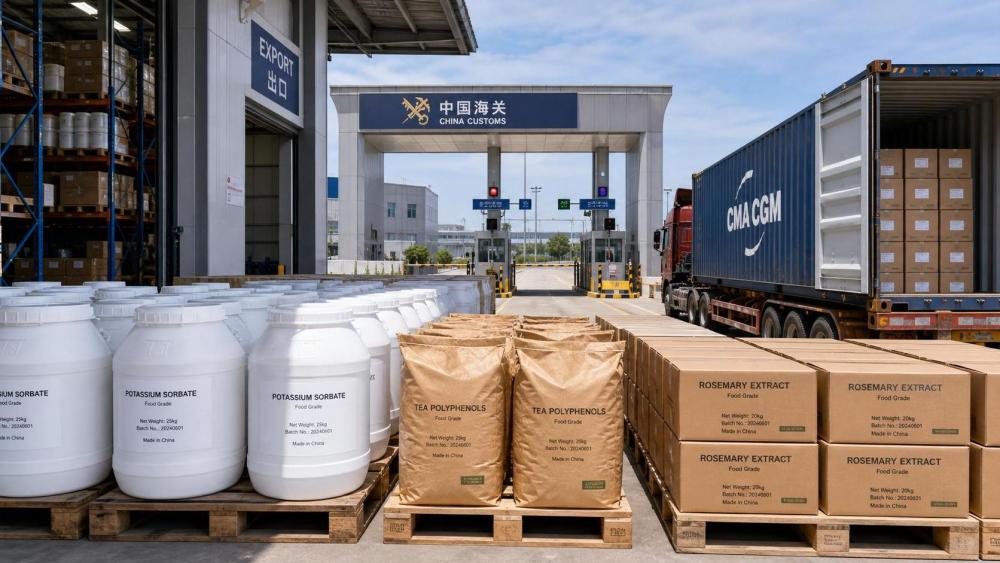
On May 1, 2026, China Customs began applying a whitelist-plus-fast-track inspection model to exported food preservatives and natural antioxidants, a change that matters not only for manufacturers of products such as potassium sorbate, sodium dehydroacetate, tea polyphenols, and rosemary extract, but also for importers, procurement teams, and supply-chain operators that depend on predictable export release times. For the food-grade preservation ingredient trade, the development is notable because it links customs supervision more directly with delivery reliability and inventory planning.
What the new customs arrangement confirms
According to the information provided, from May 2026 China Customs has implemented a "whitelist + fast inspection channel" model for exports of food preservatives and natural antioxidants. The covered products include examples such as potassium sorbate, sodium dehydroacetate, tea polyphenols, and rosemary extract.
A total of 217 manufacturing enterprises included on the whitelist receive priority inspection treatment and a 72-hour customs clearance guarantee. The information provided also states that this arrangement significantly improves delivery certainty and inventory turnover efficiency for importers in South America and Southeast Asia purchasing food-grade preservative and freshness-protection ingredients from China.
Why the effect extends beyond customs clearance
Export suppliers now face a clearer distinction in delivery capability
From an industry perspective, the rule change may affect exporters first because customs treatment is now tied more visibly to enterprise status within the whitelist framework. The most immediate business impact is likely to appear in shipment scheduling, customer delivery commitments, and communication around lead times. What deserves closer attention is whether sales contracts, shipment promises, and buyer discussions increasingly differentiate between suppliers with access to the fast-track channel and those without it.
Overseas buyers may adjust procurement rhythm and inventory assumptions
For importers and procurement teams in the affected trade flow, the change matters because customs predictability can influence replenishment timing and stock planning. Analysis shows that when a 72-hour clearance commitment is available for covered suppliers, buyers may place greater weight on delivery certainty rather than judging suppliers only on price or product specification. In practical terms, purchasers may need to pay closer attention to supplier qualification status, shipment documentation readiness, and whether quoted lead times are based on whitelist access.
Supply-chain and trade service providers may see documentation discipline become more important
Logistics coordinators, customs-facing service providers, and trade operations teams may also be affected because the value of a fast-track channel depends on how consistently cargo, documents, and declarations align. Observably, the operational focus is likely to shift toward avoiding paperwork gaps or classification inconsistencies that could weaken the benefit of priority treatment. Even where the policy direction is positive, execution quality across booking, declaration, inspection readiness, and handover remains important.
What companies should watch in current execution
Supplier qualification should be checked more carefully
Analysis shows that companies buying or exporting covered ingredients should pay closer attention to whether a manufacturer is included in the stated whitelist, because that status may affect shipment predictability. The current information confirms the existence of 217 listed manufacturers, but it does not provide the detailed operating criteria in this input, so businesses should avoid assuming that all exporters will receive the same treatment.
Technical files and shipment records deserve closer review
Where exports involve food-grade preservatives or natural antioxidants, companies should review whether product descriptions, test-related materials, and shipment documents are internally consistent. The provided information does not set out detailed documentation rules, but in practice this is the area where differences in customs handling can become commercially significant for delivery commitments and buyer confidence.
Procurement planning may need to reflect supplier pathway differences
For buyers serving South America and Southeast Asia, the practical issue is not only product availability but also whether sourcing plans now rely on suppliers benefiting from the fast-track route. It is more appropriate to understand this as a procurement planning issue as much as a customs issue, especially where shorter inventory cycles depend on stable release timing.
Further official wording still merits attention
The information provided confirms that the mechanism has been launched, but it does not include fuller official wording on scope, implementation details, or follow-up adjustments. Companies should therefore continue watching for any clarified execution standards, documentary expectations, or updates that could affect tender documents, customer commitments, or internal compliance review.
How this development is best understood for now
Observably, this is more than a routine customs facilitation note because it signals that export supervision for selected food preservation ingredients is being linked to a structured enterprise-screening mechanism. At the same time, it is not yet appropriate to treat the development as a complete picture of long-term trade conditions, because the input does not provide broader implementation detail, market feedback, or later-stage enforcement practice.
Analysis shows that the clearest near-term meaning lies in execution: the measure reads as an already effective operating signal for covered exports, while its broader commercial effect will still depend on how consistently the whitelist status, fast inspection handling, and buyer procurement behavior align in real transactions.
What the market can reasonably take from it
For the industry, the most balanced reading is that China Customs has introduced a concrete facilitation mechanism for certain exported food preservatives and natural antioxidants, and that this directly matters to delivery reliability, inventory turnover, and supplier selection in relevant export flows. It is more appropriate to understand the development as an implemented change with practical trade significance, while still keeping a close watch on how the rule is applied in documentation review, supplier qualification recognition, and downstream customer requirements.
Basis of this article and points still requiring verification
This article is generated from the user-provided news title, event date, and event summary. For developments of this type, commonly relevant source categories may include official notices, releases from regulatory authorities, customs or trade administration information, industry association updates, standard-setting documents, and reporting by authoritative media.
No specific official source link was provided in the input, so the exact official publication path still requires follow-up verification. Observably, the areas that still merit continued attention include detailed implementation wording, any clarified compliance or documentation expectations, possible changes in tender or procurement documents, market feedback from affected trade participants, and how enterprises actually execute under the new arrangement.
Related News
- Flavour preservation failures caused by oxygen exposure in beveragesOct 01, 2026Food Preservation Scientist
- Which flavour preservation method best protects citrus top notes?Sep 30, 2026Food Preservation Scientist
- How functional additives for beverages affect shelf-life stabilitySep 11, 2026Food Preservation Scientist
- Ingredient selection for preservatives when pH limits antimicrobial efficacySep 07, 2026Food Preservation Scientist
Related News
- 00
0000-00
Can biomimetic peptides in cosmetics reduce the look of wrinkles? - 00
0000-00
How to assess a bio-based thickener manufacturer's batch consistency - 00
0000-00
Verifying halal status of hydrocolloid ingredients in the Middle East - 00
0000-00
How to interpret active matter on a surfactant specification sheet - 00
0000-00
How Do You Test Hydrocolloid Viscosity After Changing a Thickener?
Food Preservation Scientist
Weekly Insights
Stay ahead with our curated technology reports delivered every Monday.