





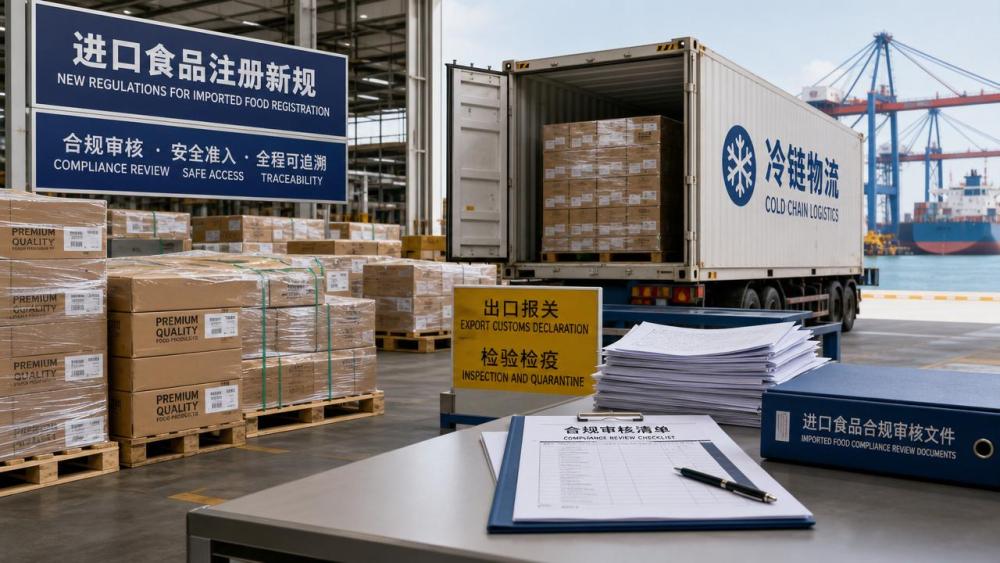
China’s new registration rules for overseas food manufacturers took effect on June 1, 2026, bringing a revised compliance framework for companies exporting food to the Chinese market. The change deserves close attention from overseas producers, importers, procurement teams, processors, and supply chain service providers because it adjusts how registration is reviewed, narrows the registration scope for some products, and changes how registration validity is maintained for most categories.
What the new rule changes
According to the information provided, GACC Decree No. 280 officially came into force on June 1, 2026 for the registration of overseas manufacturers of imported food. The rule introduces risk-based classification management, list-based batch registration, and intelligent-assisted review.
The registration scope has also been streamlined. Six categories of primary agricultural products have been removed from the registration range. In addition, an automatic validity extension mechanism has been introduced, except for meat products and bird’s nest.
The same information states that 96,000 enterprises worldwide are registered in China. Overseas suppliers are required to adapt to the new review rules promptly in order to maintain continuity of exports to China.
Where the impact is likely to be felt first
Export-facing manufacturers may see compliance workflows shift
From an industry perspective, overseas food manufacturers are the most directly affected because the rule applies to their registration status and review pathway. The practical impact is likely to center on how they prepare submissions, how they are grouped under list-based batch registration, and how they respond to risk-based review requirements.
Importers and procurement teams need to recheck supplier status
Companies buying food for the China market may be affected through supplier onboarding, order scheduling, and document verification. What deserves closer attention is whether existing and new suppliers fall within the revised registration scope and whether any category-specific exception, especially for meat products and bird’s nest, affects supply continuity.
Processors and channel operators may face delivery coordination pressure
Food processors, distributors, and other channel participants may not be the direct subject of overseas registration, but they can still be affected if supplier approvals, renewal handling, or registration categorization changes alter shipment timing. Their main point of attention is the downstream effect on delivery planning and customer commitments.
Service providers may need to adjust support around documentation and timing
Supply chain and trade service providers are likely to be involved where clients need help aligning registration materials, coordinating communications, or managing review progress under the new mechanism. Analysis shows that support work may become more focused on category identification, registration pathway confirmation, and exception handling.
What companies should watch now
Check whether a product still falls within the registration range
The rule does not simply change review methods; it also narrows the registration scope by removing six categories of primary agricultural products. Companies should distinguish between products that remain within registration requirements and products that no longer fall under the same scope.
Separate general validity handling from category exceptions
The automatic validity extension mechanism changes how many companies may manage registration continuity, but meat products and bird’s nest are explicitly excluded. In practice, businesses should avoid treating all product categories the same when planning renewals or shipment schedules.
Prepare for differences between policy wording and operational review
Observably, the introduction of risk-based classification, batch registration, and intelligent-assisted review means that companies should pay attention not only to the rule text itself but also to how reviews are carried out in actual cases. That makes internal document readiness and communication with trade counterparts more important in the near term.
Review customer and supplier communication plans
Because export continuity is specifically highlighted in the provided information, companies should focus on communication around registration status, review progress, and possible timing effects. This is especially relevant for firms managing multiple suppliers or product categories under different compliance conditions.
Why the market is reading this as more than a procedural update
Analysis shows that this is not only a technical registration adjustment. It also signals a more structured approach to managing overseas food manufacturer access to the China market, with differentiated review logic and a clearer distinction between categories that remain under registration and those removed from the scope.
At the same time, it would be premature to treat this as a fully settled long-term outcome across every food segment. It is more appropriate to understand this as an implemented regulatory change with immediate operational consequences, while also remaining a policy signal that the market will continue to interpret through actual review practice.
How this update is best understood now
For the industry, the immediate meaning of this development is practical rather than theoretical: companies involved in exporting food to China need to confirm category coverage, review registration handling, and identify whether exceptions apply to their products. A neutral reading is that the rule is already a live compliance change, but its broader operational effect will depend on how businesses and market participants adapt in execution.
Basis of this article
This article is generated based on the user-provided news title, event date, and event summary. Information of this kind is usually cross-checked against official notices, company disclosures, industry association updates, authoritative media reporting, and relevant regulatory documents.
No specific official source link was provided in the input, so the exact official link remains to be verified on an ongoing basis. For follow-up observation, the main areas to watch are how the new review rules are implemented in practice, how category scope is interpreted in operations, and how businesses adjust export continuity planning under the updated framework.
Related News
- Flavour preservation failures caused by oxygen exposure in beveragesOct 01, 2026Food Preservation Scientist
- Which flavour preservation method best protects citrus top notes?Sep 30, 2026Food Preservation Scientist
- How functional additives for beverages affect shelf-life stabilitySep 11, 2026Food Preservation Scientist
- Ingredient selection for preservatives when pH limits antimicrobial efficacySep 07, 2026Food Preservation Scientist
Related News
- 00
0000-00
Can biomimetic peptides in cosmetics reduce the look of wrinkles? - 00
0000-00
How to assess a bio-based thickener manufacturer's batch consistency - 00
0000-00
Verifying halal status of hydrocolloid ingredients in the Middle East - 00
0000-00
How to interpret active matter on a surfactant specification sheet - 00
0000-00
How Do You Test Hydrocolloid Viscosity After Changing a Thickener?
Food Preservation Scientist
Weekly Insights
Stay ahead with our curated technology reports delivered every Monday.