





Why does food additive compliance for preservatives attract so much scrutiny?
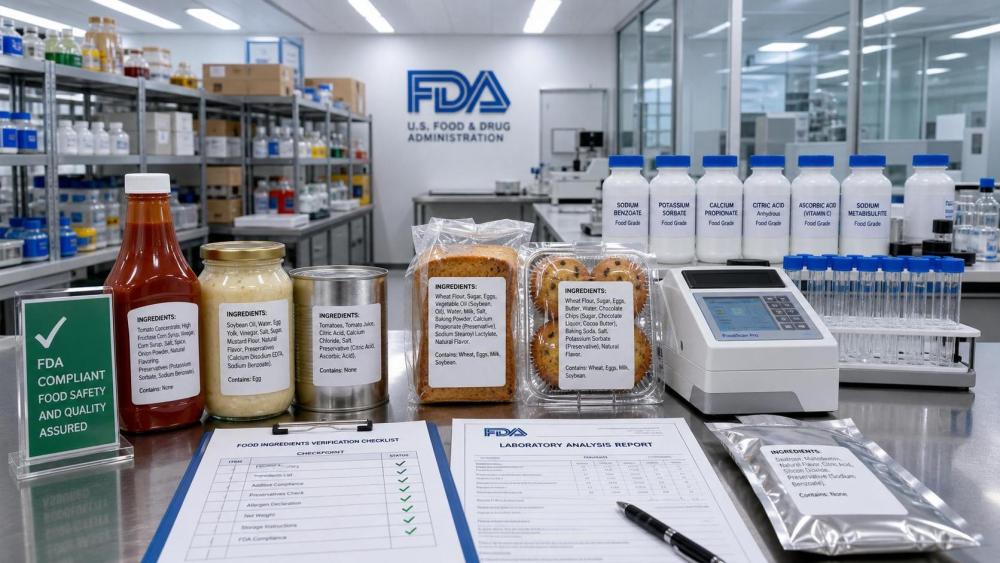
Food additive compliance for preservatives sits at the intersection of safety, shelf life, and commercial access.
A formula may perform well in storage tests, yet still fail in the market if its preservative status or label language is wrong.
That is why preservative review is never just a paperwork step.
It affects product release, import acceptance, retailer approvals, and consumer confidence in equal measure.
In practical terms, U.S. checks usually begin with one question: is the substance lawfully permitted for the intended food use?
The answer may depend on FDA food additive regulations, GRAS status, use limits, technical function, and the food category involved.
This matters across the wider FMCG chain as well.
FFAI often frames preservatives as the quiet time guardians behind stable supply chains, especially in baked goods, canned products, sauces, and prepared foods.
The same intelligence mindset used to track flavors, thickeners, and cosmetic actives also applies here.
If the molecule, process, and label do not align, the risk is rarely isolated.
Which FDA checks usually come first when reviewing a preservative?
The first pass should confirm legal identity before discussing dosage or label text.
A preservative may be common in global trade, but that does not automatically make it acceptable for every U.S. food application.
A reliable review typically includes these points:
- Confirm the exact chemical name and composition, including salts, blends, or carrier systems.
- Check whether the ingredient is covered by a food additive regulation or GRAS conclusion.
- Match the intended technical effect to the regulatory basis, such as antimicrobial or antioxidant use.
- Verify use limitations by food category, concentration, and any conditional restrictions.
- Review supporting specifications, purity, and supplier documentation.
This is where many teams lose time.
They start with formula performance data, then discover the legal basis was never clearly mapped to the finished product.
A preservative can also shift classification depending on intended function.
For example, the same substance may be positioned as a preservative in one formula and as a pH control aid in another.
That difference changes documentation logic and sometimes labeling treatment.
When food additive compliance for preservatives is reviewed early, later corrections become far less expensive.
How do you know whether the label matches the preservative use?
Labeling errors often come from oversimplifying ingredient statements.
The ingredient may be legally used, yet the declared name, placement, or explanatory wording may still create noncompliance.
More common checks include the following:
The wording itself deserves care.
“To preserve freshness,” “preservative,” and similar phrases can have different implications depending on the ingredient and regulation behind it.
In actual review work, the safest path is to compare the formula sheet, specification, and final label line by line.
That simple discipline catches most preventable errors in food additive compliance for preservatives.
Where do teams usually make the wrong call?
The biggest mistakes are rarely technical failures in the preservative itself.
They usually come from assumptions made between R&D, sourcing, and label approval.
Several patterns show up repeatedly.
A supplier document is treated as final regulatory proof
A specification sheet may confirm quality, but it does not replace use-specific regulatory analysis.
The intended food, process, and dosage still need independent review.
Global acceptance is confused with U.S. acceptance
A preservative allowed in one export region may have different limits, naming rules, or use conditions in the United States.
This matters for multinational formulas and dual-market labels.
The final matrix is ignored
pH, water activity, fat content, and heat treatment affect both efficacy and compliance logic.
A lawful substance in a beverage may not fit the same way in a bakery filling.
Label review happens too late
By the time graphics are approved, changing a preservative declaration can trigger artwork cost, inventory loss, and launch delays.
Food additive compliance for preservatives works better when label logic is built into formula development, not attached at the end.
What documents actually support a defensible review?
A strong file is not necessarily large.
It is consistent, traceable, and linked to the actual product placed on the market.
In most cases, the review file should cover these records:
- Current formula with preservative concentrations in the finished product.
- Supplier specifications, identity details, and purity criteria.
- Regulatory basis showing permitted use and any limitations.
- Finished label text, including ingredient statement and function wording.
- Change control records for reformulation, source changes, or processing changes.
- Internal rationale for classification, carryover decisions, and labeling judgments.
This is also where intelligence portals such as FFAI add value in practice.
Not by replacing legal review, but by connecting molecule-level function, processing stability, and cross-market compliance signals.
For preservatives, that connection is useful when heat exposure, oxidation control, or blended systems complicate the simple name-on-label approach.
How should food additive compliance for preservatives be built into daily release work?
The most effective approach is procedural rather than heroic.
Instead of rechecking everything from scratch at launch, build a short gate review into development and change management.
A practical sequence often looks like this:
- Screen preservative options against U.S. legal status before pilot work.
- Match the intended food category to allowed use and concentration logic.
- Draft ingredient statement language before packaging artwork starts.
- Reconfirm compliance after supplier, process, or dosage changes.
- Archive the final rationale with the released specification and label.
This kind of workflow reduces repeated debates and keeps release decisions evidence-based.
It also supports broader clean label discussions.
When reformulation pressure appears, teams can judge whether a different preservative system changes only perception, or also changes regulatory and labeling obligations.
What is the practical takeaway before the next formula or label review?
Food additive compliance for preservatives is strongest when legal status, technical purpose, and label language are reviewed together.
Separating those steps creates avoidable gaps.
The next useful move is to map every preservative in active products against four points: FDA basis, use condition, declared name, and supporting records.
That exercise usually reveals where assumptions are hiding.
From there, review open reformulations, supplier substitutions, and legacy labels that may no longer match the current formula.
For organizations handling broader ingredient portfolios, the same disciplined review model can extend beyond preservatives to antioxidants, thickeners, flavors, and other sensitive functional systems.
That is often where compliance work becomes more stable, faster to defend, and easier to scale.
Related News
- Flavour preservation failures caused by oxygen exposure in beveragesOct 01, 2026Food Preservation Scientist
- Which flavour preservation method best protects citrus top notes?Sep 30, 2026Food Preservation Scientist
- How functional additives for beverages affect shelf-life stabilitySep 11, 2026Food Preservation Scientist
- Ingredient selection for preservatives when pH limits antimicrobial efficacySep 07, 2026Food Preservation Scientist
Related News
- 00
0000-00
Verifying halal status of hydrocolloid ingredients in the Middle East - 00
0000-00
How to interpret active matter on a surfactant specification sheet - 00
0000-00
What Quality Checks Should You Run on Fragrance Ingredient Suppliers? - 00
0000-00
How to assess a flavor chemistry manufacturer's batch consistency - 00
0000-00
What drives fragrance ingredients price changes in bulk orders?
Food Preservation Scientist
Weekly Insights
Stay ahead with our curated technology reports delivered every Monday.