





How to Choose Food Preservation Ingredients for Bakery Shelf Life
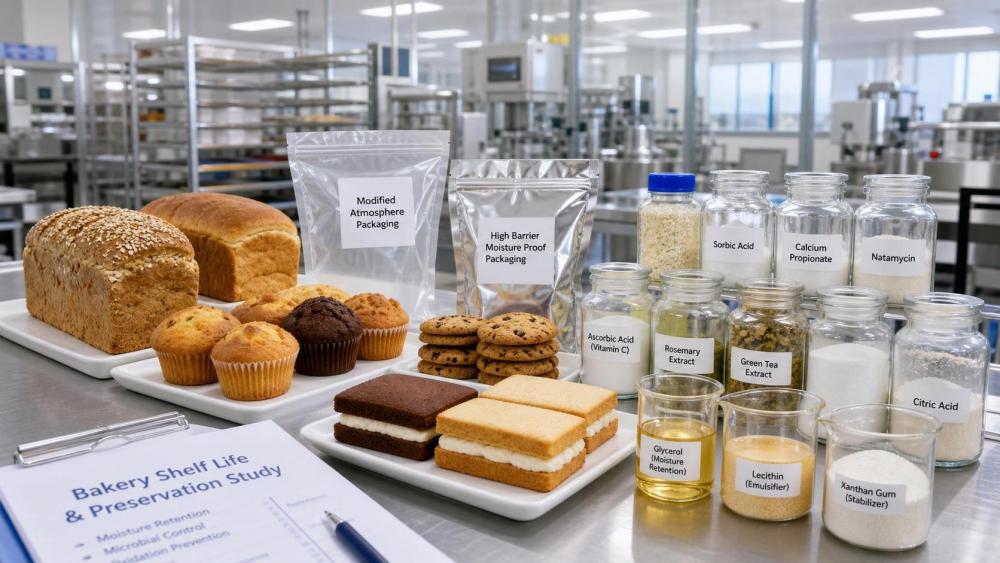
Choosing food preservation ingredients for bakery products starts with one practical truth. Shelf life is never controlled by one ingredient alone.
It is shaped by water activity, pH, packaging, process hygiene, fat stability, and the product’s expected eating experience.
That is why selection work needs a system. A preservative that performs well in tortillas may fail in cream-filled buns.
The best food preservation ingredients for bakery use are the ones that match the real spoilage route of the product.
In most bakery applications, the decision comes down to four control targets: mold growth, yeast and rope spoilage, fat oxidation, and sensory drift over time.
This also means ingredient choice should be judged in finished products, not only by supplier data generated in simplified systems.
Start with the Product Risk Profile
Before screening options, define the actual product conditions. This step prevents overpreserving low-risk items and underprotecting sensitive ones.
Focus on these variables first:
- Moisture level and water activity
- pH and acidification system
- Fat type and oxidation sensitivity
- Filling inclusion, topping, or cream phase
- Thermal process and post-bake handling
- Target shelf life and storage temperature
- Packaging barrier and headspace control
A dry biscuit mainly needs oxidation control. A soft sliced cake usually needs broad mold management and texture stability.
In practical evaluation, food preservation ingredients for bakery should be linked to the highest spoilage probability, not to a generic ingredient trend.
Understand the Main Ingredient Categories
Most bakery preservation systems combine antimicrobials and antioxidants. Some formulas also rely on humectants, acidulants, and packaging support.
Antimicrobial preservatives
Calcium propionate and sodium propionate remain common food preservation ingredients for bakery because they are effective against mold in bread systems.
Sorbic acid and potassium sorbate are widely used in cakes, fillings, frostings, and lower-pH applications.
Cultured wheat, cultured dextrose, fermented vinegar, and similar systems are often evaluated when cleaner labels are a priority.
Antioxidants
Bakery fats oxidize during storage, especially in products with nuts, seeds, whole grains, or high unsaturated oil content.
Mixed tocopherols, rosemary extract, ascorbyl palmitate, and synergistic blends can slow rancidity and preserve flavor quality.
Supporting ingredients
Humectants help manage water migration. Acidulants can improve preservative activity. Emulsifiers and hydrocolloids may indirectly support shelf life by reducing structural instability.
Recent market movement shows more teams reviewing preservation as a system design issue, not a single-additive purchase.
Match the Ingredient to the Bakery Format
The right food preservation ingredients for bakery depend heavily on product format. Performance shifts with structure and moisture distribution.
Bread and buns
Propionates are still standard for mold control. Yet dosage must be checked against yeast activity, flavor impact, and dough tolerance.
Cakes and muffins
These often need stronger mold and yeast control because of higher moisture, sugar, and inclusions. Sorbate-based systems are commonly assessed.
Cookies and crackers
Microbial risk is lower, but oxidation risk can rise. Antioxidant selection matters more than classic mold inhibition.
Filled bakery products
These are usually the most complex. Bread, cream, fruit, and glaze phases may each require separate control logic.
A single preservative rarely protects every phase equally. That is a common source of failed shelf life validation.
Evaluate Performance Under Real Processing Conditions
A strong paper specification means little if the ingredient breaks under process stress or loses effectiveness after baking.
Key checks should include:
- Thermal stability during baking or reheating
- pH-dependent activity in final product conditions
- Interaction with leavening, salt, sugar, and fat systems
- Distribution uniformity across dough, batter, and filling phases
- Impact on flavor, aroma, crumb, and color
This is where pilot testing matters. Food preservation ingredients for bakery must be screened in the exact formulation and packaging setup.
Challenge testing, accelerated storage, and side-by-side sensory reviews usually reveal issues that supplier brochures do not.
Balance Clean Label Demand with Technical Reality
Cleaner labels are shaping bakery decisions everywhere. Still, label appeal cannot replace antimicrobial performance or compliance certainty.
Fermentation-derived systems and plant-based extracts can be attractive, but they often require higher use levels or tighter process control.
More importantly, they may introduce flavor notes, color shifts, or batch variability. Those effects need full sensory review.
In actual business decisions, the right food preservation ingredients for bakery are not always the most marketable on paper.
They are the ones that meet shelf life targets without creating new formulation, legal, or consumer acceptance problems.
Check Regulatory Fit Early
Regulatory fit should be screened early, especially for export-oriented bakery lines. Late-stage reformulation is expensive and slow.
Review allowed use, dosage limits, local labeling language, and category-specific restrictions across target markets.
This matters even more when using blended systems, natural extracts, or fermentation-based ingredients with variable regional treatment.
For global teams, regulatory screening should sit next to technical trials, not after them. That saves both cycle time and cost.
Build a Practical Evaluation Matrix
A structured scorecard helps compare food preservation ingredients for bakery without bias from price alone or label claims alone.
Weight each factor by product risk. For premium cakes, sensory performance may outrank raw material cost.
For high-volume bread, dosage economics and line consistency may carry more weight.
Common Selection Mistakes
Several mistakes appear again and again in bakery shelf life projects.
- Choosing by ingredient popularity instead of spoilage mechanism
- Ignoring phase separation in filled or layered products
- Testing only microbial outcomes and skipping sensory drift
- Assuming clean label systems behave like conventional preservatives
- Leaving packaging and plant hygiene outside the preservation strategy
The stronger signal in recent projects is clear. Preservation success comes from integrated design, not additive substitution alone.
Final Decision Framework
When selecting food preservation ingredients for bakery, move in a simple order. Define risk, shortlist systems, validate in-product, then confirm regulation and cost.
That sequence keeps teams focused on real performance. It also reduces reformulation loops and shelf life surprises after launch.
For businesses reviewing bakery preservatives today, the best choice is usually a balanced system, not the strongest single ingredient.
A good system protects safety, keeps flavor stable, fits the label strategy, and stays reliable under real factory conditions.
Use that framework consistently, and food preservation ingredients for bakery become a measurable decision rather than a trial-and-error exercise.
Related News
- Flavour preservation failures caused by oxygen exposure in beveragesOct 01, 2026Food Preservation Scientist
- Which flavour preservation method best protects citrus top notes?Sep 30, 2026Food Preservation Scientist
- How functional additives for beverages affect shelf-life stabilitySep 11, 2026Food Preservation Scientist
- Ingredient selection for preservatives when pH limits antimicrobial efficacySep 07, 2026Food Preservation Scientist
Related News
- 00
0000-00
Verifying halal status of hydrocolloid ingredients in the Middle East - 00
0000-00
How to interpret active matter on a surfactant specification sheet - 00
0000-00
What Quality Checks Should You Run on Fragrance Ingredient Suppliers? - 00
0000-00
How to assess a flavor chemistry manufacturer's batch consistency - 00
0000-00
What drives fragrance ingredients price changes in bulk orders?
Food Preservation Scientist
Weekly Insights
Stay ahead with our curated technology reports delivered every Monday.