





On August 5, 2026, the European Food Safety Authority (EFSA) issued a scientific opinion that lowers the maximum permitted use levels for natural antioxidants including rosemary extract (E392) and ascorbyl palmitate (E304a) in infant formula and plant-based dairy products. With mandatory enforcement set for November 1, 2026, the change matters immediately for Chinese exporters of antioxidant ingredients, blended preservative producers, and downstream food OEM manufacturers because it affects EU-facing compliance reviews, technical documentation, and filing updates tied to CPNP/Novel Food procedures.
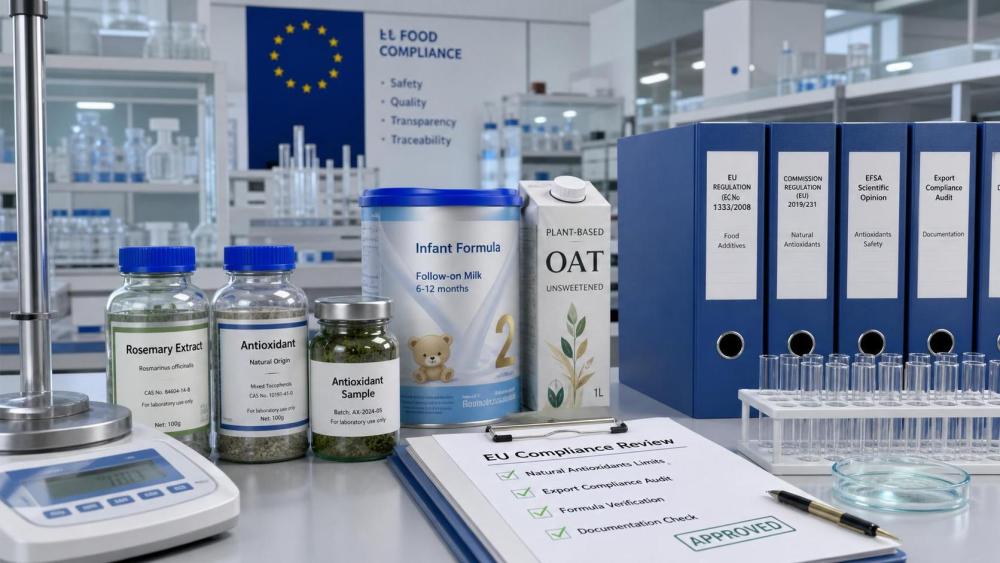
What the EFSA opinion changes
The confirmed facts are limited but clear. EFSA released its scientific opinion on August 5, 2026. The opinion reduces the maximum allowed use levels of certain natural antioxidants, including rosemary extract (E392) and ascorbyl palmitate (E304a), by 30% to 50% in two product areas: infant formula and plant-based dairy products. The new rule will become mandatory on November 1, 2026. According to the provided event summary, the adjustment directly affects Chinese suppliers of natural antioxidant raw materials, manufacturers of compounded preservative products, and downstream food OEM factories exporting to Europe. The same summary also states that affected businesses need to update product technical files and resubmit CPNP/Novel Food filings.
Where pressure is likely to appear across the chain
Ingredient suppliers facing specification risk
From an industry perspective, raw material suppliers are likely to be affected first because lower permitted use levels can change whether an ingredient specification remains commercially usable for EU-bound applications. The immediate business impact is less about the ingredient name itself and more about whether concentration ranges, recommended dosage references, and application notes in technical files still support compliant use in the covered product categories. What deserves closer attention is the need to align export-facing product documents with the revised limits before shipment or customer revalidation moves forward.
Blended preservative manufacturers under reformulation review
For manufacturers of compounded preservative systems, the change may affect formulation design, product positioning, and supporting compliance records. Analysis shows that businesses in this part of the chain need to review whether existing blends intended for infant formula or plant-based dairy products still fit within the revised thresholds when used as directed. The practical pressure point is not only formulation adjustment, but also whether supporting technical documentation, declarations, and filing materials remain internally consistent after the rule change.
Food OEM exporters dealing with market-entry compliance
Downstream OEM factories exporting finished products to Europe may face the issue at the point where formula composition, product dossiers, and market-entry paperwork must stay aligned. Observably, the provided information places immediate attention on compliance for EU exports rather than on a distant policy watch. For OEM exporters, the business exposure may show up in document revision cycles, customer approval timing, and the need to reassess whether existing filings still match the revised permitted use levels in the affected categories.
Practical points companies should check now
Revalidate technical files against the revised limits
Analysis shows that one of the first practical tasks is to review technical files for products containing rosemary extract (E392), ascorbyl palmitate (E304a), and other affected natural antioxidants where the intended use includes infant formula or plant-based dairy products for the EU market. The key concern is whether dosage statements, application scope, and compliance descriptions still match the revised thresholds described in the event summary.
Prepare filing updates without assuming old approvals still fit
The provided information specifically states that CPNP/Novel Food filings need to be resubmitted. It is therefore more appropriate to understand this as an active documentation and filing issue, not simply a labeling adjustment. Companies should pay close attention to whether internal regulatory teams, external consultants, and EU-side commercial counterparts are working from the same revised product information set.
Check procurement and delivery timing before November 1
Observably, the time gap between the August 5, 2026 opinion and the November 1, 2026 mandatory date is short. For companies already producing or shipping into the affected categories, procurement planning and delivery scheduling may require review. This is not yet evidence of a confirmed supply disruption, but it does indicate a need to check whether materials, blends, and finished goods now in pipeline remain supported by current documentation and intended compliant use.
Track execution language beyond the headline change
What deserves closer attention is the execution side of the rule change: how compliance teams, customers, and filing-related processes interpret the revised use limits in practice. Since the input does not provide detailed implementation language beyond the mandatory date and filing requirement, companies should treat this as an area requiring continued verification rather than a completed compliance picture.
Why this reads as an execution signal
Analysis shows that this development is better understood as a near-term compliance and market-access signal than as a distant policy discussion. The presence of a mandatory implementation date and the stated need to update technical files and resubmit CPNP/Novel Food filings indicate that affected companies cannot treat the EFSA opinion as background information only. At the same time, it remains necessary to distinguish confirmed facts from broader assumptions: the available information confirms the limit reduction, the affected categories, the implementation date, and the filing impact, but it does not by itself settle every operational detail of enforcement, customer acceptance, or documentation review standards.
How the market is likely to read it for now
At this stage, it is more appropriate to understand the event as a rule change with immediate compliance consequences for EU-facing food ingredient and OEM supply chains linked to the specified product categories. The significance lies in execution readiness: whether businesses can update product documents, reassess formulations, and keep export compliance aligned before the November 1, 2026 deadline. A measured reading is warranted. The change is already concrete enough to trigger action, while some practical interpretation points still need ongoing observation as the rule moves into implementation.
Basis of this article and what still needs checking
This article is generated from the user-provided news title, event date, and event summary. For developments of this type, relevant source categories typically include official notices, publications from regulatory authorities, customs or trade-administration updates, industry association releases, standard-setting documents, and reporting by authoritative media. No specific official source link was provided in the input, so the exact official reference still needs to be verified on an ongoing basis. Continued attention should also be given to subsequent policy wording, filing practice under CPNP/Novel Food, possible changes in customer or tender documentation, market feedback, and how affected companies implement the requirement in practice.
Related News
- How natural antioxidants for oils can prevent rancidity in storageSep 25, 2026Food Preservation Scientist
- How to choose natural antioxidants for beverages with longer shelf lifeAug 23, 2026Food Preservation Scientist
- EU Tightens MRLs for Three Pesticides, Prompting Raw Material Checks for Natural Antioxidant ExportsAug 17, 2026Food Preservation Scientist
- China Customs Tightens Export Filing for Food Ingredients, Raising Clearance RisksAug 16, 2026Food Preservation Scientist
Related News
- 00
0000-00
How to assess color stability from a natural food colors manufacturer - 00
0000-00
When does amino acid surfactant powder improve cleanser mildness? - 00
0000-00
How to verify a cosmetic nanotechnology supplier's safety documentation - 00
0000-00
How rheological thickeners for shampoo affect suspension stability - 00
0000-00
How to assess recombinant collagen ingredients for cream stability
Food Preservation Scientist
Weekly Insights
Stay ahead with our curated technology reports delivered every Monday.