





On 28 July 2026, the European Food Safety Authority updated its scientific opinion on several natural antioxidants used in food, beverage, and cosmetic formulations shipped to the EU. The revision covers the acceptable daily intake and safety reassessment of rosemary extract (E392), ascorbyl palmitate (E304), and mixed tocopherols (E306–E309), and it matters because the change is tied to labeling, batch certification, and import clearance timing. For exporters, manufacturers, ingredient buyers, and compliance teams, especially those shipping from China, India, and Southeast Asia, this is less a routine scientific update than a practical signal that documentation and shipment readiness may need closer review.
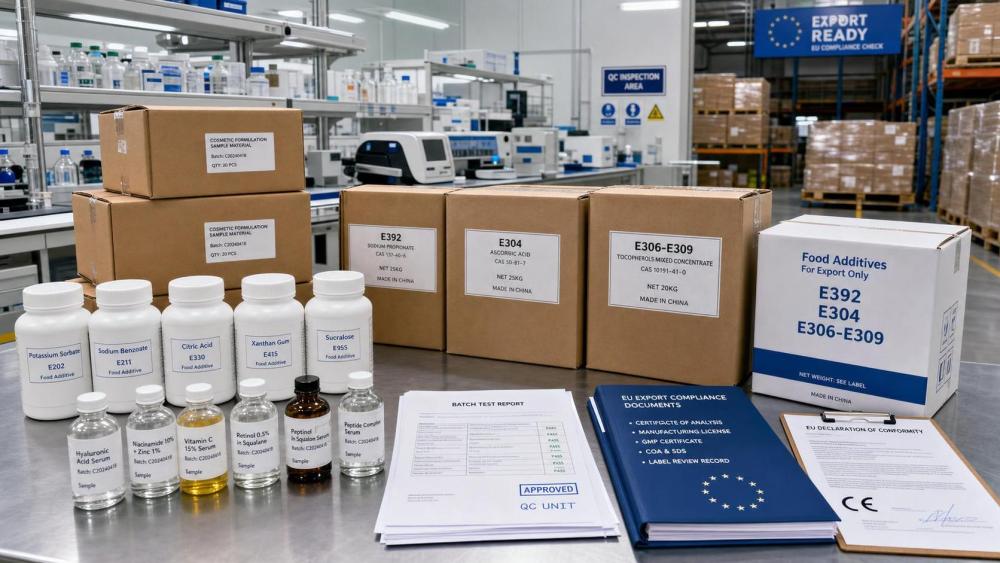
What the EFSA update confirms
According to the information provided, EFSA issued an updated scientific opinion on 28 July 2026. The opinion revises the acceptable daily intake (ADI) and re-evaluates the safety of rosemary extract (E392), ascorbyl palmitate (E304), and mixed tocopherols (E306–E309).
The substances concerned are used in exported food, beverage, and cosmetic formulations. The update is described as affecting labeling requirements, batch certification, and import clearance timelines for EU-bound shipments.
The impact is noted as particularly relevant for suppliers exporting from China, India, and Southeast Asia. No further official implementation detail, legal reference number, or enforcement timetable was provided in the input.
Where the operational pressure is likely to appear
Export shipments facing document-sensitive clearance
From an industry perspective, exporters are likely to feel the effect first where shipments depend on accurate product declarations and smooth customs or import review. Because the update is linked to labeling requirements and clearance timelines, the practical risk is not limited to formulation review; it may also extend to whether shipping files, product descriptions, and supporting compliance materials stay aligned across each batch.
Ingredient sourcing and formulation control under closer scrutiny
For ingredient buyers and manufacturers using E392, E304, and E306–E309, the main issue is whether existing sourcing and formulation records remain consistent with the updated safety assessment. Analysis shows that any business supplying EU-bound finished goods or intermediate materials may need to check whether ingredient specifications, declared use, and product files still support export claims without creating inconsistencies in downstream documentation.
Certification and testing workflows may become more time-sensitive
Batch certification is explicitly mentioned in the event summary, which means certification-related businesses and testing service providers may face tighter turnaround expectations. What deserves closer attention is not only the certificate itself, but whether supporting technical records and batch-level evidence are prepared early enough to avoid friction in shipment release.
Procurement and delivery planning may need more buffer
For procurement teams, distributors, and supply chain service providers, the issue is timing. If import clearance timelines are affected, delivery schedules, replenishment assumptions, and handover commitments may require adjustment. Observably, this kind of rule-linked delay risk can move upstream quickly, especially when exporters and EU buyers rely on narrow shipping windows or pre-agreed batch documentation.
What companies should watch in the next stage
Recheck label language and ingredient references
Analysis shows that companies using the affected antioxidants should review how these substances are identified in labels and related product documentation for EU-bound goods. The key point is consistency between formulation records, declared ingredients, and shipment paperwork, since the update is already connected to labeling requirements in the provided information.
Review batch files before goods move
Where batch certification is part of shipment readiness, businesses should pay closer attention to whether certificates, technical documents, and internal release records are complete before dispatch. It is more appropriate to understand this as a documentation readiness issue as much as a formulation issue.
Track clearance timing in live export operations
Because import clearance timelines are identified as an affected area, exporters and logistics coordinators should monitor whether review time changes begin to appear in actual EU-bound shipments. The current input does not establish a uniform enforcement outcome, so this remains a point for operational observation rather than a confirmed market-wide result.
Watch for follow-on compliance language
The provided information confirms an updated scientific opinion, but it does not include detailed execution guidance. For that reason, companies should continue watching for how the updated assessment may be reflected in compliance review language, customer document requests, certification practice, or procurement specifications tied to EU exports.
Why this reads as an execution signal rather than a closed case
Observably, this development is important because it sits at the intersection of scientific assessment and trade execution. The confirmed facts do not yet show the full downstream enforcement path, but they do show that the update already touches practical trade functions such as labeling, batch certification, and import clearance. That makes the event more than a technical review, while still leaving room for continued observation on how consistently the change is applied across business processes.
From an industry perspective, the most useful reading at this stage is cautious and operational: businesses should neither treat the update as a purely academic opinion nor assume that every compliance consequence is already fully standardized. The gap between published assessment and day-to-day implementation is exactly where exporters, buyers, and service providers need to stay alert.
How the market is likely to interpret this for now
At this point, the EFSA update is best understood as a meaningful compliance and trade signal for EU-bound FMCG exports involving the named antioxidants. Its importance lies in the fact that it can influence how products are labeled, how batches are supported, and how quickly shipments move through import review.
A neutral reading is warranted. The confirmed information supports closer compliance review and operational preparation, but it does not by itself establish a complete enforcement outcome across all affected sectors. For now, this is more appropriately understood as a live regulatory development with immediate documentation relevance and with further execution detail still worth monitoring.
Basis of this article and points that still need verification
This article is based on the user-provided news title, event date, and event summary. In this type of development, relevant source categories typically include official notices, regulatory authority publications, customs or trade administration updates, industry association releases, standard-setting documents, and reporting by established professional media.
No specific official source link was provided in the input, so the exact originating publication and any follow-up official wording still need to be verified on an ongoing basis. What remains worth watching includes detailed implementation language, certification practice, buyer document requirements, changes in tender or procurement files, industry feedback, and how companies actually adjust export execution in response.
Related News
- How to assess a food antioxidants distributor’s traceability practicesOct 11, 2026Food Preservation Scientist
- How natural antioxidants for oils can prevent rancidity in storageSep 25, 2026Food Preservation Scientist
- How to choose natural antioxidants for beverages with longer shelf lifeAug 23, 2026Food Preservation Scientist
- EU Tightens MRLs for Three Pesticides, Prompting Raw Material Checks for Natural Antioxidant ExportsAug 17, 2026Food Preservation Scientist
Related News
- 00
0000-00
Can biomimetic peptides in cosmetics reduce the look of wrinkles? - 00
0000-00
How to assess a bio-based thickener manufacturer's batch consistency - 00
0000-00
Verifying halal status of hydrocolloid ingredients in the Middle East - 00
0000-00
How to interpret active matter on a surfactant specification sheet - 00
0000-00
How Do You Test Hydrocolloid Viscosity After Changing a Thickener?
Food Preservation Scientist
Weekly Insights
Stay ahead with our curated technology reports delivered every Monday.