





On August 1, 2026, the European Food Safety Authority (EFSA) put into effect a supplementary guideline on impurity control for natural food antioxidants, adding a new documentation requirement for products entering the EU market. For exporters, importers, compliance teams, and supply chain operators handling items such as rosemary extract, tea polyphenols, and ascorbyl palmitate, the immediate issue is no longer only product shipment, but whether NDMA residue testing documents can be prepared in line with the new filing requirement and customs timeline.
What the New Filing Requirement Specifies
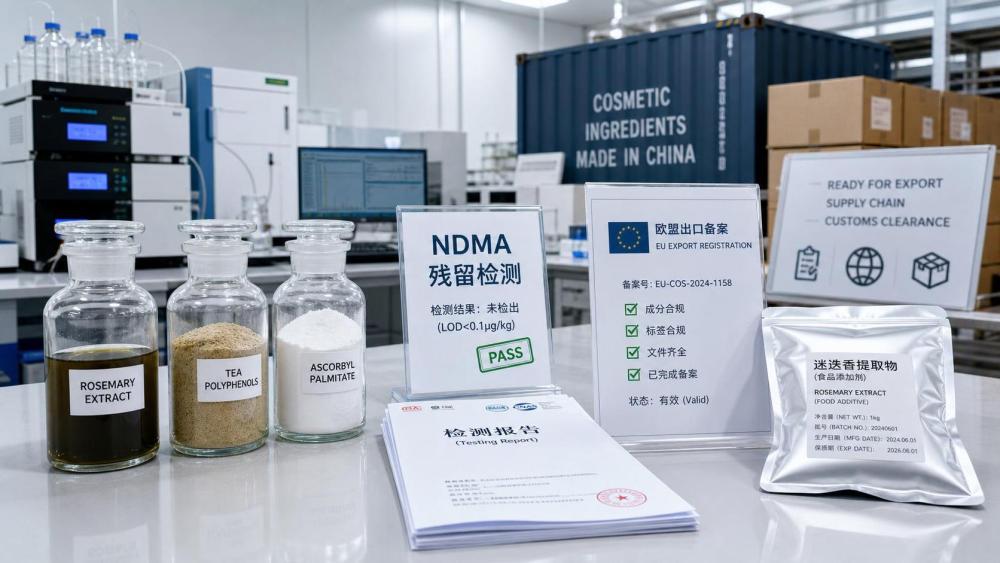
According to the information provided, EFSA formally implemented the Supplementary Guideline on Impurity Control for Natural Food Antioxidants on August 1, 2026. Under this requirement, all natural antioxidants imported into the EU must include an N-nitrosodimethylamine (NDMA) residue test report when making a CPNP or REACH notification.
The report must be issued by a laboratory with OECD GLP certification. The NDMA limit is set at no more than 0.05 μg/kg. The requirement applies to natural antioxidants including rosemary extract, tea polyphenols, and ascorbyl palmitate.
The same information states that this requirement directly affects customs clearance efficiency and compliance costs for major Chinese antioxidant exporters. Products that do not meet the requirement may be refused warehouse entry or returned.
Where the Pressure Will Be Felt First
Export transactions now depend more heavily on documentation readiness
From an industry perspective, direct trading companies are likely to feel the impact first because the new requirement is tied to notification materials and border entry outcomes. Their exposure is concentrated in pre-shipment compliance checks, document preparation, and delivery scheduling. What deserves closer attention is whether testing reports are available in time and whether they come from laboratories that meet the stated certification condition.
Manufacturers face a tighter link between production and compliance
For processing and manufacturing businesses producing natural antioxidants for the EU market, the issue is likely to move upstream into batch release, quality review, and export preparation. Analysis shows that the new rule does not only concern finished-goods movement; it also affects how manufacturers coordinate testing evidence with shipment planning. The key operational concern is whether product lots intended for the EU can move forward without delay under the new document threshold.
Importers and downstream buyers will need more caution on acceptance timing
EU-side importers, procurement teams, and downstream application companies may also face practical disruption if inbound goods arrive without compliant NDMA reports. Observably, the impact here is less about the rule text itself and more about inventory admission, notification timing, and contract execution. Buyers will need to pay closer attention to whether suppliers can provide compliant materials before shipment and not only after arrival.
Supply chain service providers may see longer coordination cycles
For logistics coordinators, customs service providers, and related compliance service firms, the likely pressure point is timing. Analysis shows that any missing or non-compliant report could affect warehouse entry or trigger return handling, making shipment scheduling and file verification more sensitive than before. The practical change to watch is whether document review becomes a front-loaded step rather than a final procedural check.
What Companies Should Watch Now
Check whether target products fall within the affected export scope
Companies dealing in natural antioxidants for the EU should first identify which product categories are directly exposed under the new requirement. The provided information specifically mentions rosemary extract, tea polyphenols, and ascorbyl palmitate, making product scope confirmation a necessary starting point for commercial and compliance teams.
Verify laboratory qualification before arranging filings
The rule as described requires NDMA reports from laboratories with OECD GLP certification. What deserves closer attention is not only obtaining a test report, but confirming whether the issuing laboratory meets the stated qualification condition before CPNP or REACH notification materials are assembled.
Reassess delivery schedules and customer communication
Because the requirement is described as directly affecting customs clearance efficiency and compliance cost, exporters and supply chain teams should closely monitor how testing lead time may interact with shipment commitments. Observably, customer communication may need to shift earlier in the order cycle, especially where delivery timing depends on complete compliance documentation.
Prepare for the difference between rule language and execution at the border
Analysis shows that a formal requirement and its day-to-day implementation are not always identical in operational impact. For businesses, the practical issue is whether notification review, warehouse admission, and return risk become stricter immediately. That makes internal contingency planning important even where contracts or shipments were arranged before the effective date.
Why This Looks Like More Than a Short-Term Procedural Change
This section is an editorial observation. It is more appropriate to understand this development as a concrete compliance signal rather than a routine paperwork update. The rule connects impurity control, formal notification, and border handling in a direct way, which means the commercial risk is tied to documentation quality as much as to the product itself.
Analysis shows that the current significance lies in execution risk. The information provided already indicates potential refusal of warehouse entry or return shipment for non-compliant goods, so the market relevance is immediate. At the same time, it remains necessary to keep watching how consistently the requirement is applied across actual filing and clearance processes.
How the Market May Need to Read This Development
At this stage, the update is best read as an actionable compliance change with immediate operational consequences for natural antioxidant exports to the EU. It should not be reduced to a general policy headline, because the effect described in the provided information reaches customs timing, cost structure, and shipment acceptance. A neutral reading is that the rule has already created a clear requirement, while the full extent of workflow adjustment across the supply chain still deserves continued observation.
Basis of This Article
This article is based on the user-provided news title, event date, and event summary. For developments of this kind, commonly relevant source types may include official notices, company disclosures, industry association updates, authoritative media reporting, and standard-setting or regulatory documents.
No specific official source link was provided in the input, so the precise official document path still requires ongoing verification. Continued attention should be paid to any later official clarification on filing practice, document interpretation, and implementation at the customs and warehouse-entry stage.
Related News
- How natural antioxidants for oils can prevent rancidity in storageSep 25, 2026Food Preservation Scientist
- How to choose natural antioxidants for beverages with longer shelf lifeAug 23, 2026Food Preservation Scientist
- EU Tightens MRLs for Three Pesticides, Prompting Raw Material Checks for Natural Antioxidant ExportsAug 17, 2026Food Preservation Scientist
- China Customs Tightens Export Filing for Food Ingredients, Raising Clearance RisksAug 16, 2026Food Preservation Scientist
Related News
- 00
0000-00
How to assess color stability from a natural food colors manufacturer - 00
0000-00
When does amino acid surfactant powder improve cleanser mildness? - 00
0000-00
How to verify a cosmetic nanotechnology supplier's safety documentation - 00
0000-00
How rheological thickeners for shampoo affect suspension stability - 00
0000-00
How to assess recombinant collagen ingredients for cream stability
Food Preservation Scientist
Weekly Insights
Stay ahead with our curated technology reports delivered every Monday.