





On July 23, 2026, a new compliance threshold takes effect for food imports involving naturally sourced BHA and BHT after the European Food Safety Authority (EFSA) issued an emergency scientific opinion on July 22. The change combines a lower maximum residue limit with a new documentation requirement for third-party migration testing, making it immediately relevant to exporters, ingredient formulators, procurement teams, testing partners, and import compliance functions handling compound ingredients, flavor bases, and functional food additives supplied into the EU market.
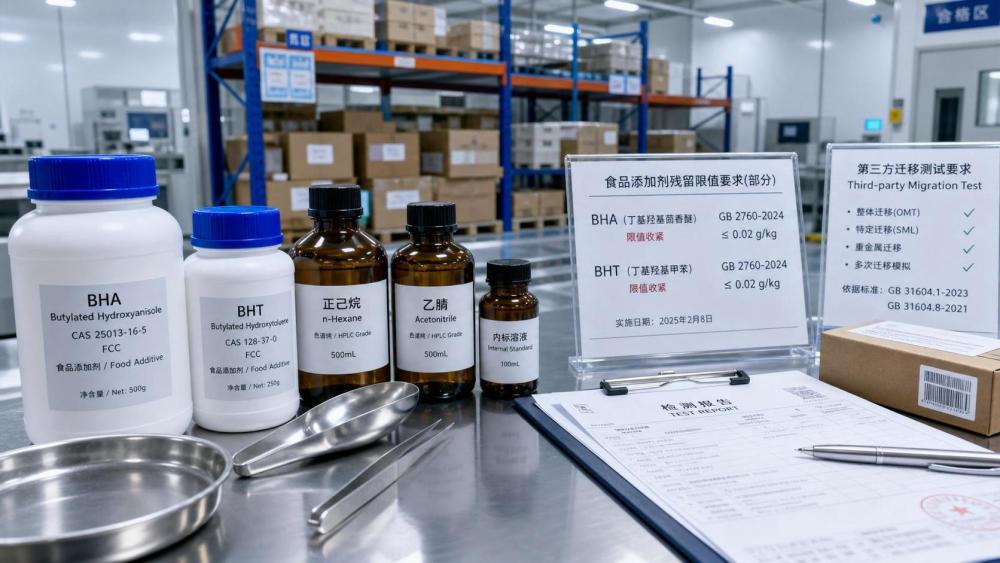
What the EFSA emergency opinion changes
According to the information provided, EFSA released an emergency scientific opinion on July 22, 2026 concerning naturally sourced butylated hydroxyanisole (BHA) and butylated hydroxytoluene (BHT) used in food. The opinion lowers the maximum residue limit for these substances by 40%.
The same update also requires all imported compound ingredients, flavor bases, and functional food additives containing these antioxidants to be accompanied by a third-party migration test report issued by an accredited laboratory.
The information provided further indicates that this change directly affects the compliance entry path for Chinese suppliers exporting natural antioxidant blends, preservative masterbatch materials, and water-soluble flavor carriers to the EU.
Where pressure is likely to emerge across the supply chain
Export suppliers face a narrower compliance window
From an industry perspective, exporters of antioxidant blends and related additive systems are likely to feel the impact first because the rule change affects both formulation acceptability and import documentation. The practical pressure point is no longer limited to product composition; it now also extends to whether supporting test evidence is available in the form required for market access.
What deserves closer attention is the combined effect of lower residue limits and required accredited-laboratory migration reports. For export-facing businesses, this may affect shipment readiness, technical file preparation, and customer confirmation before goods move into the EU channel.
Procurement and formulation teams may need to recheck specifications
Analysis shows that procurement functions and technical buyers involved in compound ingredients, flavor bases, and functional additives may need to revisit existing specifications, supplier declarations, and acceptance criteria. Where products rely on naturally sourced BHA or BHT within a broader formulation, the compliance review may shift upstream into raw material selection and downstream into finished-product documentation.
For manufacturers using these inputs, the main issue is not only whether a material was previously accepted, but whether it still fits the revised residue threshold and can be supported by the required third-party migration evidence for EU-bound business.
Testing and document control become part of delivery risk
Observably, laboratories, regulatory support teams, and supply chain coordinators may become more central to transaction execution under this change. Because the new requirement explicitly refers to migration testing by an accredited laboratory, document timing and report validity may affect customs preparation, customer approval, or release scheduling even where the product itself is commercially ready.
This means the compliance burden is likely to sit across multiple handoff points: sample preparation, laboratory coordination, dossier assembly, customer review, and shipment release planning.
What companies should watch in the near term
Check whether current product files still match the new threshold
Analysis shows that companies supplying affected categories should first identify which export products include naturally sourced BHA or BHT and whether existing technical files were built against a now outdated residue assumption. The key task is to determine where the 40% reduction may require specification review, reformulation review, or revised customer-facing declarations.
Verify the readiness of accredited third-party testing support
What deserves closer attention is whether the required migration test report can be obtained in a form accepted by customers and border-facing compliance processes. The input information confirms the requirement for accredited-laboratory third-party migration testing, but it does not provide further execution detail. For that reason, companies should treat report scope, acceptance wording, and document timing as active compliance checkpoints rather than settled practice.
Review contracts, purchase terms, and delivery planning
From an industry perspective, affected businesses should also look at how compliance evidence is allocated contractually between supplier and buyer. Where shipments depend on supporting reports, delays in document preparation could influence order confirmation, dispatch timing, or acceptance at destination. This is especially relevant for products positioned as compound ingredients, flavor bases, or functional additive systems for EU-bound use.
Track how market access language evolves in customer requirements
Observably, one of the most practical near-term watchpoints is whether buyers, importers, or channel partners begin revising technical specifications, vendor qualification requests, or tender-related documentation to reflect the new EFSA position. The provided information does not confirm a finalized implementation format beyond the stated requirement, so businesses should continue monitoring how the rule is translated into day-to-day commercial screening.
Why this reads as an execution signal, not just a headline
Analysis shows that this development is more than a routine scientific update because it links a lower residue limit with a concrete import-side evidence requirement. That combination usually matters to industry participants not only as a legal or regulatory reference point, but as a direct access condition affecting whether a product file is complete enough for cross-border trade.
At the same time, it is more appropriate to understand this as both an effective rule change and an area that still requires observation. The core requirement is already clear from the information provided, while the detailed enforcement approach, customer interpretation, and market response still need continued attention.
How the market is likely to read this stage
In practical terms, this update is best understood as an immediate tightening of entry requirements for certain EU-bound food ingredient and additive categories involving naturally sourced BHA and BHT. The confirmed facts point to a real compliance change effective from July 23, 2026, while the broader commercial consequences will depend on how testing expectations, documentation review, and buyer-side qualification standards are applied in practice.
A neutral reading is that affected companies should not treat this as a distant policy signal. They should also avoid overstating outcomes before further execution details emerge. The current stage calls for targeted compliance review, documentation readiness, and close monitoring of downstream acceptance criteria.
Basis of this article and points requiring follow-up
This article is generated based on the user-provided news title, event date, and event summary. For events of this kind, relevant source types typically include official notices, regulatory authority releases, customs or trade administration information, industry association updates, standards documentation, and reporting from established professional media.
No specific official source link was provided in the input, so the exact official publication path still requires further verification. Observably, the points that remain worth tracking include any detailed implementation language, certification or testing interpretation, updates in technical or tender documentation, market feedback from importers and buyers, and how affected companies adjust execution in response to the new requirement.
Related News
- How to assess a food antioxidants distributor’s traceability practicesOct 11, 2026Food Preservation Scientist
- How natural antioxidants for oils can prevent rancidity in storageSep 25, 2026Food Preservation Scientist
- How to choose natural antioxidants for beverages with longer shelf lifeAug 23, 2026Food Preservation Scientist
- EU Tightens MRLs for Three Pesticides, Prompting Raw Material Checks for Natural Antioxidant ExportsAug 17, 2026Food Preservation Scientist
Related News
- 00
0000-00
Verifying halal status of hydrocolloid ingredients in the Middle East - 00
0000-00
How to interpret active matter on a surfactant specification sheet - 00
0000-00
What Quality Checks Should You Run on Fragrance Ingredient Suppliers? - 00
0000-00
How to assess a flavor chemistry manufacturer's batch consistency - 00
0000-00
What drives fragrance ingredients price changes in bulk orders?
Food Preservation Scientist
Weekly Insights
Stay ahead with our curated technology reports delivered every Monday.