





On August 11, 2026, the European Food Safety Authority (EFSA) revised its guidance on maximum residue limits for natural antioxidants used in ready-to-eat meat products, with immediate effect. The update matters not only to exporters shipping seasoned meat products, prepared meals, and clean label lines into the EU, but also to importers, formulators, procurement teams, and compliance functions that rely on existing supplier documentation. The immediate industry concern is practical rather than theoretical: products and supporting test records that were previously considered acceptable may now require rechecking against the new limits.
What EFSA Changed on August 11
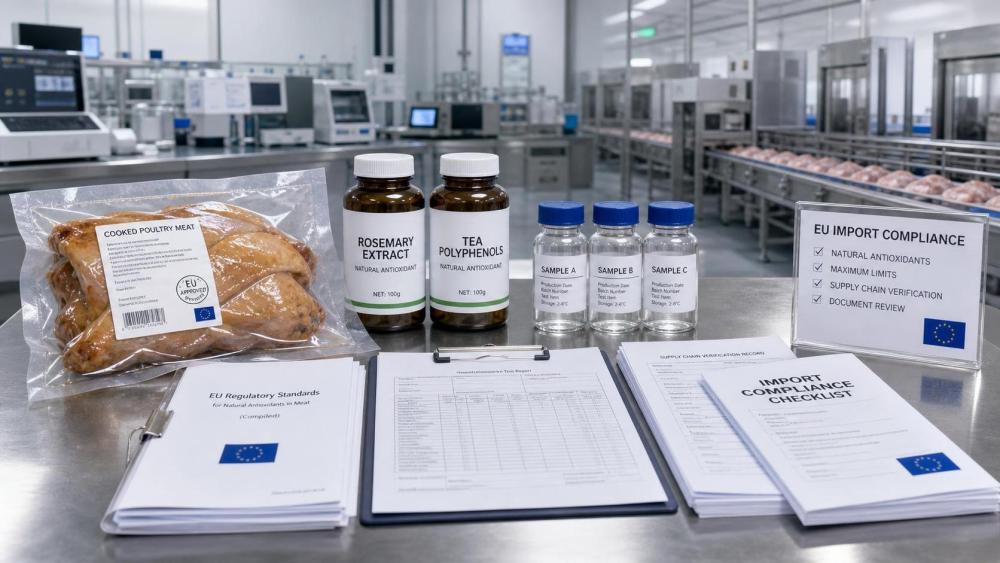
According to the information provided, EFSA issued revised guidance on the use of natural antioxidants including rosemary extract, tea polyphenols, and ascorbyl palmitate in ready-to-eat meat products on August 11, 2026, and the revision took effect immediately.
The confirmed changes include a reduction in the maximum residue limit for tea polyphenols in cured poultry from 50 mg/kg to 30 mg/kg. The updated guidance also adds dual limit requirements for microbial purity and solvent residues.
The adjustment directly affects EU compliance pathways for flavored meat products, prepared foods, and clean label products exported from major supplying countries including China, Vietnam, and Thailand. Importers are required to recheck existing formulations and supplier test reports.
Where the Compliance Pressure Now Falls
Export-oriented product lines face immediate review pressure
From an industry perspective, the first impact is likely to fall on businesses already shipping ready-to-eat or seasoned meat products into the EU. The reason is straightforward: a lower residue limit for tea polyphenols in cured poultry can affect whether existing formulations still align with the updated requirement. The business impact is most visible in specification review, batch release documentation, and customer-side compliance confirmation.
Ingredient sourcing and technical documentation move to the forefront
Companies purchasing natural antioxidant ingredients may also face near-term pressure because the update does not stop at residue levels. The addition of microbial purity and solvent residue limits means supplier documentation and test records become more important in day-to-day transactions. What deserves closer attention is whether current certificates and laboratory reports are detailed enough to support EU-bound shipments under the revised framework.
Importers and EU-facing buyers carry a verification burden
For importers and procurement teams, the immediate issue is verification rather than reformulation alone. The provided information explicitly notes that importers must review current formulations and supplier testing reports. In practice, this places attention on approval workflows, technical file checks, and communication with upstream suppliers before goods move further through the EU market.
What Companies Should Check First
Reconfirm formulas used in affected poultry products
Businesses handling cured poultry products should first identify whether tea polyphenols are used and whether current product specifications were built around the previous 50 mg/kg threshold. This is the clearest immediate checkpoint because the revised limit is already in force.
Examine supplier reports beyond headline residue values
The new dual requirements on microbial purity and solvent residues mean companies should not focus only on the revised MRL. They also need to check whether supplier test reports cover these newly specified control points in a usable and current form.
Separate regulatory wording from shipment readiness
Analysis shows that a rule change taking immediate effect does not automatically translate into operational readiness across the supply chain. Companies should distinguish between knowing the new requirement and being able to document compliance for EU customers, customs, or internal quality review. That gap may matter for shipment timing and customer communication.
Prepare for document and timeline adjustments with counterparties
Importers, exporters, and processors may need to revisit technical exchanges with suppliers and customers, especially where products are marketed as clean label or where formulas depend on natural antioxidant positioning. The practical focus should be on documentation completeness, supplier response speed, and whether any pending deliveries require additional review before release.
Why This Reads as More Than a Routine Technical Update
Observably, this development should not be read only as a narrow parameter change. The lower limit for tea polyphenols in cured poultry is one part of the update, but the added requirements on microbial purity and solvent residues suggest a broader compliance emphasis around how natural antioxidant ingredients are controlled and evidenced. That does not by itself confirm a wider policy direction beyond the information provided, but it does indicate that documentation quality and ingredient scrutiny now carry more weight in EU-facing meat product compliance.
It is more appropriate to understand this as an immediate operational change with potential longer-term signaling value. The immediate effect is already clear in product review and supplier verification. The longer-term meaning still requires continued observation, especially in how market participants and regulators interpret and apply these requirements in practice.
How the Market Is Likely to Read It for Now
At this stage, the most balanced interpretation is that EFSA's update creates a direct compliance task for exporters and importers involved in EU-bound ready-to-eat meat products, particularly in categories tied to cured poultry, prepared meals, and clean label positioning. The update should not be overstated as a complete reset of the market, but it is also not a minor wording change that can be ignored. For affected companies, the near-term significance lies in formulation checks, supplier evidence, and trade documentation readiness.
Basis of This Article and Ongoing Verification
This article is based on the user-provided news title, event date, and event summary relating to EFSA's August 11, 2026 revision of guidance for natural antioxidants in ready-to-eat meat products. For this type of industry development, commonly relevant source categories may include official regulatory notices, company disclosures, industry association updates, authoritative media coverage, and standards-related documents.
A specific official source link was not provided in the input, so the precise original document link remains to be verified. Continued follow-up should focus on any further official wording, practical implementation details, and how affected companies update formulations and supplier documentation in response.
Related News
- How natural antioxidants for oils can prevent rancidity in storageSep 25, 2026Food Preservation Scientist
- How to choose natural antioxidants for beverages with longer shelf lifeAug 23, 2026Food Preservation Scientist
- EU Tightens MRLs for Three Pesticides, Prompting Raw Material Checks for Natural Antioxidant ExportsAug 17, 2026Food Preservation Scientist
- China Customs Tightens Export Filing for Food Ingredients, Raising Clearance RisksAug 16, 2026Food Preservation Scientist
Related News
- 00
0000-00
How to assess color stability from a natural food colors manufacturer - 00
0000-00
When does amino acid surfactant powder improve cleanser mildness? - 00
0000-00
How to verify a cosmetic nanotechnology supplier's safety documentation - 00
0000-00
How rheological thickeners for shampoo affect suspension stability - 00
0000-00
How to assess recombinant collagen ingredients for cream stability
Food Preservation Scientist
Weekly Insights
Stay ahead with our curated technology reports delivered every Monday.