





On August 10, 2026, the FDA updated its GRAS framework by adding three natural antioxidant ingredients to the GRAS list under GRN No. 1092-1094. The change matters for food and functional beverage manufacturers in North America, as well as exporters and ingredient suppliers seeking entry into U.S. OEM and ODM supply chains, because it reduces compliance entry requirements for the listed substances and may shorten product launch timelines.
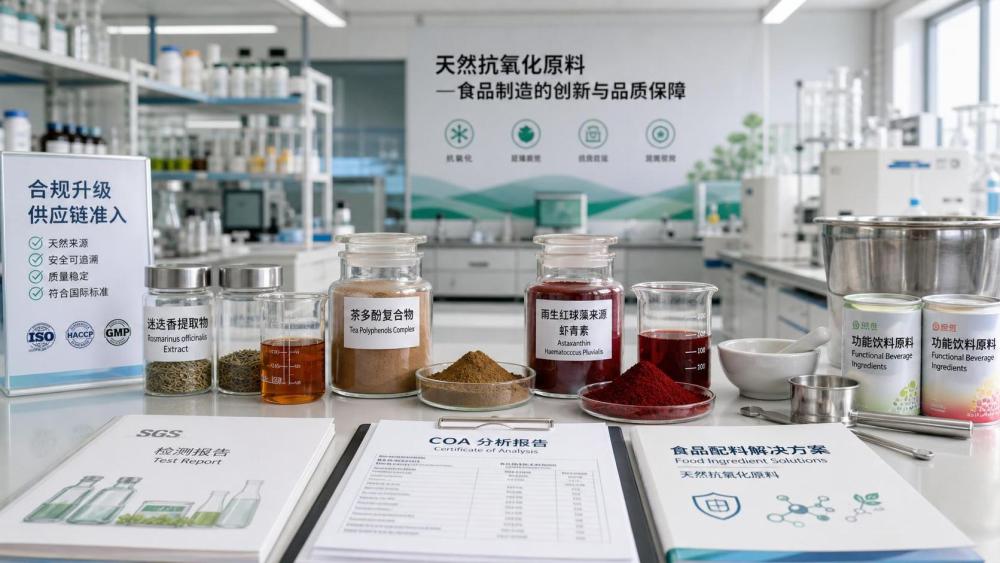
What the FDA Update Confirms
According to the information provided, the FDA on August 10, 2026 formally included rosemary extract containing carboxyrosmarinic acid, a tea polyphenol complex composed of EGCG and ECG, and fermented astaxanthin derived from Haematococcus pluvialis in the GRAS list. The relevant notices are identified as GRN No. 1092-1094.
The confirmed effect of this update is a lower compliance access threshold for North American food and functional beverage manufacturers using these ingredients. The provided information also indicates that this may shorten the time needed to bring new products to market.
For export-oriented businesses, the confirmed point is that Chinese suppliers holding the corresponding testing reports and process validation documents can immediately begin filing supporting declarations related to FDA GRAS, with the aim of accelerating entry into mainstream U.S. OEM and ODM supply chains.
Where the Operational Impact Is Likely to Appear First
Ingredient sourcing and formulation decisions
From an industry perspective, manufacturers and procurement teams are likely to be the first groups affected because the rule change directly concerns whether certain ingredients can move forward more smoothly in product formulation and launch planning. The main operational impact is likely to appear in ingredient screening, supplier approval, and internal compliance review. What deserves closer attention is whether purchasing teams can obtain testing reports and process validation materials that align with the newly recognized ingredients.
Export supply chains targeting U.S. customers
Analysis shows that export suppliers may see the most immediate commercial relevance where U.S.-bound ingredient sales depend on documentation readiness. The update matters in practical terms because the provided information specifically points to Chinese suppliers with matching test data and validated production documentation as being able to start GRAS-related supporting declaration filings. In this context, the critical business links are document preparation, customer qualification review, and onboarding into OEM or ODM procurement systems.
Compliance and verification service activity
Observably, certification-related businesses and testing service providers may also be affected because supporting declarations, testing reports, and process validation files become more central once buyers begin moving these ingredients into active sourcing discussions. The impact here is less about a new mandatory regime stated in the input and more about increased attention to the completeness and consistency of compliance files used in transactions and supplier assessments.
What Companies Should Track Now
Document readiness should be checked against the listed ingredients
Analysis shows that companies using or exporting the three newly listed ingredients should first verify whether their technical files clearly correspond to the ingredient identity described in the update. The most relevant materials mentioned in the provided information are testing reports and process validation documents. At this stage, businesses should focus on readiness rather than assume that all customer-side acceptance steps are already settled.
Customer communication may move faster than internal compliance review
What deserves closer attention is the possibility that sales opportunities accelerate before internal and customer compliance teams fully align on filing language and supporting records. For suppliers, this means commercial outreach may need to proceed in parallel with careful review of declaration materials, product specifications, and traceability files.
Procurement and delivery planning may need adjustment
From an industry perspective, a lower compliance barrier can influence procurement timing and new product scheduling, especially for manufacturers seeking shorter launch cycles. Even so, the input does not provide detailed execution rules, so companies should treat any purchasing or delivery acceleration as a practical possibility to monitor rather than a guaranteed market outcome.
Ongoing interpretation still needs to be watched
Observably, businesses should continue monitoring how this update is reflected in customer qualification requests, technical review standards, and supply documentation requirements. The information provided confirms the listing and its immediate compliance significance, but it does not define every downstream execution detail.
Why This Looks More Like an Execution Signal Than a Broad Policy Shift
Analysis shows that this update is better understood as a concrete execution signal within ingredient compliance rather than a broad new regulatory framework. The listing itself is already in effect, which gives the market a clear reference point for formulation and sourcing decisions involving the three named antioxidants.
At the same time, observably, the more important follow-up question is how quickly buyers, OEM and ODM partners, and service providers translate that regulatory recognition into procurement specifications, supplier onboarding steps, and documentary review standards. That is why the industry still needs to watch implementation feedback rather than assume uniform adoption speed across all business channels.
How to Read the Update at This Stage
From an industry perspective, the August 10, 2026 FDA action has immediate relevance because it reduces compliance entry barriers for three specific natural antioxidants and creates a clearer path for related sourcing and export activity. A measured reading is still necessary: this is a landed compliance change for the listed ingredients, but the pace and scope of business execution will depend on how procurement, documentation review, and supply chain qualification develop in practice.
Basis of This Article and What Still Requires Verification
This article is based on the user-provided news title, event date, and event summary. For developments of this type, relevant information is commonly associated with official notices, regulator releases, trade or customs information, industry association updates, standard-setting documents, and reporting by authoritative media. No specific official source link was provided in the input, so the exact official link remains to be independently verified.
Observably, the points that still require continued checking include any subsequent clarification in regulatory wording, the practical filing approach for GRAS-related supporting declarations, changes in customer qualification or tender documentation, market feedback from OEM and ODM channels, and how suppliers implement testing, validation, and traceability support in actual transactions.
Related News
- How natural antioxidants for oils can prevent rancidity in storageSep 25, 2026Food Preservation Scientist
- How to choose natural antioxidants for beverages with longer shelf lifeAug 23, 2026Food Preservation Scientist
- EU Tightens MRLs for Three Pesticides, Prompting Raw Material Checks for Natural Antioxidant ExportsAug 17, 2026Food Preservation Scientist
- China Customs Tightens Export Filing for Food Ingredients, Raising Clearance RisksAug 16, 2026Food Preservation Scientist
Related News
- 00
0000-00
How to assess color stability from a natural food colors manufacturer - 00
0000-00
When does amino acid surfactant powder improve cleanser mildness? - 00
0000-00
How to verify a cosmetic nanotechnology supplier's safety documentation - 00
0000-00
How rheological thickeners for shampoo affect suspension stability - 00
0000-00
How to assess recombinant collagen ingredients for cream stability
Food Preservation Scientist
Weekly Insights
Stay ahead with our curated technology reports delivered every Monday.