





Food-Grade Antioxidants: How to Balance Shelf Life, Label Claims, and Cost
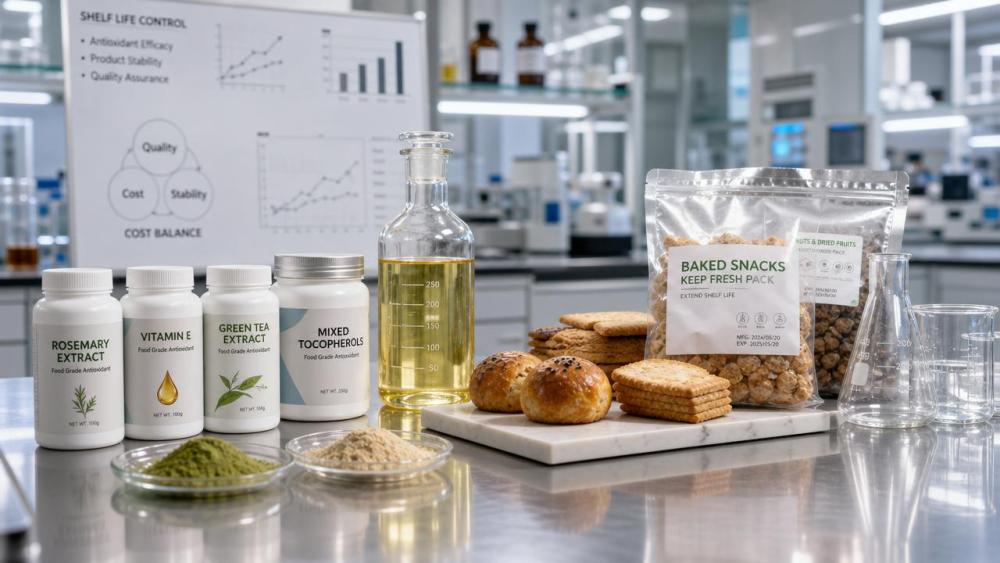
For food manufacturers and brand leaders, choosing food-grade antioxidants now shapes more than expiry dates.
It affects clean-label positioning, regulatory readiness, ingredient compatibility, and the real economics of every production run.
That shift is becoming clearer as supply chains stretch across regions, channels, and storage conditions.
A low-cost antioxidant system may look efficient on paper, yet create losses through flavor drift, discoloration, complaints, or relabeling.
On the other hand, premium food-grade antioxidants can raise costs without delivering value if they do not match the product matrix.
The practical goal is balance: longer shelf life, credible label claims, and a cost structure that supports margin.
In real business terms, that means selecting food-grade antioxidants as part of a formulation strategy, not as an isolated additive decision.
Why Food-Grade Antioxidants Matter More Than Before
Oxidation remains one of the most expensive hidden problems in modern food manufacturing.
It reduces flavor quality, shortens freshness windows, damages fats, and weakens visual appeal.
For oils, snacks, bakery items, meat alternatives, sauces, and supplements, oxidation can also undermine brand consistency.
This is why food-grade antioxidants are often central to product stability programs.
They help slow rancidity, protect sensitive compounds, and support target shelf life across transport and retail exposure.
More importantly, they now sit at the intersection of science and market perception.
Consumers want simple labels, but technical teams still need robust oxidation control.
That tension makes antioxidant selection a leadership issue, not just an R&D task.
Start With the Real Shelf-Life Risk
The first mistake is choosing food-grade antioxidants before defining the actual oxidation risk.
Not every product fails for the same reason.
Some systems are highly sensitive to light.
Others break down under heat, metal contamination, air headspace, or repeated handling.
A useful evaluation usually includes the following points:
- Fat composition and degree of unsaturation
- Water activity and emulsion structure
- Processing temperature and residence time
- Packaging barrier performance
- Distribution distance and storage variability
- Sensory failure threshold at launch and end of shelf life
Once those factors are clear, food-grade antioxidants can be selected more precisely.
This reduces the common habit of overdosing expensive ingredients just to feel safe.
Match Antioxidant Type to Product Matrix
Different food-grade antioxidants behave differently in oils, powders, emulsions, and baked products.
That sounds obvious, yet it still drives many formulation failures.
Synthetic options may offer strong performance and predictable economics.
Natural options may better support label claims, but stability can vary by source, purity, and process conditions.
In practice, the best food-grade antioxidants often work as systems rather than single ingredients.
A primary antioxidant may need support from a chelator, oxygen barrier packaging, or process control improvements.
That is especially true in complex formulations with flavors, pigments, or sensitive actives.
Typical Selection Priorities
- For edible oils, focus on oxidative stability under heat and light.
- For snacks, evaluate fried-note retention and post-packaging air exposure.
- For bakery, check thermal survival during processing and storage.
- For emulsions, examine oil-water interface protection and flavor interaction.
- For nutritional products, protect vitamins, omega oils, and botanical extracts.
How Label Claims Change the Decision
Shelf life alone does not define the right antioxidant strategy anymore.
Label language now influences brand access, channel acceptance, and price positioning.
If a product is built around natural, clean-label, or minimally processed messaging, the antioxidant choice must support that story.
This is where many teams face trade-offs.
Some food-grade antioxidants deliver excellent protection but create label language that marketing teams cannot use comfortably.
Others support a cleaner claim but require higher dosage, stronger packaging, or shorter distribution windows.
A smarter approach is to define acceptable claims before final formulation lock.
That avoids late-stage reformulation, artwork changes, and commercial delay.
Questions Worth Settling Early
- Is the product targeting a clean-label retail segment?
- Will the ingredient name create resistance in key markets?
- Can the claim survive future regulatory scrutiny?
- Does the antioxidant align with the broader brand architecture?
Control Total Cost, Not Ingredient Cost Alone
The lowest-priced antioxidant is not always the most economical choice.
This is one of the most important commercial realities around food-grade antioxidants.
A narrow cost view ignores waste, returns, markdowns, sensory failures, and the cost of replacing lost consumer trust.
It also ignores operational complexity.
Some food-grade antioxidants require special handling, tighter storage, or formulation adjustments that raise indirect costs.
A better business case compares total delivered value.
When viewed this way, food-grade antioxidants become a margin protection tool, not just a formulation expense.
Build a Practical Selection Framework
A workable framework helps teams move faster and avoid internal disagreement.
The strongest programs usually score food-grade antioxidants across technical, regulatory, and commercial criteria.
- Define the target shelf life by channel and geography.
- Rank the likely oxidation triggers in the formula and process.
- Shortlist food-grade antioxidants that fit the product matrix.
- Review label claim implications in each key market.
- Compare total cost-in-use, not price per kilogram.
- Run accelerated and real-time stability checks.
- Confirm supply continuity and documentation quality.
This kind of framework turns antioxidant selection into a repeatable business process.
It also makes cross-functional decisions much easier during scale-up.
Where Strategic Intelligence Adds Value
As formulations become more global, technical choice alone is not enough.
Decision quality improves when teams combine market intelligence, regulatory tracking, and formulation science.
That is where FFAI brings practical value.
Its focus on food preservation, ingredient performance, and compliance helps translate complex technical data into usable decisions.
For companies evaluating food-grade antioxidants, that means better visibility into formulation trade-offs, evolving market expectations, and cost logic.
It also supports a more confident path when products need both scientific credibility and commercial speed.
Make the Final Decision With Confidence
The best food-grade antioxidants are not simply the strongest, cheapest, or most marketable.
They are the ones that fit the product, protect the claim, and support the economics.
That balance is what separates short-term fixes from durable formulation strategy.
In practical terms, successful teams assess oxidation risk first, align label priorities early, and model cost across the full value chain.
When food-grade antioxidants are chosen this way, shelf life improves, claims stay credible, and margin pressure becomes easier to manage.
That is the real advantage in a market where safety, simplicity, and performance must now work together.
The next smart move is simple: review current formulas, identify oxidation-related cost leaks, and rebuild the antioxidant strategy around measurable business outcomes.
Related News
- How to assess a food antioxidants distributor’s traceability practicesOct 11, 2026Food Preservation Scientist
- How natural antioxidants for oils can prevent rancidity in storageSep 25, 2026Food Preservation Scientist
- How to choose natural antioxidants for beverages with longer shelf lifeAug 23, 2026Food Preservation Scientist
- EU Tightens MRLs for Three Pesticides, Prompting Raw Material Checks for Natural Antioxidant ExportsAug 17, 2026Food Preservation Scientist
Related News
- 00
0000-00
Can biomimetic peptides in cosmetics reduce the look of wrinkles? - 00
0000-00
How to assess a bio-based thickener manufacturer's batch consistency - 00
0000-00
Verifying halal status of hydrocolloid ingredients in the Middle East - 00
0000-00
How to interpret active matter on a surfactant specification sheet - 00
0000-00
How Do You Test Hydrocolloid Viscosity After Changing a Thickener?
Food Preservation Scientist
Weekly Insights
Stay ahead with our curated technology reports delivered every Monday.