





On June 8, 2026, China released GB 2763-2026, a new maximum residue limit standard for pesticides in food, with implementation set for September 1, 2026. The update is particularly relevant to tea, fresh grapes, broccoli, and other export-oriented categories because it adds residue limits for 12 biologically derived pesticides, including matrine, azadirachtin, and polyoxin. For natural preservative producers, raw material growers, exporters, and procurement teams, the change deserves close attention because it links regulatory compliance more directly to upstream cultivation practices and extraction control.
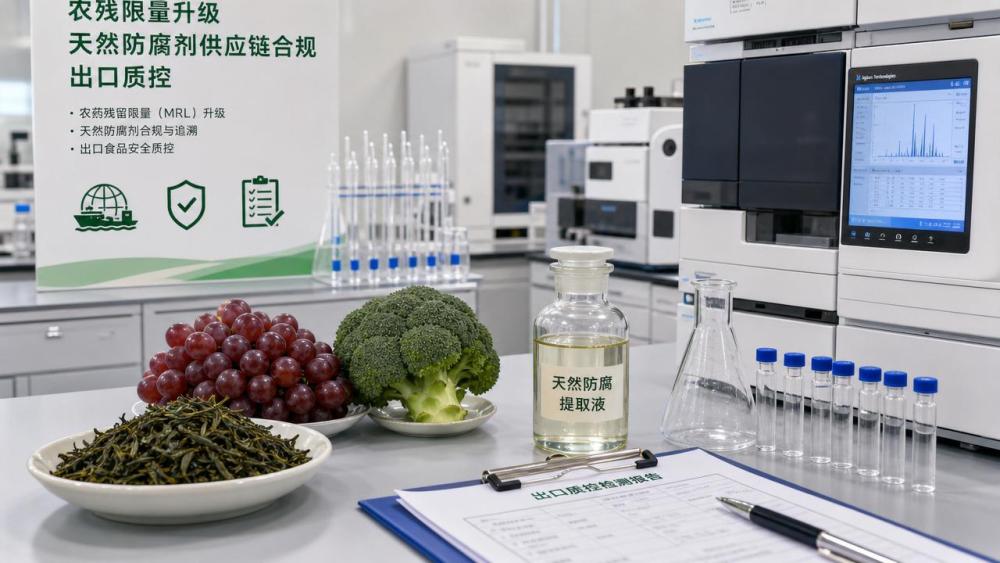
What the new standard explicitly changes
According to the information provided, the National Health Commission and the State Administration for Market Regulation jointly issued GB 2763-2026 Maximum Residue Limits for Pesticides in Food. The standard will take effect on September 1, 2026.
The new version adds limit requirements for 12 biologically derived pesticides in product categories that include tea, fresh table grapes, and broccoli. The named examples include matrine, azadirachtin, and polyoxin.
Among the specific adjustments disclosed, the maximum residue limit for azadirachtin in dry tea is tightened from 1.0 mg/kg to 0.2 mg/kg. The information provided also indicates that this revision will push natural preservative manufacturers to upgrade GAP certification at raw material planting bases and strengthen control over extraction solvent residues.
Where pressure is likely to appear first in the value chain
Export-facing crop supply chains may feel the change early
From an industry perspective, exporters and first-line trading companies connected to tea, fresh grapes, broccoli, and similar categories may be among the first to react. The reason is straightforward: once new residue thresholds are in force, shipment compliance, supplier screening, and product release decisions become more sensitive to upstream residue management.
Natural preservative manufacturers face a tighter upstream linkage
Analysis shows that producers using biologically derived pesticide-related raw materials or positioning their ingredients around natural preservation claims may need to pay closer attention to cultivation and extraction stages. The provided information specifically points to two pressure points: GAP certification at planting bases and residue control tied to extraction solvents.
Procurement and quality teams will need closer document alignment
For raw material buyers and quality assurance teams, the practical impact is likely to appear in qualification review, incoming material checks, and customer-facing compliance documentation. What deserves closer attention is not only the new numeric limit in a single category, but also whether existing supplier files and control records remain aligned with the new standard after September 1, 2026.
What companies should watch before the effective date
Focus on the named categories and substances first
Analysis shows that businesses should begin with the product groups and substances already identified in the released information, especially tea and the disclosed azadirachtin adjustment in dry tea. This is the most direct starting point for assessing whether current sourcing and testing practices still fit the new compliance baseline.
Separate regulatory language from operational readiness
Observably, the policy text and day-to-day execution are not the same issue. Companies should pay attention to how the new requirements translate into supplier qualification, batch release standards, and customer communication, rather than assuming that a standard update automatically means every operational step is already aligned.
Review planting-base qualification and extraction controls
The information provided specifically highlights GAP certification for raw material planting bases and extraction solvent residue control. For manufacturers and service providers, this suggests a need to review whether current upstream partners, process controls, and internal records can support consistent compliance under the tighter framework.
Prepare for contract and delivery discussions
What deserves closer attention is the commercial side of compliance. Procurement, supply chain, and sales teams may need to revisit specification sheets, supplier commitments, and delivery planning so that residue-limit changes do not surface too late in fulfillment or client review.
Why this looks like more than a short-term adjustment
Analysis shows that this development is better understood as a regulatory tightening signal rather than only a one-off technical revision. The reason is that the disclosed changes do not stop at end-product testing; they point back to planting-base management and extraction-stage controls, which are structural parts of the supply chain.
At the same time, it is more appropriate to understand this as an implemented rule with ongoing industry interpretation, not as a finished market outcome. The standard has been released and has a defined effective date, but how different companies absorb the new requirements into sourcing, documentation, and delivery workflows still deserves continued observation.
How the industry may need to frame this update now
At this stage, the update is most reasonably read as a clear compliance change with broader operational implications for natural preservative-related supply chains. The confirmed facts already indicate tighter residue expectations in certain export-oriented categories and a stronger connection between compliance, cultivation standards, and extraction management.
For industry participants, a neutral conclusion is that this is neither a routine headline nor a basis for overstated market predictions. It is a concrete standards update that requires practical review in upstream qualification, process control, and customer-facing compliance preparation.
Basis of this article and what still needs verification
This article is generated based on the user-provided news title, event date, and event summary. The analysis is limited to the disclosed information about the release of GB 2763-2026, its effective date, the added residue limits for 12 biologically derived pesticides in specified categories, the azadirachtin limit change in dry tea, and the indicated pressure on GAP certification and extraction solvent residue control.
For this type of industry update, commonly relevant source categories include official notices, standard documents, company disclosures, industry association information, and reporting by authoritative media. A specific official source link was not provided in the input, so the exact source document link still needs to be verified on an ongoing basis. Continued attention should also be paid to any subsequent official clarification and to how companies translate the released standard into procurement, quality, and delivery practice.
Related News
- How to assess a food antioxidants distributor’s traceability practicesOct 11, 2026Food Preservation Scientist
- How natural antioxidants for oils can prevent rancidity in storageSep 25, 2026Food Preservation Scientist
- How to choose natural antioxidants for beverages with longer shelf lifeAug 23, 2026Food Preservation Scientist
- EU Tightens MRLs for Three Pesticides, Prompting Raw Material Checks for Natural Antioxidant ExportsAug 17, 2026Food Preservation Scientist
Related News
- 00
0000-00
Can biomimetic peptides in cosmetics reduce the look of wrinkles? - 00
0000-00
How to assess a bio-based thickener manufacturer's batch consistency - 00
0000-00
Verifying halal status of hydrocolloid ingredients in the Middle East - 00
0000-00
How to interpret active matter on a surfactant specification sheet - 00
0000-00
How Do You Test Hydrocolloid Viscosity After Changing a Thickener?
Food Preservation Scientist
Weekly Insights
Stay ahead with our curated technology reports delivered every Monday.