





For quality-control and safety teams, preventing oxidative deterioration is not simply a matter of keeping an oil “fresh” for longer. It is about protecting the flavour profile approved at launch, avoiding off-notes that trigger complaints, preserving nutritional positioning where relevant, and making sure a product still performs as intended after transport, warehousing, and repeated consumer use. Natural antioxidants for oils can be a practical part of that control strategy, but they are not a universal fix. Their value depends on the oil’s fatty-acid profile, the processing route, the package, metal contamination, headspace oxygen, and the storage conditions the product actually sees.
Rancidity often becomes visible late in the process, when an oil develops paint-like, cardboard, grassy, fatty, or stale notes. By then, oxidation has usually been progressing for some time. The more useful approach is to understand where the reaction starts, then select a natural antioxidant system that slows the specific failure mode rather than merely adding a familiar clean-label ingredient to the specification.
Why oils become rancid during storage
Most storage-related rancidity is driven by lipid oxidation. Unsaturated fatty acids are especially vulnerable because their molecular structure provides reactive sites where oxygen-driven chain reactions can begin. Once initiated, oxidation forms hydroperoxides. These primary oxidation products may not always create an obvious odour, but they later break down into aldehydes, ketones, acids, and other volatile compounds responsible for the sensory defects consumers notice.
The reaction is accelerated by heat, light, oxygen, and trace metals such as iron or copper. That is why a refined oil can look acceptable on a retained sample shelf but fail after a warm distribution cycle, or why an oil-based dressing may become unstable after repeated opening despite passing initial release tests. In fragranced oils and cosmetic emulsions, the same chemistry can alter the intended scent architecture: delicate citrus, green, floral, and unsaturated botanical notes tend to reveal oxidative damage early.
A useful quality-control distinction is that hydrolytic rancidity and oxidative rancidity are not identical. Hydrolysis is associated with water, enzymes, or processing conditions that split triglycerides and increase free fatty acids. Oxidation is primarily a free-radical chain reaction. A natural antioxidant may slow oxidative changes, but it will not correct poor moisture control, lipase activity, or an already elevated free-fatty-acid level. Treating every rancid odour as an antioxidant problem leads to expensive but disappointing trials.
How natural antioxidants for oils interrupt oxidation
Natural antioxidants for oils work mainly by donating hydrogen atoms or electrons to reactive lipid radicals before those radicals attack more unsaturated fat molecules. In practical terms, they help break the chain reaction. Some also contribute by chelating pro-oxidant metals, while others are more effective when used with a supporting ingredient that regenerates or complements their activity.
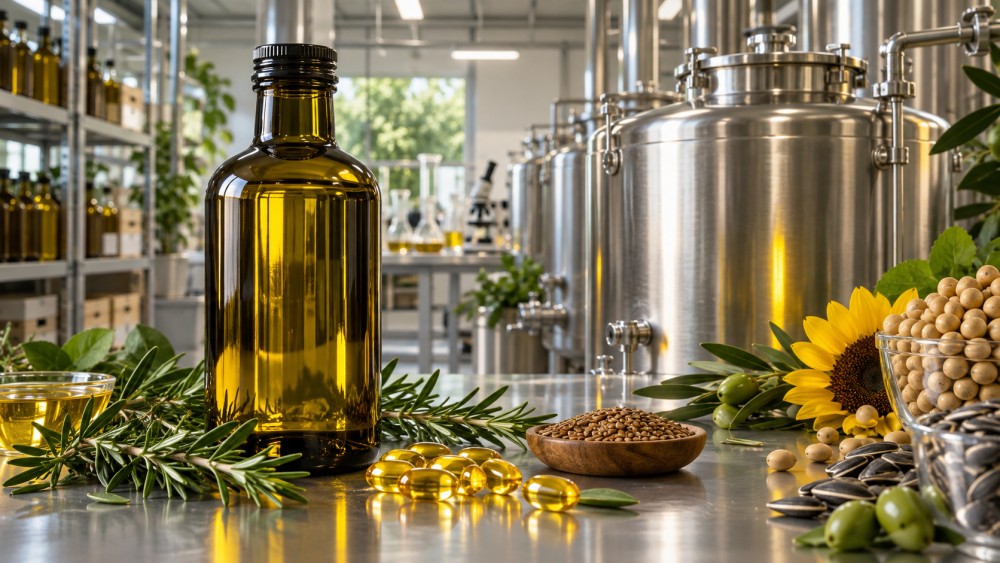
Mixed tocopherols are among the best-known examples. They occur naturally in vegetable oils and are often selected where a label-friendly approach is important. Their performance, however, varies by composition, dosage, oil type, temperature exposure, and oxygen availability. A tocopherol blend that works well in a sealed edible oil may behave differently in a snack seasoning oil exposed to heat and surface area, or in a cosmetic oil packaged in a clear bottle.
Rosemary extracts are another common option, valued for antioxidant components such as carnosic acid and carnosol. They can be useful in fats and oil-rich foods, but sensory compatibility needs careful attention. Depending on the extract quality and application level, rosemary may bring colour or herbal notes that are acceptable in savoury systems yet problematic in neutral frying oils, delicate bakery fats, fine fragrances, or pale personal-care formulations.
Other naturally derived materials, including certain tea-derived extracts and ascorbyl-based ingredients, may have a role in specific antioxidant systems. The important point is not whether an ingredient has antioxidant activity in a general sense. The question is whether it is sufficiently oil-soluble, process-stable, sensory-compatible, and legally suitable for the intended product category and market.
Start with the oil, not with the label claim
The same antioxidant cannot be expected to protect every fat equally. Highly unsaturated oils usually require more careful protection than relatively stable fats because they contain more oxidation-sensitive sites. Fish oils, algae oils, flaxseed oil, walnut oil, and some specialty botanical oils can be particularly demanding. They may need a combined strategy involving antioxidant selection, oxygen management, light protection, and tightly controlled handling from bulk receipt through filling.
Refined oils deserve their own assessment. Refining may reduce naturally occurring protective compounds, but it may also remove impurities that contribute to instability. Crude, cold-pressed, and minimally processed oils can retain desirable native antioxidants while also carrying pigments, phospholipids, metals, or volatile compounds that complicate shelf-life performance. “Less refined” does not automatically mean “more stable,” even when it supports a stronger natural or artisanal product story.
For blended products, consider the full lipid phase rather than the headline oil. A formulation marketed around olive oil, for example, may contain other oils, flavour carriers, oleoresins, or emulsifier systems that change its oxidative behaviour. In a fragrance or cosmetic oil, unsaturated carrier oils, essential oils, and certain aroma materials may all influence the degradation pattern. The ingredient with the lowest oxidation stability can become the practical shelf-life limiter.
Antioxidants work best as part of a storage system
An antioxidant is often expected to compensate for weak packaging or uncontrolled logistics. That expectation is risky. Once oxygen, light, and heat are allowed to work together, even a well-chosen natural system can be overwhelmed. The better decision is to treat antioxidant addition as one layer in a broader oxidative-stability plan.
The point is not to build an unnecessarily complicated system. It is to avoid placing the full burden on one ingredient. Darker or UV-protective packaging, limited headspace, appropriate closures, cooler storage, and clean process equipment can materially change the antioxidant requirement. In some projects, improving these basics gives more reliable protection than simply increasing the antioxidant dosage.
Choosing a natural system without creating a new quality problem
The clean-label conversation can create pressure to replace conventional antioxidant approaches quickly. That is understandable, but replacement trials need to be more disciplined than a one-for-one substitution. Natural extracts can vary in active composition, carrier oil, colour, odour, and lot-to-lot sensory impact. Procurement specifications should therefore look beyond the ingredient name and define the properties that matter to the application.
For a neutral edible oil, assess whether the antioxidant changes colour, turbidity, or flavour immediately and after storage. For a flavoured oil, ask whether it modifies top-note release or masks delicate herbs and spices. In premium skin oils, test not only oxidative stability but also odour evolution, colour drift, compatibility with the pack, and the effect of repeated air exposure after opening. The best result in a laboratory bottle is not necessarily the best result on a retail shelf.
Heat is another common blind spot. Some antioxidants perform well in room-temperature storage but lose effectiveness during frying, baking, deodorisation, or hot filling. This does not mean they are unsuitable; it means the addition point and anticipated thermal history must be part of the formulation decision. An antioxidant added before a harsh thermal step may be partly consumed before the finished product ever reaches the warehouse.
Build validation around the product’s real failure mode
A credible validation plan uses more than one signal. Peroxide value can be useful for monitoring primary oxidation, but it may fall after hydroperoxides decompose, even while sensory quality worsens. Depending on the oil and product category, teams may also monitor secondary oxidation markers, volatile profiles, free fatty acids, colour, odour, and sensory acceptance. The selected methods should fit the product specification and applicable internal or external standards rather than being copied from an unrelated oil system.
Accelerated storage can help compare formulations quickly, but it should not be mistaken for a perfect forecast of ambient shelf life. Elevated temperature may change reaction pathways, and light exposure or package permeability can be underrepresented in a simplified study. Where the product has a long expected shelf life or is vulnerable to seasonal logistics, retaining samples under realistic pack and storage conditions remains valuable.
It is also worth recording the starting condition of each oil lot. Antioxidants preserve what is present; they do not restore an oxidised raw material. Incoming checks, supplier handling history, transport conditions, and retained-sample comparison can prevent a formulation team from blaming an otherwise sound antioxidant system for instability that began before production.
Compliance and documentation should be addressed early
“Natural” is a marketing and sourcing description, not a universal regulatory permission. Permitted substances, use levels, food categories, declaration requirements, and cosmetic notification expectations vary by market. A rosemary-derived antioxidant suitable for one application may require a different review in another, particularly when the same company sells food, supplements, fragrances, and personal-care products across regions.
This is where formulation intelligence needs to connect chemistry with documentation. Ingredient identity, extraction method, carrier system, specifications, stability data, allergen considerations where relevant, and market-specific regulatory status should be reviewed before scale-up. FFAI’s work across food preservation, flavour systems, fragrance materials, and high-value cosmetic actives reflects a practical reality: molecular performance and compliance cannot be separated at the point where a product is prepared for international distribution.
Natural antioxidants for oils are most effective when they are selected as part of a risk-based storage design, not as a last-minute label upgrade. Start with the oil’s actual vulnerability, test the antioxidant in the final package, protect it from oxygen, light, heat, and metals, and verify performance with both analytical and sensory evidence. That approach is slower than choosing the most familiar botanical extract, but it is far more likely to prevent the rancidity problem that matters: the one the customer can smell when the product is opened.
Related News
- How to assess a food antioxidants distributor’s traceability practicesOct 11, 2026Food Preservation Scientist
- How natural antioxidants for oils can prevent rancidity in storageSep 25, 2026Food Preservation Scientist
- How to choose natural antioxidants for beverages with longer shelf lifeAug 23, 2026Food Preservation Scientist
- EU Tightens MRLs for Three Pesticides, Prompting Raw Material Checks for Natural Antioxidant ExportsAug 17, 2026Food Preservation Scientist
Related News
- 00
0000-00
How to assess a food antioxidants distributor’s traceability practices - 00
0000-00
How minimum order quantities shape private label ingredient sourcing costs - 00
0000-00
What drives personal care ingredient price volatility in sourcing - 00
0000-00
What drives micelles price differences in cosmetic formulations? - 00
0000-00
How to assess color stability from a natural food colors manufacturer
Food Preservation Scientist
Weekly Insights
Stay ahead with our curated technology reports delivered every Monday.