





A distributor’s traceability system should be able to reconstruct the full history of a food antioxidant lot without relying on memory, spreadsheets assembled after the fact, or a single certificate detached from the physical material. The test is simple: starting with one received container, can the distributor identify its original producer, production lot, ingredient identity, relevant quality documents, storage history, any relabelling or repacking activity, and every customer shipment that received material from that lot?
For antioxidants, this reconstruction matters because identity alone is insufficient. A material sold under the same commercial name may differ by assay, carrier, solvent residue limits, physical form, origin, packaging configuration, or approved food-use conditions. Traceability must preserve those distinctions through receipt, warehousing, sampling, handling, and dispatch. A system that only records a product code and delivery date can look orderly while failing during a complaint investigation or withdrawal.
Start with the traceability unit
Ask what the distributor considers a traceable unit. The answer should be more specific than “the product.” For a sealed manufacturer drum, the practical unit is often the producer’s lot number plus the distributor’s internal receipt or handling identifier. If the material is split into smaller packs, blended, relabelled, or transferred to another container, the traceability unit must change accordingly and retain a documented link to the source lot.
A robust record connects several identifiers without overwriting any of them: the manufacturer’s batch or lot number, the distributor’s goods-receipt number, the warehouse location, and the outbound shipment reference. Each code serves a different purpose. The producer lot connects the material to its original manufacturing records. The receipt number shows when and under what condition it entered the distributor’s control. The shipment reference establishes downstream distribution.
Be cautious when a distributor assigns a new lot number but does not preserve the original producer lot on labels and shipment paperwork. Internal numbering is not inherently weak; it becomes weak when it breaks the chain. The original lot should remain searchable and visible in the transaction history, especially when multiple original lots have been received under one stock item.
Follow the lot from release to receipt
Traceability begins before the truck arrives. A distributor should be able to show how an approved source is linked to the material being sold. This usually involves a controlled supplier list, a defined product specification, and documentation received for the particular lot. The documents should identify the material clearly enough to prevent substitution between similar antioxidants or grades.
For example, a record for tocopherol, rosemary extract, ascorbyl palmitate, butylated hydroxyanisole, or another antioxidant should distinguish the active substance from its formulation. A liquid antioxidant preparation may contain a carrier oil; a powder may use a permitted processing aid or flow agent. Treating all variants as interchangeable because the principal antioxidant sounds the same creates a traceability gap. The lot documentation should match the exact grade, concentration, and form ordered.
Review whether the certificate of analysis, specification, allergen statement where relevant, origin information where required by the product program, and any food-contact or packaging declarations are controlled versions. A document with a correct product name but no lot reference supports a general qualification file, not batch-level traceability. Conversely, a batch certificate without a stable approved specification makes it difficult to determine whether the reported results were assessed against the right acceptance criteria.
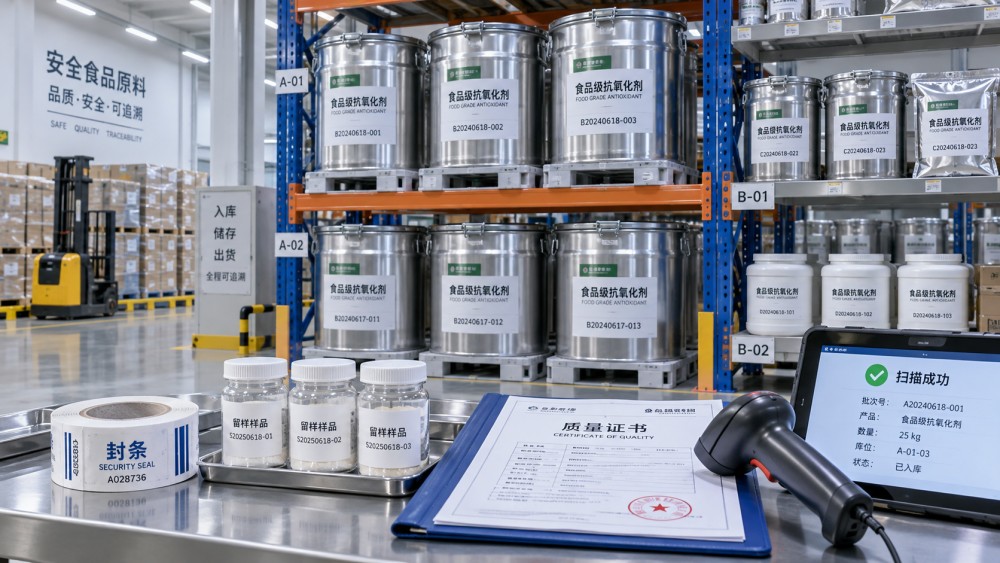
Receipt controls should capture the condition of incoming goods. The record does not need to be elaborate to be meaningful, but it should show whether the seal status, container integrity, label identity, quantity, and temperature-sensitive transport conditions were reviewed when relevant. Oxidation-sensitive materials can lose quality before they are ever issued. Light exposure, damaged liners, prolonged heat, or a partially open drum may not alter the lot code, yet they can change the disposition of that inventory.
Separate document traceability from physical traceability
It is possible to have complete-looking electronic files while physical stock is poorly controlled. During an assessment, compare the system record with the actual warehouse situation. Select a stored container and verify its product name, supplier lot, internal status, expiry or retest date where applicable, net quantity, and storage location. Then work backwards through the system to the receipt record and quality documentation. Repeat the exercise in the opposite direction by selecting a historical incoming lot and identifying all remaining stock and completed shipments.
The physical label should support safe handling, not merely inventory counting. If a drum is placed in quarantine, rejected, sampled, released, or restricted for a particular use, the label or clearly controlled electronic status must prevent accidental issue. A warehouse map alone does not establish control when pallets are moved, partial containers are stored separately, or inventory is transferred between facilities.
Location traceability becomes more important for antioxidants that are sensitive to heat, oxygen, humidity, or light. A record that shows “warehouse A” does not demonstrate whether the lot was held in its specified conditions. The useful evidence is a combination of assigned storage requirement, relevant monitoring records, deviation handling, and stock movement history. Conditions need not be logged at the container level in every operation, but the monitoring arrangement should be sufficient to show that the location used was suitable for that material.
Examine repacking, relabelling, and partial-lot handling closely
These activities create the most common breakpoints in distributor traceability. A sealed original pack preserves the producer’s label and chain of custody. Once material is repacked, the distributor takes on additional control responsibilities. The repacked unit needs a unique identifier linked to the original lot, the date of activity, the quantity transferred, the container or packaging used, the personnel or controlled operation record, and the reconciliation of source and output quantities.
Reconciliation is especially informative. If one original drum is divided into several packs, the total packed quantity plus documented samples, losses, and remaining balance should make sense. An unexplained difference does not automatically indicate a safety issue, but it signals that the distributor may be unable to define the scope of an affected lot later.
Relabelling can be appropriate when local language, customer-facing codes, or storage instructions are required. It should never obscure the original identity. The new label needs clear linkage to the source lot and should be subject to label verification. Errors in unit conversion, concentration statements, expiry dates, or allergen wording can spread through downstream records even when the producer’s original certificate was accurate.
Blending requires an even higher threshold of control. If two lots of the same antioxidant are combined, the resulting lot must retain links to every input lot and their quantities. The expiry date cannot be selected casually; the limiting input, the product specification, and the basis for the assigned date need to be clear. A distributor that cannot explain whether blending occurs, under what authorization, and how blend genealogy is recorded should not be assumed to have full lot traceability.
Test the speed and quality of a mock recall
A mock recall is valuable only when it tests both directions. Forward tracing answers where a named incoming lot went: all shipment references, customers, quantities, and dates, including samples and transfers. Backward tracing answers what entered a specified outbound shipment: producer lot, receipt date, documentation, handling events, and any repack or blend record. A useful exercise also identifies stock still on hand, stock in transit, returned goods, and material already consumed during a controlled repacking operation.
Ask for a demonstration using a real closed lot, rather than a polished generic report. The exercise should begin with a lot identifier selected during the assessment. Observe whether records are retrieved from the normal system and whether results reconcile with stock records. A report generated quickly is helpful, but completeness matters more than speed alone. Fast retrieval of incomplete shipment history can lead to a narrower withdrawal scope than the evidence supports.
Read certificates in the context of the material
A certificate of analysis is a lot record, not proof that every traceability control is functioning. Its value depends on whether it is authentic, linked to the correct lot, internally reviewed where required, and consistent with the approved specification. Examine whether the reported tests fit the antioxidant and its intended food application. Assay may be important, but it does not replace checks for physical form, sensory condition where relevant, moisture, residual solvents, contaminants, carrier identity, or microbiological parameters when the product risk assessment calls for them.
Results can also be misread when material is diluted or standardized. A lower active-content result may be correct for a formulated antioxidant blend and incorrect for a neat active material. The specification must state the basis of the result. Likewise, an antioxidant in oil and the same antioxidant on a dry carrier can require different storage and handling controls even when the active molecule is identical.
Expiry and retest information deserves the same scrutiny. A distributor should not extend, shorten, or overwrite a producer date without a documented basis and defined authority. A warehouse system that automatically applies a standard shelf life to all receipts can conflict with the producer’s lot-specific date. First-expired-first-out controls are useful, but they only work when the date in the inventory record is correct and when released stock is not mixed with material awaiting review.
Assess exceptions, not just normal flow
Normal receipts and routine dispatches are the easiest transactions to control. The maturity of the traceability system is often revealed by exceptions: a damaged container, a returned pallet, an incorrect label, a temperature excursion, a customer complaint, a missing certificate, or a lot held while a document discrepancy is investigated.
For each type of exception, look for a defined status, decision record, and connection to the affected lot. A returned antioxidant should not automatically re-enter saleable inventory because the outer packaging appears intact. Its chain of custody, storage exposure, seal condition, and original shipment identity need review. Where no reliable link to the original released lot remains, the material should be handled under a controlled disposition process rather than silently merged back into stock.
Complaint records should permit trend review by lot, product, producer, and handling step. A complaint about off-odor, discoloration, poor dispersion, unexpected assay, or damaged packaging may originate upstream, during transportation, or in repacking. Traceability does not identify the root cause by itself; it establishes which records and materials must be examined before a cause is assigned.
Confirm governance behind the records
Traceability depends on controlled data entry and change management. Ask who can create products, amend lot attributes, release stock, alter expiry fields, issue replacement labels, and correct shipment transactions. Broad access without review can make a system appear flexible while weakening the evidentiary value of its history. Corrections should retain the original entry, reason, date, and authorization rather than simply replacing data.
Training records are relevant when warehouse staff handle multiple food ingredients with similar packaging or names. The practical concern is not generic awareness training; it is whether personnel understand the local controls for scanning labels, preventing lot commingling, identifying partial containers, recording a relabel operation, and escalating damaged or uncertain stock.
A distributor does not need identical controls for every antioxidant. The traceability depth should reflect the material’s form, stability, repacking activity, storage requirements, and downstream use. What cannot vary is the ability to establish a reliable chain from the shipped unit back to its documented origin, and from an affected origin lot forward to every location where it was placed.
Related News
- How to assess a food antioxidants distributor’s traceability practicesOct 11, 2026Food Preservation Scientist
- How natural antioxidants for oils can prevent rancidity in storageSep 25, 2026Food Preservation Scientist
- How to choose natural antioxidants for beverages with longer shelf lifeAug 23, 2026Food Preservation Scientist
- EU Tightens MRLs for Three Pesticides, Prompting Raw Material Checks for Natural Antioxidant ExportsAug 17, 2026Food Preservation Scientist
Related News
- 00
0000-00
Wissen Research: Global Cosmetics Market to Reach $497.2 Billion by 2031 - 00
0000-00
Can biomimetic peptides improve skin firmness? - 00
0000-00
China Records 543 New Cosmetic Ingredients, Including 167 in 2026 - 00
0000-00
How to check a fragrance raw material specification for IFRA compliance - 00
0000-00
Australia and New Zealand Weigh Wider Steviol Glycoside Use in Griddle Products
Food Preservation Scientist
Weekly Insights
Stay ahead with our curated technology reports delivered every Monday.