





Choosing natural antioxidants for beverages has become a formulation and risk-management question, not just a clean-label exercise. Technical evaluators usually are not asking whether oxidation matters; they are asking which antioxidant system can survive the actual beverage matrix, protect flavor and color long enough to meet distribution targets, and still remain commercially and regulatorily workable. That is a narrower and more practical question than much of the market language suggests.
In beverages, oxidation rarely shows up as a single failure mode. It appears as aroma flattening in tea and juice, color drift in plant-based drinks, vitamin loss in fortified products, bitterness in lipid-containing emulsions, or a general “old” sensory profile that emerges earlier than the printed shelf life. The challenge is that natural antioxidants do not behave the same way across acidic clear drinks, cloudy juice systems, dairy alternatives, functional beverages, and fat-containing formulations. A material that performs well in one format may be underdosed, insoluble, flavor-active, or unstable in another.
That is why the decision should start from the beverage system itself. If the team begins with an ingredient trend and then tries to force it into the formula, the evaluation often goes wrong. For most developers, the better sequence is: identify the dominant oxidation pathway, map process and packaging stress, define acceptable sensory drift over time, and only then compare candidate antioxidant systems.
What technical buyers are really deciding
When someone searches for natural antioxidants for beverages, the underlying decision is usually one of fit: is a natural system good enough for the required shelf life and channel strategy, or will it create more instability than brand value? That is particularly relevant now because “natural” is often assumed to mean safer, cleaner, and commercially superior, while in practice it can also mean greater variability, stronger sensory impact, tighter process windows, and higher cost-in-use.
For a technical evaluator, four questions matter more than the headline claim:
- What exactly needs protection: flavor volatiles, lipids, pigments, vitamins, or overall sensory freshness?
- Where is the oxidative stress coming from: dissolved oxygen, headspace oxygen, metal catalysis, light exposure, heat load, or ingredient interactions?
- How long must the beverage remain acceptable in real channels, not just in retained samples?
- What trade-offs are tolerable in taste, appearance, label language, sourcing, and margin?
If these questions stay vague, antioxidant selection becomes guesswork dressed up as innovation.
Natural does not mean interchangeable
The market often groups natural antioxidants into one bucket, but beverage performance differs sharply by chemistry and delivery form. Rosemary extracts, mixed tocopherols, ascorbic acid, acerola-derived systems, green tea extracts, certain spice extracts, and fruit-derived phenolics can all be positioned as natural or naturally sourced depending on market and labeling context. Yet they do not solve the same technical problem.
Ascorbic acid is a good example of a material that is both useful and misunderstood. In some beverage systems it works well as an oxygen scavenger and can support flavor protection. In others, especially where metal ions are not well controlled, it may participate in reactions that create new stability issues. The result can be counterintuitive: adding an antioxidant can improve one quality parameter while accelerating another failure pathway.
Rosemary extract is another frequent candidate, particularly where lipid oxidation is the main concern. It can be effective, but beverage teams must evaluate flavor carryover, solubility, haze risk, and emulsion compatibility. What works in an oil-rich system may be hard to use in a delicate, lightly flavored clear beverage. Tocopherols also have clear value in fat-containing systems, but they are not a universal answer for water-based drinks.
The practical takeaway is simple: the antioxidant has to match the oxidation mechanism. Selection by ingredient reputation alone is weak technical practice.
Start with the beverage matrix, not the ingredient brochure
A more reliable way to assess options is to classify the beverage first.
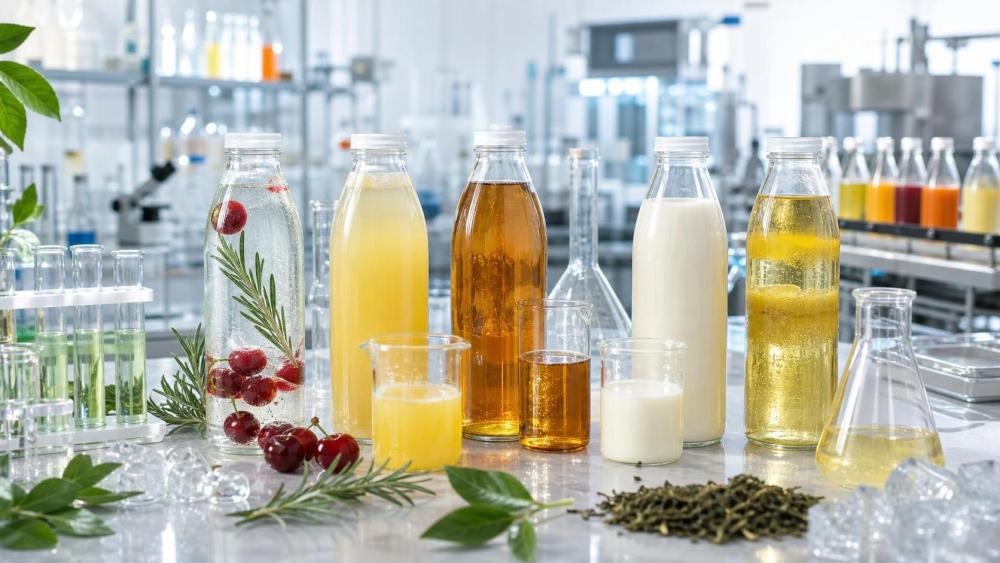
Clear acidic beverages
These systems are highly sensitive to haze, color shift, and off-notes. Any antioxidant with poor water solubility, visible color contribution, or herbal taste can become a problem even at relatively low use levels. If the product depends on a bright, clean flavor profile, sensory side effects may eliminate otherwise promising options early.
Juices, teas, and botanical drinks
These formulas already contain polyphenols, pigments, pulp, or natural solids, so oxidation is often tied to color and aroma evolution rather than a single ingredient degradation event. Here, antioxidant performance must be tested together with the existing phenolic profile. Some combinations are complementary; others create instability, sedimentation, or taste harshness over storage.
Protein beverages and dairy alternatives
These are usually harder than they look. Protein interactions, mineral fortification, emulsified lipids, and thermal processing can create several simultaneous stress points. A natural antioxidant that performs in a simple water-based prototype can lose effectiveness after UHT, hot fill, or prolonged warehouse exposure. In these systems, bench-top success often overstates commercial reality.
Functional and fortified beverages
When vitamins, caffeine, amino acids, botanicals, or omega oils are present, antioxidants must be evaluated as part of a broader stability network. The question is not just whether the antioxidant survives, but whether it protects the claims-driving actives without generating color, odor, or taste deviations that undermine consumer acceptance.
For this reason, beverage matrix mapping should be written into the screening protocol. Many failed launches can be traced back to testing antioxidants as isolated ingredients instead of as participants in a crowded chemical system.
Processing and packaging usually decide the winner
Teams often over-focus on ingredient identity and under-focus on process exposure. Yet oxygen pickup during blending, deaeration efficiency, fill conditions, thermal treatment, and closure performance may matter as much as the antioxidant itself. A moderate antioxidant system in a well-controlled process can outperform a stronger one in a poorly controlled line.
Heat is an obvious screening factor. Some natural antioxidants lose activity or shift sensory character under aggressive thermal load. If the beverage uses hot fill or UHT, test conditions should reflect actual thermal history rather than idealized lab treatment. Light exposure is another common blind spot, especially for products in clear PET or transparent glass. If the package invites photo-oxidation, the antioxidant system is effectively being asked to compensate for a packaging decision.
Headspace oxygen also deserves more attention in procurement discussions. Two antioxidant candidates may look similar in accelerated testing but diverge under real fill variability. The stronger option on paper may not deliver better market performance if its success depends on tighter oxygen control than the plant can consistently maintain.
In other words, antioxidant selection should be made alongside packaging and process capability, not after those choices are locked.
What to ask suppliers before shortlisting
Supplier data sheets are useful, but they are rarely enough for a beverage decision. Technical evaluators should push beyond generic claims such as “clean label,” “natural preservation support,” or “improved shelf life.” The stronger questions are operational.
- In which beverage categories has the material been used commercially: clear drinks, emulsions, protein beverages, juice systems, or concentrates?
- What is the effective use range under realistic pH, thermal, and oxygen conditions?
- What sensory impact appears near the effective dose?
- Does the ingredient require dispersion aids, carriers, or oil-phase incorporation?
- How consistent is the active composition lot to lot, especially for botanical extracts?
- What impurity, residual solvent, or contaminant controls are in place? Claims here should be verified against the supplier’s quality documentation.
- What regulatory position applies in the target markets, including labeling language and usage constraints? Market-specific status may need confirmation as regulations and interpretation evolve【待核实】.
The point is not to make the supplier conversation adversarial. It is to expose whether the ingredient is a formulation tool or just a trend response.
Common assumptions that do not fully hold up
“Natural antioxidants always support a cleaner taste profile.”
Not necessarily. Some bring herbal, phenolic, bitter, or lingering notes. In subtle beverage systems, these can be more commercially damaging than mild oxidation.
“A higher dosage gives safer shelf-life protection.”
Often false. Higher use levels may intensify flavor defects, increase haze, or destabilize appearance. There is usually an optimal window, not a simple more-is-better curve.
“If it works in food, it will work in beverages.”
Beverages are less forgiving. Water activity, clarity expectations, pH, and immediate sensory perception make transfer from bakery, snacks, or sauces unreliable.
“Natural equals easier market acceptance.”
Only partly true. Commercial acceptance depends on taste, shelf-life confidence, supply continuity, and label simplicity together. A natural ingredient with difficult naming, variable availability, or unstable pricing may complicate the business case.
Build the evaluation around cost-in-use, not headline price
Natural antioxidant programs are frequently judged too early on ingredient price per kilogram. For technical selection, that is a weak metric. A more useful comparison is cost-in-use over the intended shelf-life target, including dose, processing accommodations, sensory masking, quality losses, and potential packaging offsets.
For example, a more expensive antioxidant system may still win if it allows longer distribution reach, reduces flavor returns, or preserves premium sensory cues that justify pricing. On the other hand, a lower-cost option may be the right answer if the beverage has a short local distribution cycle and oxidation is not the main shelf-life limiter.
This is where technical and commercial teams often misalign. Procurement may compare unit price, while R&D is trying to reduce spoilage risk and maintain brand character. The evaluation model should make those trade-offs visible instead of burying them inside separate departmental decisions.
Risk points that deserve a formal check
Some issues are common enough that they should be built into every review:
- Botanical variability: natural extracts may show seasonal or origin-based composition changes.
- Sensory drift over time: an acceptable day-0 profile can become intrusive by month three or six.
- Interaction with fortification systems: minerals and vitamins can change antioxidant behavior.
- Appearance effects: haze, ring formation, sediment, or emulsion changes may emerge late.
- Regulatory interpretation: “natural” positioning and ingredient naming may differ by market【待核实】.
- Supply resilience: some plant-derived ingredients are more exposed to harvest and geopolitical volatility than synthetic alternatives.
Technical evaluators should also be cautious with accelerated shelf-life claims. Useful as a screening tool, yes. Sufficient as a launch decision, usually no. Oxidation pathways in beverages can shift under real-time conditions, especially when light exposure, closure oxygen ingress, or distribution temperature variation are involved.
A practical screening approach
For most beverage programs, a staged method is more reliable than a broad ingredient bake-off.
- First, define the dominant failure modes and rank them: aroma loss, color drift, vitamin degradation, lipid rancidity, or general aged notes.
- Second, narrow the candidate set by matrix compatibility, processing tolerance, and likely sensory burden.
- Third, test in the actual beverage with the intended package or a close proxy, under both accelerated and real-time conditions.
- Fourth, compare not just analytical markers but also commercial acceptability thresholds: what level of change would trigger rejection in market?
- Fifth, review supply, regulatory fit, and cost-in-use before final selection.
This sounds basic, but it often prevents the most expensive mistake in beverage stability work: selecting an antioxidant that looks technically active in isolation but does not protect the product that consumers actually buy.
Where the market is moving
The broader direction is clear even if the exact regulatory and commercial pace differs by region. Beverage brands want shorter, more recognizable ingredient decks; technical teams want systems that survive modern processing and global distribution; and buyers want fewer surprises in supply and compliance. That combination is pushing selection away from single-claim ingredients and toward more integrated oxidation-control strategies.
In practice, that means natural antioxidants increasingly will be judged as part of a package: oxygen management, chelation where appropriate, process control, light protection, and formula redesign. The companies that handle this well are usually not the ones chasing the most marketable antioxidant name. They are the ones treating oxidation as a system problem and using natural inputs where they genuinely improve the total shelf-life equation.
For technical evaluators, that is the useful mindset to keep. The question is not whether natural antioxidants for beverages are worth considering. In many categories, they clearly are. The real question is whether a given antioxidant system can protect the beverage you actually make, under the process, package, and shelf-life promise you actually need.
Related News
- How to assess a food antioxidants distributor’s traceability practicesOct 11, 2026Food Preservation Scientist
- How natural antioxidants for oils can prevent rancidity in storageSep 25, 2026Food Preservation Scientist
- How to choose natural antioxidants for beverages with longer shelf lifeAug 23, 2026Food Preservation Scientist
- EU Tightens MRLs for Three Pesticides, Prompting Raw Material Checks for Natural Antioxidant ExportsAug 17, 2026Food Preservation Scientist
Related News
- 00
0000-00
Verifying halal status of hydrocolloid ingredients in the Middle East - 00
0000-00
How to interpret active matter on a surfactant specification sheet - 00
0000-00
What Quality Checks Should You Run on Fragrance Ingredient Suppliers? - 00
0000-00
How to assess a flavor chemistry manufacturer's batch consistency - 00
0000-00
What drives fragrance ingredients price changes in bulk orders?
Food Preservation Scientist
Weekly Insights
Stay ahead with our curated technology reports delivered every Monday.