





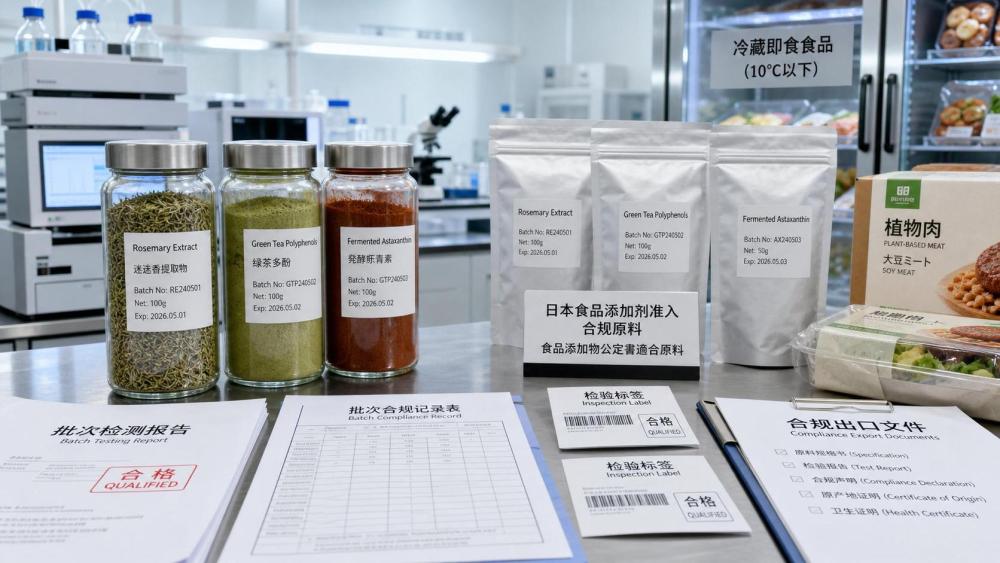
On 12 July 2026, Japan’s Ministry of Health, Labour and Welfare (MHLW) updated JAS Standard Annex B by adding seven natural antioxidants to the “Designated Additives” framework, including rosemary extract standardized to 20% carnosic acid, green tea polyphenols, and fermented astaxanthin. The move is particularly relevant for exporters, importers, ingredient suppliers, and food manufacturers serving chilled ready meals and plant-based meat applications, because the market access path is becoming clearer while shipment-level documentation requirements remain a practical checkpoint.
What the 12 July update confirmed
According to the information provided, the MHLW expansion of JAS Standard Annex B took effect on 12 July 2026 and brought seven natural antioxidants into scope under the designated list. Among the specifically named substances are rosemary extract standardized to 20% carnosic acid, green tea polyphenols, and fermented astaxanthin.
The approved use stated in the input applies to chilled ready meals and plant-based meats. The same information also confirms that importers must submit JAS certification together with batch-specific assay reports for each shipment. The update is described as lowering entry barriers for exporters that can provide high-purity natural antioxidants meeting JAS Grade A specifications.
Where the impact is likely to be felt first
Export supply programs face a more defined access route
From an industry perspective, exporters of high-purity natural antioxidants are among the first groups likely to feel the impact. The reason is straightforward: the update creates a clearer approved-use path for certain natural antioxidants in defined food categories. In business terms, the main effect is likely to appear in product qualification, customer discussions, and shipment preparation.
What deserves closer attention is whether suppliers can consistently match the stated JAS-related quality expectations and support shipment-by-shipment documentation without delay.
Import operations will be shaped by document execution
Importers are directly affected because the input makes clear that each shipment must be accompanied by JAS certification and batch-specific assay reports. That means the impact is less about broad policy messaging and more about execution at the documentation and customs-facing stage of trade.
Analysis shows that for import-side teams, the critical issue is not only whether a material is now permitted, but whether the supporting paperwork is complete, batch-linked, and ready in time for each consignment.
Food manufacturers gain options, but only within a defined compliance frame
Manufacturers in chilled ready meals and plant-based meats may see this change as an expanded ingredient option set. Observably, the potential benefit sits in formulation and sourcing flexibility, but the practical effect still depends on whether upstream suppliers and import partners can meet the stated certification and assay-report requirements.
For procurement and technical teams, the change is therefore relevant at the interface between ingredient selection and compliance verification.
What companies should track in practical terms
Check whether product specifications align with the stated standard
For companies working with rosemary extract, the input specifically mentions material standardized to 20% carnosic acid. In practical terms, that makes specification matching a priority. Businesses should pay close attention to whether existing product grades, quality documents, and customer-facing technical sheets align with the approved description in the update.
Prepare shipment-level evidence, not only general approvals
The requirement for batch-specific assay reports means general product compliance claims are not enough on their own. What deserves closer attention is the operational readiness to issue, review, and transmit shipment-specific evidence every time goods move into Japan under this framework.
Separate policy access from execution readiness
Analysis shows that a lower entry barrier does not remove the need for disciplined document control. Companies may be tempted to read the update mainly as a market-opening signal, but in practice the commercial result will depend on whether certification, assay reporting, and supplier coordination are already built into the transaction process.
Keep customer communication tightly tied to confirmed facts
Because the confirmed information is precise, commercial teams should avoid overstating the change. The clearest communication basis is that designated natural antioxidants have been expanded for specified applications, while shipment-by-shipment JAS certification and assay documentation remain necessary.
How this development is best understood at this stage
Observably, this update can be read as both an immediate operational change and a broader regulatory signal, but the stronger near-term meaning lies in execution rather than market scale. The confirmed facts point to a more accessible route for qualified antioxidant exporters, especially those able to supply high-purity materials that meet JAS Grade A specifications.
At the same time, it is more appropriate to understand this as a controlled opening rather than a fully simplified process. The need for batch-specific assay reports indicates that access is being expanded alongside traceable proof requirements, which keeps compliance discipline central to actual trade flow.
Why the industry should keep watching
In summary, the 12 July 2026 update matters because it changes the practical compliance landscape for natural antioxidants used in chilled ready meals and plant-based meats in Japan. For the industry, the message is not simply that more substances are listed, but that approved access and shipment-level verification now need to be managed together.
Current reading suggests this is best treated as a concrete near-term regulatory development with longer-term commercial implications that still depend on documentation performance, supplier capability, and how consistently the new requirements are applied in day-to-day trade.
Basis of this article and points for follow-up verification
This article is based on the user-provided news title, event date, and event summary. For developments of this type, commonly relevant source categories may include official government notices, standard-setting documents, industry association updates, company disclosures, and reporting by authoritative trade media.
No specific official source link was provided in the input, so the exact underlying notice and any later implementation detail still require ongoing verification. Follow-up attention should remain on any further official wording, document interpretation, and operational clarifications related to certification and batch-specific assay reporting.
Related News
- How natural antioxidants for oils can prevent rancidity in storageSep 25, 2026Food Preservation Scientist
- How to choose natural antioxidants for beverages with longer shelf lifeAug 23, 2026Food Preservation Scientist
- EU Tightens MRLs for Three Pesticides, Prompting Raw Material Checks for Natural Antioxidant ExportsAug 17, 2026Food Preservation Scientist
- China Customs Tightens Export Filing for Food Ingredients, Raising Clearance RisksAug 16, 2026Food Preservation Scientist
Related News
- 00
0000-00
How to assess color stability from a natural food colors manufacturer - 00
0000-00
When does amino acid surfactant powder improve cleanser mildness? - 00
0000-00
How to verify a cosmetic nanotechnology supplier's safety documentation - 00
0000-00
How rheological thickeners for shampoo affect suspension stability - 00
0000-00
How to assess recombinant collagen ingredients for cream stability
Food Preservation Scientist
Weekly Insights
Stay ahead with our curated technology reports delivered every Monday.