





On June 28, 2026, Japan’s Ministry of Health, Labour and Welfare (MHLW) revised the 7th edition of its Food Additives Compendium, lowering by 20% the unified limits for lead, cadmium, and arsenic in natural antioxidants such as rosemary extract, tea polyphenols, and vitamin E. With mandatory enforcement set for December 1, 2026, the update deserves close attention from exporters, ingredient suppliers, manufacturers, and quality teams involved in products entering the Japanese market, because it directly affects compliance thresholds and testing precision requirements.
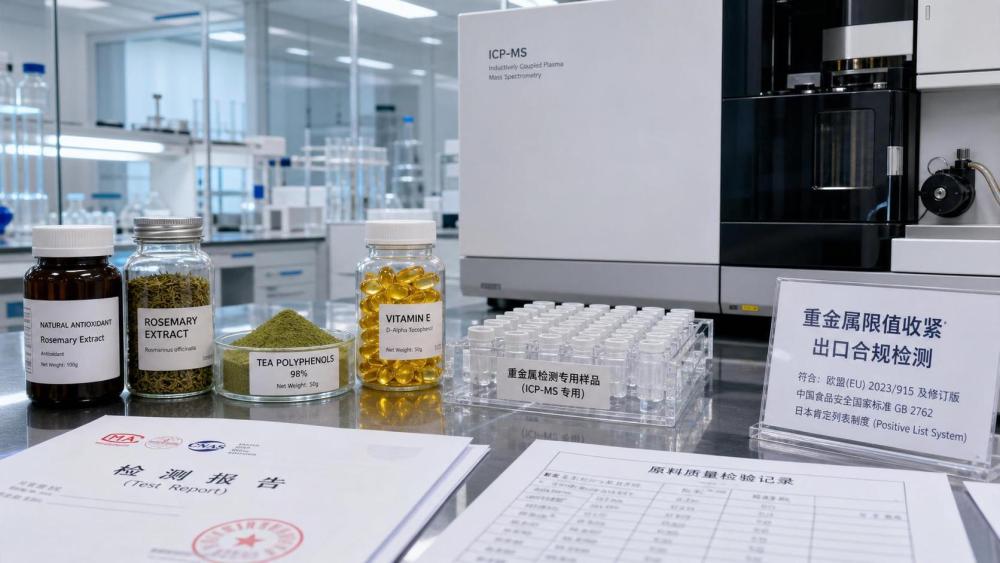
What the revision clearly changes
According to the provided information, the MHLW revised the 7th edition of the Food Additives Compendium on June 28, 2026. The revision applies to natural antioxidants including rosemary extract, tea polyphenols, and vitamin E, and it uniformly lowers the limits for three heavy metals: lead, cadmium, and arsenic.
The new requirements will become mandatory on December 1, 2026. The provided information also states that Chinese export enterprises will need to adopt a three-tier ICP-MS quality control system in order to meet the testing precision required under the new rule.
Where the immediate pressure is likely to appear
Export-facing ingredient suppliers
From an industry perspective, suppliers shipping natural antioxidants to Japan may be affected first because the rule directly concerns the compliance status of the ingredient itself. The main pressure point is likely to be pre-shipment quality control, especially where existing testing margins were already narrow. What deserves closer attention is whether internal release standards, supplier certificates, and batch testing workflows are aligned with the tighter thresholds before the December 2026 enforcement date.
Manufacturers using natural antioxidants in production
Manufacturing businesses that incorporate rosemary extract, tea polyphenols, vitamin E, or similar natural antioxidants may face follow-on impacts in raw material approval and incoming quality checks. Analysis shows that even where the regulation is aimed at the additive standard, the operational effect can extend into procurement review, specification confirmation, and batch acceptance criteria. For these companies, the practical issue is not only whether the ingredient is available, but whether its supporting compliance documentation remains adequate for Japan-bound business.
Trade and supply chain coordination teams
For trading companies and supply chain service providers, the impact is likely to concentrate in document handling, testing coordination, and delivery planning. A tighter heavy metal limit can increase the importance of consistency between laboratory results, shipment schedules, and customer-facing declarations. Observably, this raises the need for clearer communication across suppliers, laboratories, and buyers, particularly where Japanese market deliveries are time-sensitive.
Buyers and downstream customers
Purchasing teams and downstream users may need to review whether current suppliers can continue to meet Japanese requirements under the revised standard. The main area to watch is verification: not only the presence of test reports, but also whether those reports are generated under a quality control framework capable of meeting the required ICP-MS precision referenced in the provided information.
What companies should be checking now
Whether product scope and specifications are fully mapped
Companies involved in Japan-related business should first identify where rosemary extract, tea polyphenols, vitamin E, and comparable natural antioxidants appear in their export or supply portfolio. The key practical issue is to determine which specifications, contracts, and customer commitments may be touched by the revised heavy metal limits.
Whether testing systems are sufficient for the new precision threshold
The provided information specifically points to the need for a three-tier ICP-MS quality control system for Chinese export enterprises. Analysis shows that this is not only a laboratory matter; it also affects how companies validate test reliability, manage batch release, and support customer or regulatory inquiries. Businesses relying on external laboratories may need to confirm that their service arrangements match the new precision expectation.
Whether supplier and customer communication is being updated in time
What deserves closer attention is the gap between a published rule and day-to-day execution. Companies may need to review supplier qualification materials, certificates, and batch documents, while also preparing updated compliance communication for Japanese customers. This is especially relevant where procurement cycles or shipment lead times extend close to the December 1, 2026 enforcement date.
Whether transition planning is realistic
Observably, the enforcement date creates a defined transition window. Businesses should pay attention to how current inventory, pending orders, and future shipments align with that date, and whether internal approval timelines leave enough room for retesting, document updates, or supplier replacement if needed.
How this update is best interpreted at this stage
Analysis shows that this development is more than a routine wording change, because it combines a tighter contaminant threshold with an explicit testing precision implication for exporters. At the same time, it should not be overstated as a complete reshaping of the market based on the provided information alone. It is more appropriate to understand this as a clear compliance signal with near-term operational consequences, especially for companies already serving Japan with natural antioxidant ingredients or products containing them.
From an industry perspective, the update also deserves continued observation because the immediate rule text is already defined, but the real business effect will depend on how companies translate the new limits into procurement controls, laboratory practice, and delivery execution.
A compliance signal with practical supply chain consequences
Based on the provided information, the MHLW revision sets a firmer compliance bar for natural antioxidants entering the Japanese market by lowering heavy metal limits for lead, cadmium, and arsenic and setting a December 1, 2026 mandatory date. The most balanced reading for industry participants is that this is a concrete short-term regulatory change with broader implications as a longer-term quality signal. The immediate task is operational readiness, while the broader significance lies in how supply chains adapt their testing and documentation standards.
Basis of this article and what still needs verification
This article is based on the user-provided news title, event date, and event summary. For this type of industry update, relevant source categories typically include official notices, company disclosures, industry association information, authoritative media coverage, and standard-setting documents. The specific official source link was not provided in the input, so continued verification remains necessary.
What should continue to be monitored includes any further official wording, implementation guidance, and market-side compliance practices related to the revised heavy metal limits and the stated ICP-MS quality control requirement.
Related News
- How to assess a food antioxidants distributor’s traceability practicesOct 11, 2026Food Preservation Scientist
- How natural antioxidants for oils can prevent rancidity in storageSep 25, 2026Food Preservation Scientist
- How to choose natural antioxidants for beverages with longer shelf lifeAug 23, 2026Food Preservation Scientist
- EU Tightens MRLs for Three Pesticides, Prompting Raw Material Checks for Natural Antioxidant ExportsAug 17, 2026Food Preservation Scientist
Related News
- 00
0000-00
What drives fragrance ingredients price changes in bulk orders? - 00
0000-00
How to assess a food antioxidants distributor’s traceability practices - 00
0000-00
How minimum order quantities shape private label ingredient sourcing costs - 00
0000-00
What drives personal care ingredient price volatility in sourcing - 00
0000-00
What drives micelles price differences in cosmetic formulations?
Food Preservation Scientist
Weekly Insights
Stay ahead with our curated technology reports delivered every Monday.