





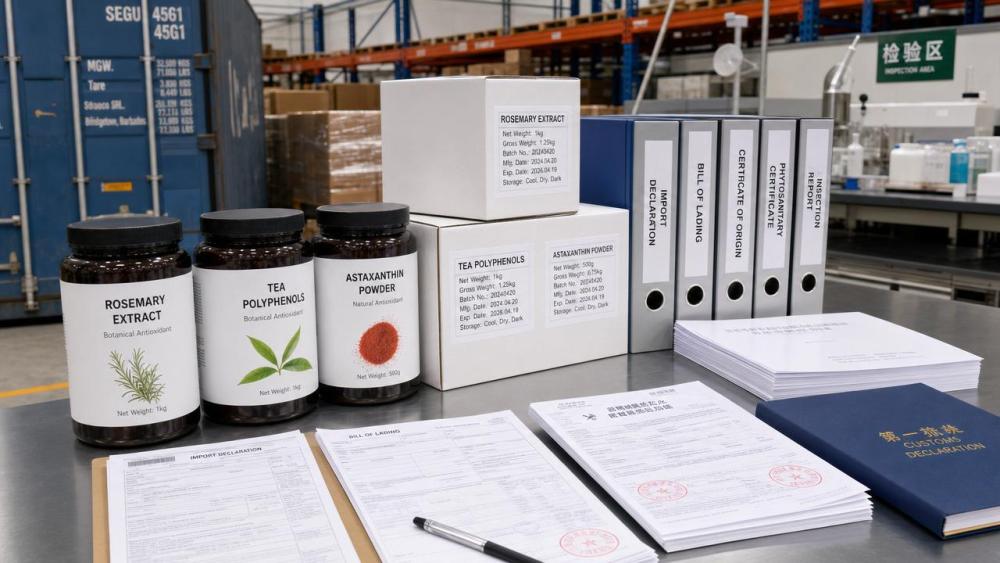
Pakistan’s revised import policy is set to take effect on June 1, 2026, introducing a new compliance threshold for natural antioxidants and food ingredients that contain plant-derived components. Importers will need to provide an ILO-recognized forced-labor-free due diligence certificate for products such as rosemary extract, tea polyphenols, and astaxanthin, making this a development worth close attention for exporters, importers, procurement teams, and cross-border supply chain operators involved in plant extract trade with Pakistan.
What the revised rule clearly requires
According to the information provided, Pakistan’s Ministry of Commerce amended its Import Policy Order on April 28. From June 1, 2026, imports of natural antioxidants and food ingredients containing plant-origin components will be subject to a documentation requirement tied to forced-labor-free due diligence.
The required proof must be recognized by the International Labour Organization (ILO). If the importer does not submit this documentation, the goods will not be allowed to clear customs. The measure directly affects exports from Chinese plant extract companies to Pakistan.
Where the disruption may appear first
Export transactions may face a new documentation gate
From an industry perspective, direct trading companies are likely to feel the impact first because customs clearance now depends on an additional compliance document rather than only on product and shipping arrangements. What deserves closer attention is whether transaction timing, shipment release, and contract execution can still proceed smoothly once the new rule begins to apply.
Procurement teams will need to verify document readiness earlier
For ingredient buyers and import-side sourcing teams, the issue is not only product availability but also whether the required due diligence proof is in place before shipment arrival. The practical pressure point may shift upstream into supplier confirmation, document review, and coordination with exporters before purchase decisions are finalized.
Supply chain service providers may need tighter clearance coordination
Customs brokers, logistics coordinators, and other supply chain service providers may also be affected because a missing certificate now creates a direct clearance barrier. Observably, the operational risk is concentrated at the handover between shipment preparation, document submission, and customs processing.
Chinese plant extract suppliers face a market access condition
For Chinese exporters of plant extracts and related food ingredients, the change is not simply a paperwork issue. It functions as a market access condition for sales into Pakistan, especially for shipments involving the product categories explicitly referenced in the policy summary.
What companies should monitor now
Watch how the requirement is described in practice
Analysis shows that one of the immediate priorities is to follow any further official wording or implementation detail around what qualifies as an ILO-recognized forced-labor-free due diligence certificate. The current information confirms the requirement, but actual execution will depend on how the proof is interpreted in customs practice.
Check affected product lines and shipment pipelines
Companies handling rosemary extract, tea polyphenols, astaxanthin, or other plant-based antioxidant ingredients should review which active orders, planned shipments, or customer programs may fall within the effective date. The key issue is to identify where product scope and shipment timing intersect with the new clearance threshold.
Prepare supplier and importer document coordination
What deserves closer attention is the coordination between exporter, importer, and any service provider managing filing or clearance. Businesses may need to confirm in advance who is responsible for preparing, presenting, and validating the required documentation so that customs risk does not emerge only after goods are in transit.
Separate policy wording from delivery execution risk
Observably, there is a difference between a policy requirement on paper and the operational ability to meet it consistently across shipments. Companies should therefore focus not only on whether the rule exists, but also on whether their documentation process, lead times, and buyer communication are aligned with the June 1, 2026 start date.
Why this matters beyond a single customs formality
As an editorial observation, this development is more than a narrow import filing update because it links market entry for certain ingredient categories to labor-related due diligence proof. It is more appropriate to understand this as a compliance signal with direct trade consequences, rather than as a routine administrative adjustment.
At the same time, it should not yet be overstated into broader conclusions beyond the provided facts. The confirmed point is clear: without the required certificate, customs clearance will be blocked. The broader commercial effect will still need continued observation through implementation.
How to read the current signal
At this stage, the industry significance lies in the combination of three factors: a defined effective date, a document-based compliance threshold, and a direct impact on exports of Chinese plant extract companies to Pakistan. For market participants, the most reasonable reading is that this is an actionable near-term compliance change with possible longer-term implications if similar requirements gain wider use.
In that sense, the update is best understood neither as a temporary headline nor as a fully settled long-term market outcome. It is a concrete rule change that already warrants operational attention, while its wider commercial impact still requires ongoing monitoring.
Basis of this article
This article is based on the user-provided news title, event date, and event summary concerning Pakistan’s import restrictions on natural antioxidants and plant extracts. Relevant source types for developments of this kind typically include official government notices, company disclosures, industry association updates, authoritative media reporting, and documents from standards or international organizations.
A specific official source link was not provided in the input, so the exact publication text and any later interpretive updates still need continued verification. Follow-up attention should focus on any further official clarification, implementation wording, and customs-side application of the certificate requirement after June 1, 2026.
Related News
- How natural antioxidants for oils can prevent rancidity in storageSep 25, 2026Food Preservation Scientist
- How to choose natural antioxidants for beverages with longer shelf lifeAug 23, 2026Food Preservation Scientist
- EU Tightens MRLs for Three Pesticides, Prompting Raw Material Checks for Natural Antioxidant ExportsAug 17, 2026Food Preservation Scientist
- China Customs Tightens Export Filing for Food Ingredients, Raising Clearance RisksAug 16, 2026Food Preservation Scientist
Related News
- 00
0000-00
How to assess color stability from a natural food colors manufacturer - 00
0000-00
When does amino acid surfactant powder improve cleanser mildness? - 00
0000-00
How to verify a cosmetic nanotechnology supplier's safety documentation - 00
0000-00
How rheological thickeners for shampoo affect suspension stability - 00
0000-00
How to assess recombinant collagen ingredients for cream stability
Food Preservation Scientist
Weekly Insights
Stay ahead with our curated technology reports delivered every Monday.