





Anti-Aging Active Ingredients Supplier: What to Compare First
Choosing an anti-aging active ingredients supplier is not just about price or claims.
The first comparison should focus on evidence, compliance, formulation fit, and supply reliability.
That early filter saves time, reduces launch risk, and protects brand positioning.
In practical buying decisions, the supplier shapes more than ingredient cost.
The right partner supports premium claims, formulation stability, and commercial scale.
That is why comparing an anti-aging active ingredients supplier needs a structured approach from the start.
Start With Proof of Efficacy, Not Marketing Language
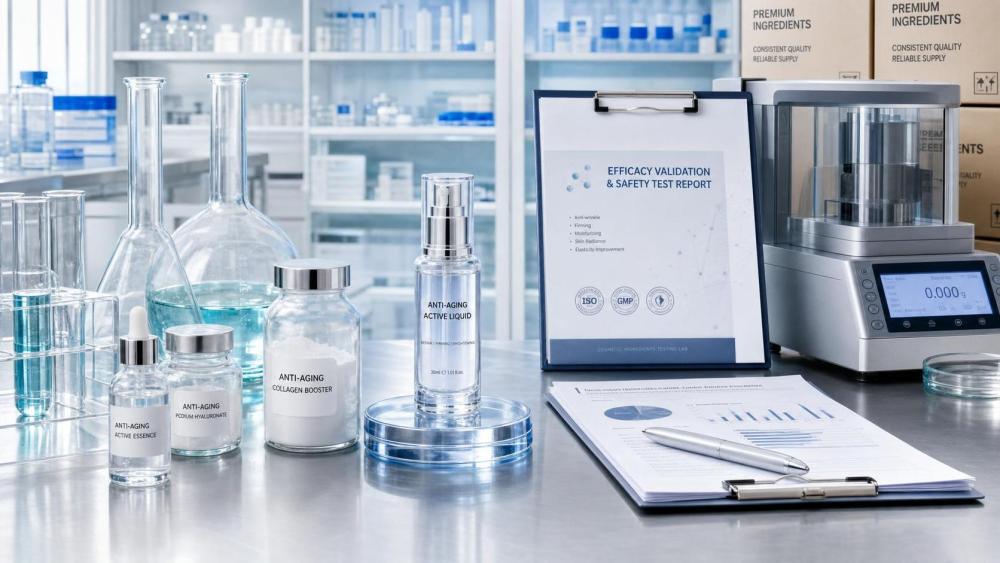
The first test for any anti-aging active ingredients supplier is scientific credibility.
Many suppliers present bold anti-wrinkle or firming claims.
What matters is whether those claims are backed by usable evidence.
Ask for in vitro, ex vivo, and clinical data.
Check whether the dosage in testing matches the recommended use level in your formula.
That detail is often where inflated supplier narratives start to weaken.
A credible anti-aging active ingredients supplier should clearly explain the mechanism of action.
For peptides, that may involve signaling pathways or extracellular matrix support.
For actives like Pro-Xylane alternatives or fermented compounds, penetration and bioavailability matter just as much.
Useful questions include:
- Was the active tested alone or inside a finished formula?
- Were results measured against a control group?
- How long did the study run?
- Are endpoints linked to visible consumer outcomes?
If the supplier cannot answer these questions cleanly, move cautiously.
A serious anti-aging active ingredients supplier will usually have technical teams ready for this review.
Check Regulatory Readiness Before Sample Approval
Once efficacy looks credible, regulatory readiness should come next.
This is where many supplier evaluations become too reactive.
A strong anti-aging active ingredients supplier should already support market entry requirements.
That includes INCI clarity, safety files, impurity profiles, and documentation for target regions.
For global brands, the gap between supplier claims and compliance status can become expensive very quickly.
Look closely at support for FDA-related considerations, EU CPNP documentation, and other local cosmetic frameworks.
If an active sits in a gray zone, the supplier should explain the risk plainly.
This also applies to claims language.
An anti-aging active ingredients supplier may offer good data, yet weak guidance on compliant market claims.
That disconnect creates legal and reputational pressure later.
In real sourcing projects, teams often compare suppliers using a document checklist:
- TDS and specification sheet
- SDS and toxicology summary
- Allergen, residual solvent, and heavy metal information
- Stability and storage guidance
- Claim substantiation support
A supplier that prepares this well is usually easier to scale with.
Compare Formulation Compatibility and Sensory Impact
The next comparison point is formulation behavior.
An anti-aging active ingredients supplier may have impressive science, but poor formulation fit can erase value fast.
This becomes even more important in premium skincare, where texture, stability, and visible performance must work together.
Review pH tolerance, heat sensitivity, solubility, and incompatibilities with preservatives or emulsifier systems.
Some actives degrade during processing.
Others work well on paper but add odor, stickiness, color drift, or instability in finished products.
That is why sample evaluation should never focus on efficacy alone.
Ask the anti-aging active ingredients supplier for prototype formulas and stress-test results.
The best suppliers usually provide practical guidance, not just ingredient brochures.
Key areas to compare include:
- Recommended use level and cost-in-use
- Compatibility with creams, serums, masks, and ampoules
- Interaction with fragrance, color, and preservation systems
- Impact on skin feel and afterfeel
- Long-term stability under transport and storage conditions
From a product strategy view, sensory performance affects repeat purchase as much as clinical language.
A capable anti-aging active ingredients supplier understands both lab logic and shelf reality.
Assess Supply Consistency, Scale, and Commercial Fit
Supply consistency is where sourcing decisions become fully commercial.
An anti-aging active ingredients supplier must support forecast accuracy, batch consistency, and future scale.
A good sample means little if lead times become unstable after launch.
This is especially true for high-value actives such as peptides, recombinant collagen, and specialized fermentation extracts.
Ask how the supplier manages raw material sourcing, production capacity, and quality deviation control.
Find out whether manufacturing is internal or outsourced.
That answer often reveals how much control the anti-aging active ingredients supplier really has.
Commercial fit also means margin logic.
A higher-priced anti-aging active ingredients supplier may still deliver better return if the ingredient supports premium pricing, lower use levels, or stronger claims.
This is where sourcing and brand strategy need to stay connected.
Use a Practical Supplier Scorecard Before Negotiation
At the final stage, comparison should become measurable.
A simple scorecard helps rank each anti-aging active ingredients supplier before price negotiation begins.
That keeps decisions anchored in business value instead of presentation quality.
A practical model can assign weighted scores across five areas:
- Efficacy evidence and claim strength
- Regulatory readiness and documentation quality
- Formulation compatibility and sensory performance
- Supply stability and scale capability
- Cost-in-use and premiumization potential
This process also reveals where suppliers differ in strategic value.
Some are strong innovation partners.
Others are better for cost control or rapid volume expansion.
For teams tracking global ingredient intelligence, this broader context matters.
FFAI continues to monitor anti-aging actives, molecular performance, compliance shifts, and pricing signals across the FMCG landscape.
That kind of intelligence helps turn supplier selection into a stronger product decision.
When comparing an anti-aging active ingredients supplier, start with proof, not promises.
Then test compliance readiness, formulation fit, and supply strength in that order.
That sequence creates cleaner decisions, stronger launches, and more credible anti-aging products.
Related News
- How to assess recombinant collagen ingredients for cream stabilityOct 02, 2026Cosmeceutical Formulator
- How to assess an anti-aging ingredients manufacturer’s batch consistencySep 17, 2026Cosmeceutical Formulator
- How to verify cosmetic peptide delivery compliance before launchAug 30, 2026Cosmeceutical Formulator
- When do biomimetic actives in North America justify a premium in anti-aging formulasAug 25, 2026Cosmeceutical Formulator
Related News
- 00
0000-00
How to assess color stability from a natural food colors manufacturer - 00
0000-00
When does amino acid surfactant powder improve cleanser mildness? - 00
0000-00
How to verify a cosmetic nanotechnology supplier's safety documentation - 00
0000-00
How rheological thickeners for shampoo affect suspension stability - 00
0000-00
How to assess recombinant collagen ingredients for cream stability
Cosmeceutical Formulator
Weekly Insights
Stay ahead with our curated technology reports delivered every Monday.