





Anti-Aging Ingredients: How to Compare Efficacy, Stability, and Cost in 2026
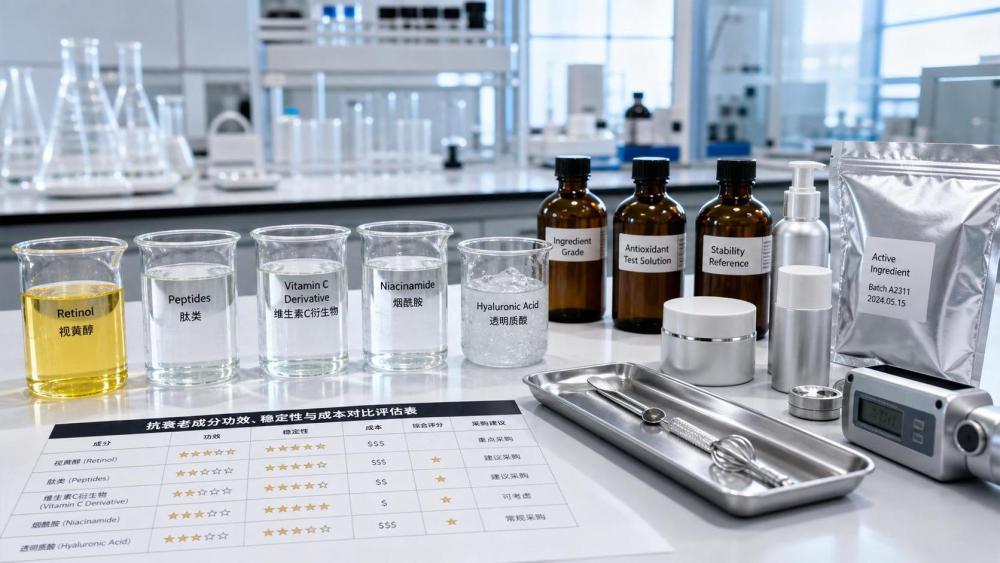
For procurement teams evaluating anti-aging ingredients in 2026, performance claims alone are no longer enough.
Buyers now compare efficacy, formulation stability, regulatory fit, and total cost at the same time.
That shift matters because the anti-aging ingredients market is getting more crowded, more technical, and more expensive.
Some actives look impressive on paper, yet fail in real formulas.
Others deliver decent results, but only at usage levels that crush margin.
In practical sourcing, the best anti-aging ingredients are not always the most advanced ones.
They are the ingredients that balance proven skin benefits, stable manufacturing performance, and sustainable commercial returns.
This guide breaks down how to compare anti-aging ingredients with a sourcing and decision-making lens for 2026.
What Buyers Should Compare First
When reviewing anti-aging ingredients, start with three questions.
Does the active work, does it survive the formula, and does the cost make sense at launch scale?
This sounds simple, but many ingredient comparisons stop too early.
A supplier may highlight in vitro data, while avoiding difficult questions about oxidation, pH sensitivity, or color drift.
In 2026, a useful anti-aging ingredients review should cover these checkpoints.
- Clinical relevance, not just lab mechanism.
- Stability under heat, light, oxygen, and water exposure.
- Compatibility with emulsions, gels, and low-pH systems.
- Regulatory documentation for target markets.
- True cost at effective dosage, not cost per kilogram alone.
This is where sourcing becomes strategic rather than transactional.
Comparing Efficacy Across Core Anti-Aging Ingredients
Not all anti-aging ingredients target the same biological pathway.
That is why direct price comparison often misleads sourcing teams.
Retinoids
Retinoids remain benchmark anti-aging ingredients for wrinkles, texture, and cell turnover.
They often show strong efficacy, but irritation risk and stability issues remain major tradeoffs.
Encapsulated retinol and hydroxypinacolone retinoate gain attention because they improve user tolerance and shelf performance.
Peptides
Peptides are popular anti-aging ingredients for firming, repair, and barrier support.
However, efficacy varies widely by sequence, delivery system, and concentration.
A premium peptide with weak penetration may underperform a simpler active with better formulation fit.
Vitamin C Derivatives
Vitamin C remains a core choice among anti-aging ingredients for brightness and antioxidant defense.
Pure ascorbic acid delivers strong performance, but it is notoriously unstable.
Derivatives such as 3-O-ethyl ascorbic acid or MAP trade some potency for easier formulation control.
Niacinamide and Support Actives
Niacinamide is one of the most versatile anti-aging ingredients in mass and masstige formulas.
It supports barrier function, tone evenness, and fine-line improvement with relatively low risk.
In value-focused portfolios, it often delivers the best efficacy-to-cost ratio.
Hyaluronic Acid and Biotech Polymers
These anti-aging ingredients mainly improve hydration, plumping, and sensory appeal.
They do not replace deeper remodeling actives, but they can improve visible results fast.
That makes them commercially useful in claims-driven launches.
Why Stability Decides Real-World Value
Efficacy without stability is a hidden sourcing risk.
This is especially true for anti-aging ingredients used in transparent serums, air-exposed jars, or warm-fill processes.
From recent market shifts, a clearer signal is emerging.
Brands now ask suppliers for accelerated stability data much earlier in the selection cycle.
For anti-aging ingredients, stability review should include the following.
- Sensitivity to oxygen and metal ions.
- Performance across target pH range.
- Color and odor changes over time.
- Interaction with preservatives and fragrances.
- Need for encapsulation, chelators, or special packaging.
A cheaper active can become expensive if it forces formula redesign or shortens shelf life.
This also affects production yield, complaint risk, and retailer confidence.
How to Evaluate Cost Beyond Price per Kilogram
In anti-aging ingredients sourcing, headline price is only the starting point.
The smarter metric is cost at effective use level.
For example, a low-cost ingredient at 5% dosage may be less profitable than a premium active at 0.3%.
In actual business decisions, total cost should include five layers.
- Ingredient cost at recommended and tested dosage.
- Extra stabilizers or delivery technologies required.
- Packaging upgrades such as airless pumps or opaque bottles.
- Quality documentation and compliance support.
- Supply security, lead time, and MOQ flexibility.
This broader view helps compare anti-aging ingredients across premium, mid-market, and entry-level product strategies.
A Practical Comparison Table for 2026
The table below gives a simplified sourcing view of major anti-aging ingredients.
This table is not a substitute for formulation testing.
Still, it helps narrow anti-aging ingredients before investing in full development.
Supplier Questions That Prevent Costly Mistakes
Supplier screening is where many hidden risks surface.
A polished brochure does not guarantee reliable anti-aging ingredients.
Ask direct questions early.
- What is the minimum effective concentration in finished formula testing?
- Which pH and temperature limits are validated?
- What stability data exists for six and twelve months?
- Are there region-specific compliance files for EU, US, and Asia?
- How many manufacturing sites support this material?
- What is the contingency plan for raw material disruption?
These questions sharpen comparison across anti-aging ingredients and suppliers at the same time.
How to Build a Smarter 2026 Selection Strategy
A strong anti-aging ingredients strategy usually mixes hero actives with dependable support materials.
That approach protects both claims and margin.
For example, one high-impact retinoid may be paired with niacinamide, hyaluronic acid, and a barrier-support peptide.
The result is often better commercial balance than chasing several expensive actives at once.
In 2026, the most resilient anti-aging ingredients programs will follow four habits.
- Prioritize evidence that matches intended claims.
- Model cost using actual formula dosage.
- Test stability before marketing direction is finalized.
- Keep backup suppliers for strategic actives.
This also means working closely with technical and compliance teams from the start.
When efficacy, stability, and cost are reviewed together, anti-aging ingredients become easier to rank objectively.
That is the real advantage in a market where premium claims face tighter scrutiny.
The best next move is simple.
Build a shortlist of anti-aging ingredients using one shared scorecard, then validate each option against formula fit, compliance readiness, and full landed value.
Related News
- Can biomimetic peptides in cosmetics reduce the look of wrinkles?Oct 17, 2026Cosmeceutical Formulator
- How to assess recombinant collagen ingredients for cream stabilityOct 02, 2026Cosmeceutical Formulator
- How to assess an anti-aging ingredients manufacturer’s batch consistencySep 17, 2026Cosmeceutical Formulator
- How to verify cosmetic peptide delivery compliance before launchAug 30, 2026Cosmeceutical Formulator
Related News
- 00
0000-00
Can biomimetic peptides in cosmetics reduce the look of wrinkles? - 00
0000-00
How to assess a bio-based thickener manufacturer's batch consistency - 00
0000-00
Verifying halal status of hydrocolloid ingredients in the Middle East - 00
0000-00
How to interpret active matter on a surfactant specification sheet - 00
0000-00
How Do You Test Hydrocolloid Viscosity After Changing a Thickener?
Cosmeceutical Formulator
Weekly Insights
Stay ahead with our curated technology reports delivered every Monday.