





Why does a bioactive peptides bulk order become a sourcing risk so quickly?
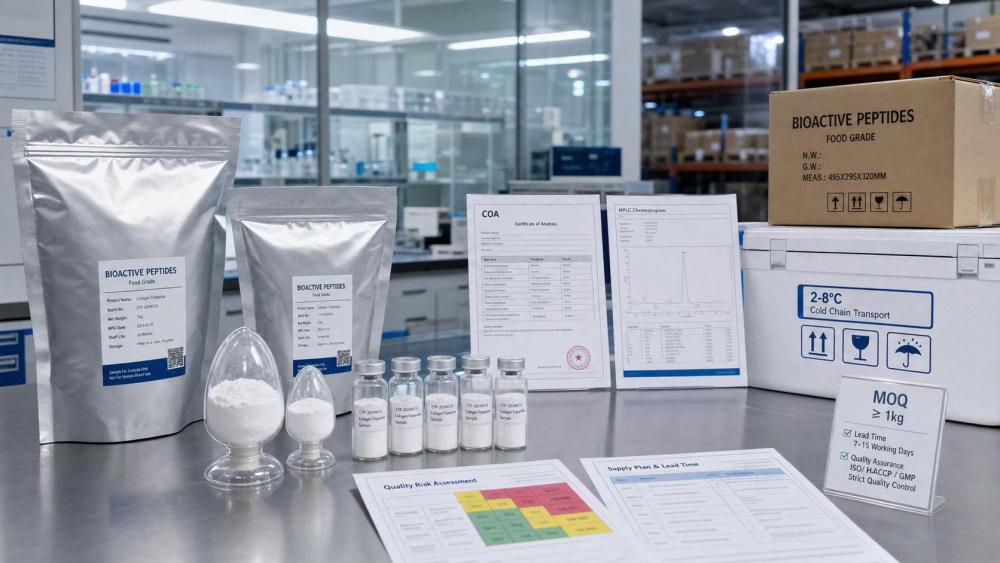
A bioactive peptides bulk order usually looks simple on paper. In practice, it sits at the intersection of chemistry, regulation, logistics, and claim support.
That matters even more in food, beauty, and health-related FMCG categories, where one ingredient can shape efficacy language, shelf stability, and pricing logic.
For peptide buyers, the real question is rarely just unit cost. The bigger issue is whether the supply model matches launch timing and downstream formulation risk.
A low quote can become expensive if the minimum order quantity is misaligned, the lead time slips, or purity varies from batch to batch.
This is where FFAI’s cross-category perspective becomes useful. The same discipline used to assess preservatives, flavor systems, and cosmetic actives also applies to peptides.
In other words, bulk peptide sourcing works best when commercial terms, technical files, and application fit are reviewed together rather than in separate conversations.
How should MOQ be judged beyond the number itself?
MOQ is often treated as a negotiation detail. A better approach is to read it as a signal of manufacturing logic and supplier flexibility.
For a bioactive peptides bulk order, MOQ may reflect reactor scale, purification loss, custom synthesis steps, or packaging constraints under controlled storage conditions.
A higher MOQ is not automatically negative. It may indicate a supplier is running standardized campaigns with tighter process control and more predictable quality output.
The problem appears when forecast demand is uncertain. Excess peptide inventory can create expiry pressure, cold-chain cost, and write-off risk.
More practical questions usually include these points:
- Is the MOQ tied to a standard grade or a custom sequence?
- Can production lots be split into staged deliveries?
- Does the MOQ include reserve stock for repeat orders?
- What storage life remains at shipment, not at manufacture?
In real sourcing decisions, the best MOQ is often the one that protects validation, launch timing, and inventory turnover at the same time.
What lead time should be considered realistic for a bioactive peptides bulk order?
Lead time is rarely one block of time. It is a chain of steps, and each step adds risk if expectations are vague.
For standard peptides, lead time may be manageable if raw materials, synthesis capacity, and analytical release windows are already reserved.
For custom or high-purity grades, the timeline can extend because purification, testing, and document review take longer than many quotations suggest.
A useful way to evaluate lead time is to break it into operational checkpoints rather than relying on one promised date.
When reviewing a bioactive peptides bulk order, realistic lead time means knowing which step can fail first, not just when the supplier says it should arrive.
Which quality risks deserve the closest attention before approval?
Purity is the headline number, but not the whole story. Two batches can both pass purity targets and still behave differently in formulation or stability testing.
For a bioactive peptides bulk order, the most important quality discussion usually includes identity confirmation, impurity profile, residual solvents, moisture, and microbiological suitability where relevant.
In cosmetic actives, documentation may also need to support safety files, traceability, and restricted substance review. In nutrition-related use, application standards may differ again.
That is why cross-functional review matters. FFAI’s intelligence model is built around this exact overlap between molecular performance, compliance logic, and commercial consequences.
Before confirming a large order, it helps to compare not only the certificate of analysis, but also the evidence behind it.
- Check whether the assay method is clearly stated, not implied.
- Ask if HPLC or LC-MS reference data can be shared by batch.
- Confirm how out-of-spec material is handled and documented.
- Review stability under the intended pH, solvent, and temperature range.
- Verify packaging that limits oxidation, moisture uptake, and transit stress.
The cost of weak quality control usually appears later, during formulation drift, claim review, delayed release, or reformulation work that could have been avoided earlier.
What documents separate a credible supplier from a risky one?
In peptide sourcing, paperwork is not administrative clutter. It is often the fastest way to see whether a supplier truly understands regulated commercial use.
A basic COA is necessary, but it rarely answers application-level questions on its own. Buyers usually need a wider documentation set.
Depending on use case, the file package may include TDS, SDS, manufacturing flow summary, allergen statements, residual solvent limits, origin statements, and storage guidance.
If the peptide supports cosmetic applications, additional data may be needed for safety assessment or regional notification work. That is especially relevant for export-driven brands.
The same logic applies across FFAI’s core sectors. Whether assessing antioxidants, thickeners, fragrances, or anti-aging actives, documentation quality predicts commercial reliability surprisingly well.
A simple decision screen can help:
Is the cheapest bioactive peptides bulk order ever the best commercial choice?
Usually not. The more useful comparison is total acquisition risk rather than quoted price per kilogram or gram.
A cheaper supplier may still cost more if extra testing, reformulation, delayed launch, or claim revision becomes necessary after receipt.
This is especially true for premium cosmetic actives, where peptide credibility can influence finished product positioning and margin logic.
In actual sourcing reviews, commercial value tends to come from four balances:
- Price versus acceptable MOQ exposure.
- Lead time versus launch or replenishment windows.
- Purity target versus real application performance.
- Documentation completeness versus compliance workload.
If one of those balances fails, the bioactive peptides bulk order may still close commercially, but the downstream operating burden becomes much heavier.
What should be clarified before placing the first large order?
The safest first step is not asking for a better price. It is building a short approval checklist around application, timing, and evidence.
Start by defining whether the peptide is being used for efficacy positioning, formulation support, or both. That decision changes the level of proof needed.
Then confirm the order structure. A staged release, pilot lot, or reserved capacity agreement can sometimes reduce exposure better than a simple MOQ concession.
It also helps to request one aligned conversation covering technical, regulatory, and commercial points together. Fragmented review often hides the real risk.
For teams tracking ingredients across food preservation, sensory systems, and high-end beauty actives, this integrated method is increasingly standard rather than optional.
Before moving ahead with a bioactive peptides bulk order, clarify these final points:
- Approved specification range and test method.
- Manufacturing and release timeline by stage.
- Shelf life remaining upon arrival.
- Documentation package needed for the target market.
- Corrective action path if a batch fails internal review.
That creates a more defensible purchasing decision and reduces surprises after the contract is signed.
A well-planned bioactive peptides bulk order is less about chasing the lowest figure, and more about matching MOQ, lead time, and quality evidence to actual business use.
The next practical move is to compare shortlisted suppliers against the same checklist, then test where assumptions on timing, purity, and documentation begin to diverge.
Related News
- Can biomimetic peptides in cosmetics reduce the look of wrinkles?Oct 17, 2026Cosmeceutical Formulator
- How to assess recombinant collagen ingredients for cream stabilityOct 02, 2026Cosmeceutical Formulator
- How to assess an anti-aging ingredients manufacturer’s batch consistencySep 17, 2026Cosmeceutical Formulator
- How to verify cosmetic peptide delivery compliance before launchAug 30, 2026Cosmeceutical Formulator
Related News
- 00
0000-00
Can biomimetic peptides in cosmetics reduce the look of wrinkles? - 00
0000-00
How to assess a bio-based thickener manufacturer's batch consistency - 00
0000-00
Verifying halal status of hydrocolloid ingredients in the Middle East - 00
0000-00
How to interpret active matter on a surfactant specification sheet - 00
0000-00
How Do You Test Hydrocolloid Viscosity After Changing a Thickener?
Cosmeceutical Formulator
Weekly Insights
Stay ahead with our curated technology reports delivered every Monday.