





Bioactive Peptides Price per Kg in 2026: why the quote rarely tells the full story
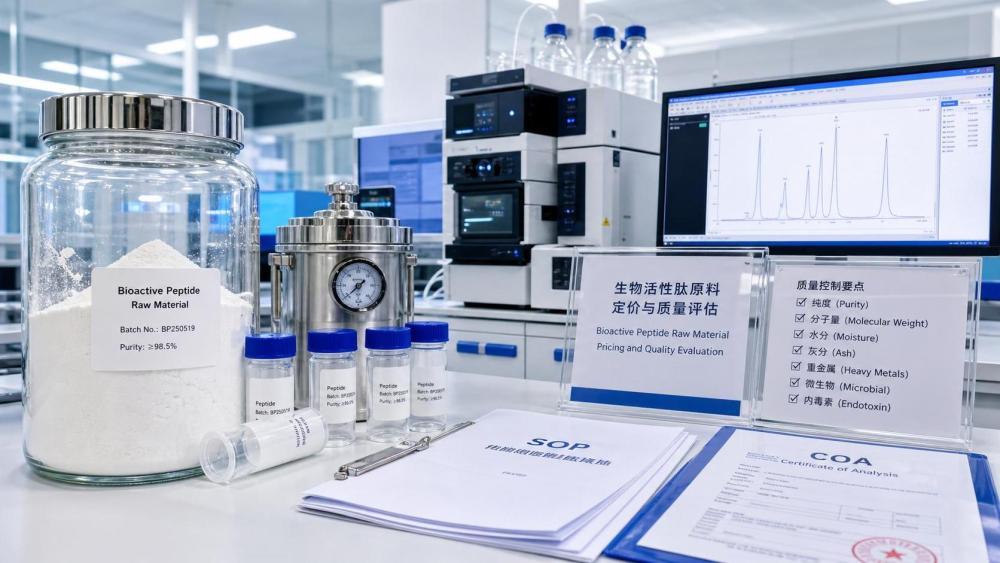
When teams compare the bioactive peptides price per kg, the visible number is only the starting point.
In 2026, peptide sourcing is shaped by purity, process control, documentation, and intended use.
That matters across food, beauty, wellness, and premium FMCG formulations, where functional ingredients must perform, remain stable, and pass scrutiny.
FFAI follows this market from a practical angle.
Its research focus on food protection, sensory chemistry, and cosmetic actives makes peptide pricing easier to read in real business terms.
So the real question is not, “What is the cheapest peptide?”
A better question is, “What exactly is included in this bioactive peptides price per kg, and what risks sit behind it?”
What does bioactive peptides price per kg actually include?
A peptide quote usually combines far more than raw amino acid cost.
It may include synthesis losses, purification yield, testing, packaging, cold-chain handling, and compliance support.
Short peptides with simple sequences can look affordable at first glance.
Once stricter purity targets or cosmetic-grade documentation are added, the bioactive peptides price per kg can move sharply upward.
In practical sourcing, three quotes for the same INCI or functional claim may describe very different materials.
- One may be research-grade only.
- One may be suitable for topical finished goods.
- One may carry broader quality files and better batch consistency.
That is why comparing price without specification alignment often creates false savings.
More common in 2026 is a total-cost review, not a list-price review.
A quick comparison checklist before reading any quote
Why are some peptide prices several times higher than others?
The biggest driver is production route.
Solid-phase synthesis, recombinant production, enzymatic hydrolysis, and downstream purification do not create the same economics.
A highly defined anti-aging peptide with sequence verification is priced very differently from a broader peptide fraction.
This is especially relevant in the high-end cosmetic actives market, where efficacy claims and skin delivery narratives influence value.
FFAI often tracks this logic across premium ingredients.
The same pattern appears in flavors, preservatives, and specialty thickeners.
The more precise the function and cleaner the dossier, the less likely the ingredient is to behave like a bulk commodity.
Cost drivers that usually create the widest spread
- Protected or modified amino acids with higher upstream cost.
- Low-yield synthesis steps that increase scrap and solvent use.
- Tighter residual solvent and heavy metal limits.
- Freeze-drying, special carriers, or encapsulation.
- Clinical, stability, or compatibility data used to support formulation decisions.
So if one supplier shows a very low bioactive peptides price per kg, the first check should be definition, not negotiation.
How do application and compliance change the final cost?
Application decides the burden of proof.
A peptide intended for a prestige serum needs a different support package than one used for early R&D screening.
The same applies when food-adjacent, nutraceutical, or export-sensitive uses are under review.
In 2026, regulatory readiness is no longer a side issue.
It is one reason the bioactive peptides price per kg may differ even when chemistry appears similar.
Need to register a cosmetic product in Europe?
Need cleaner toxicology support for North America or Asia?
Those requirements influence supplier choice, lead time, and the real landed cost.
This is where FFAI’s compliance intelligence becomes useful.
Its reading of FDA, GRAS-related pathways, and European cosmetic documentation helps separate usable quotes from risky ones.
A lower price can become expensive when these items are missing
- No clear specification for assay and purity method.
- No batch-to-batch consistency data.
- No support for restricted substances review.
- Unclear storage and transport conditions.
- Incomplete documents for customer audits or product file preparation.
What price signals suggest value, and which ones suggest risk?
Not every premium quote is justified.
Not every cheap quote is dangerous either.
The more reliable approach is to read price through four lenses: chemistry, evidence, continuity, and fit.
Chemistry asks whether the sequence and purity really match the target use.
Evidence asks whether claims are backed by meaningful testing.
Continuity asks whether the supplier can repeat the same quality next quarter.
Fit asks whether the peptide works in the actual formula, not only in an isolated brochure claim.
Useful price-reading signals in 2026
How should buyers compare suppliers without oversimplifying the cost?
A workable approach is to build a short scoring sheet before requesting final offers.
That prevents the bioactive peptides price per kg from dominating decisions that are really about risk-adjusted value.
In actual sourcing rounds, the best comparison framework usually includes commercial and technical points together.
- Sequence identity and purity verification.
- Functional fit with the intended formula or finished product.
- Compliance package for destination markets.
- MOQ, annual capacity, and supply resilience.
- Lead time under normal and urgent conditions.
- Total delivered cost, including storage and freight controls.
This broader view is common across the ingredient categories FFAI tracks.
Whether the material is a preservative, fragrance molecule, rheology aid, or peptide active, value depends on both performance and business reliability.
A supplier that saves two percent on paper but causes reformulation, delay, or compliance gaps rarely saves money at all.
So, what is the smartest next step before locking a 2026 peptide contract?
Start by defining the application boundary in writing.
Then align sequence, purity, dosage form, and market compliance needs before asking for the final bioactive peptides price per kg.
It also helps to request one recent COA, one stability summary, and one document list upfront.
Those three items often reveal more than a polished sales deck.
In 2026, the strongest sourcing decisions will come from connecting molecular detail with commercial discipline.
That is exactly the space where ingredient intelligence matters.
If a quote looks unusually low or unusually high, pause and decode the structure behind it.
The better question is never only price per kilogram.
It is whether the peptide can support performance, safety, continuity, and margin at the same time.
Related News
- How to assess recombinant collagen ingredients for cream stabilityOct 02, 2026Cosmeceutical Formulator
- How to assess an anti-aging ingredients manufacturer’s batch consistencySep 17, 2026Cosmeceutical Formulator
- How to verify cosmetic peptide delivery compliance before launchAug 30, 2026Cosmeceutical Formulator
- When do biomimetic actives in North America justify a premium in anti-aging formulasAug 25, 2026Cosmeceutical Formulator
Related News
- 00
0000-00
How to assess color stability from a natural food colors manufacturer - 00
0000-00
When does amino acid surfactant powder improve cleanser mildness? - 00
0000-00
How to verify a cosmetic nanotechnology supplier's safety documentation - 00
0000-00
How rheological thickeners for shampoo affect suspension stability - 00
0000-00
How to assess recombinant collagen ingredients for cream stability
Cosmeceutical Formulator
Weekly Insights
Stay ahead with our curated technology reports delivered every Monday.