





Bioactive Peptides for Skin Regeneration: What to Compare Before Supplier Approval
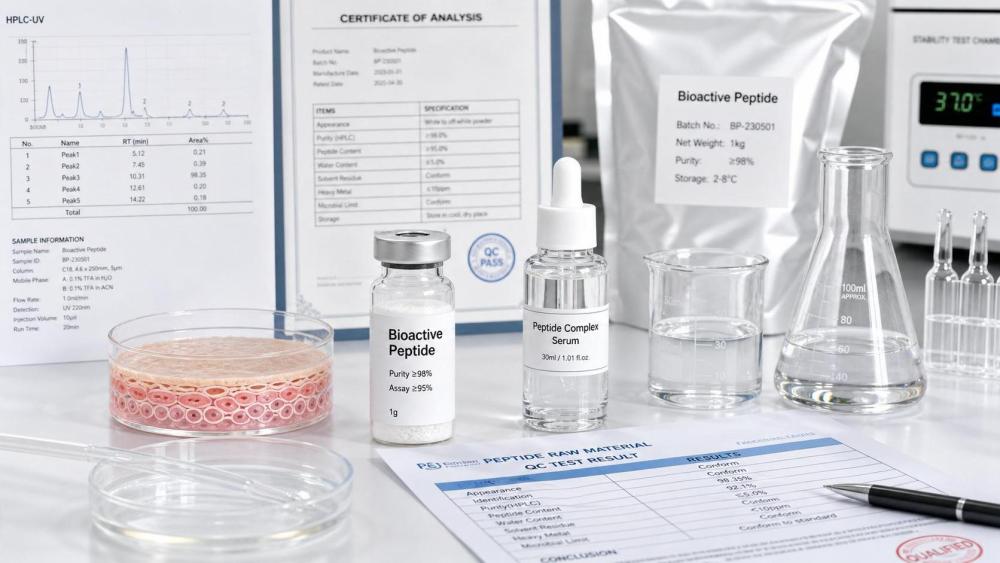
When evaluating bioactive peptides for skin regeneration, attractive claims are never enough.
A strong sourcing decision depends on proof, stability, compliance, and supply confidence.
In practice, bioactive peptides for skin regeneration sit at the intersection of science and purchasing risk.
That also means supplier approval should go beyond sample performance or a polished presentation.
A peptide may look promising on paper, yet fail under formulation stress or commercial scaling.
For skin repair, anti-aging, and barrier-support products, comparison discipline protects both margin and brand credibility.
The most reliable approach is to compare five areas together: purity, efficacy, compatibility, regulatory support, and supply reliability.
Once these are reviewed side by side, bioactive peptides for skin regeneration become easier to rank on total value.
Start with peptide identity and purity
The first question is simple: are you buying the exact peptide claimed in the specification?
For bioactive peptides for skin regeneration, identity errors create downstream formulation and efficacy problems very quickly.
Ask for molecular identity confirmation, sequence details, purity method, and batch-level consistency records.
High purity sounds impressive, but the method behind the number matters just as much.
HPLC data, impurity profiles, residual solvent information, and moisture limits should all be visible.
This matters because two suppliers may both claim 98% purity while delivering very different impurity risks.
In anti-aging formulas, low-level impurities can affect odor, color stability, and even preservative performance.
It is also worth checking whether the peptide is synthetic, recombinant, or part of a delivery complex.
That distinction changes cost, positioning, and the comparability of bioactive peptides for skin regeneration across vendors.
Useful comparison points
- Declared INCI name and peptide sequence
- Purity percentage and test method
- Impurity spectrum and residual solvents
- Batch-to-batch variation limits
- Storage conditions and shelf life
Compare efficacy data, not marketing language
This is where many sourcing decisions become risky.
Marketing claims often describe skin renewal, collagen support, wrinkle reduction, or regeneration in broad terms.
But bioactive peptides for skin regeneration should be compared using evidence depth, not adjective strength.
Start by asking what level of evidence supports the peptide.
Cell data can be useful, but it should not be treated the same as ex vivo or human data.
A supplier offering clinical or instrumental studies usually provides a stronger approval basis.
It also helps to review test concentration, application period, panel size, and placebo control design.
Without that context, efficacy data for bioactive peptides for skin regeneration can look stronger than it really is.
A more practical question is whether the peptide supports the exact product claim you plan to make.
For example, barrier recovery, firmness, post-procedure repair, and fine line reduction require different evidence pathways.
What strong efficacy files usually include
- Mechanism data linked to fibroblasts, collagen, elastin, or barrier markers
- Dose-response information at cosmetic use levels
- Human or ex vivo studies with clear endpoints
- Claim language aligned with actual results
- Reasonable comparison against benchmark actives
Check formulation compatibility early
Even high-performing peptides can disappoint if they are difficult to formulate.
This is especially true for bioactive peptides for skin regeneration used in multi-active anti-aging systems.
Ask suppliers how the peptide behaves across pH ranges, temperatures, solvents, and emulsification conditions.
Some peptides lose activity under heat stress.
Others struggle in formulas containing acids, high electrolytes, or certain preservation systems.
From a purchasing perspective, poor compatibility increases hidden cost.
It can trigger reformulation work, extra stability cycles, delayed launch timing, or higher usage rates.
That is why bioactive peptides for skin regeneration should be reviewed together with prototype guidance.
A supplier that shares use recommendations, incompatibility alerts, and formulation examples often reduces development risk significantly.
Questions worth asking
- What is the recommended pH window?
- Can the peptide tolerate hot process manufacturing?
- Does it interact with retinoids, acids, niacinamide, or vitamin C?
- Is it supplied in powder, solution, or encapsulated form?
- What dosage range gives commercial performance?
Review regulatory and safety support in detail
Regulatory confidence is not a side topic.
For bioactive peptides for skin regeneration, it directly affects approval speed and cross-market scalability.
A supplier should provide more than a basic specification sheet.
Look for SDS, TDS, allergen statements, residual solvent disclosure, origin statements, and microbiological controls.
Depending on the market, additional support may include cosmetic regulatory status, CPNP-related documentation, or claim substantiation files.
Safety packages should also be proportionate to the intended use level and product category.
For leave-on skincare, the standard is naturally higher than for rinse-off exposure.
This becomes even more important when bioactive peptides for skin regeneration are positioned for sensitive or post-treatment skin.
If documentation arrives slowly or inconsistently, that often signals future compliance friction.
Measure supply reliability and true landed cost
A peptide is only valuable if it remains available at the required quality and timeline.
That is why bioactive peptides for skin regeneration should never be selected on price per kilogram alone.
Lead times, minimum order quantities, cold-chain needs, packaging protection, and forecast flexibility all affect actual cost.
A cheaper source can become expensive when shipments are delayed or batches fail incoming QC.
It helps to compare primary and backup manufacturing sites, historical service performance, and inventory policies.
More buyers now also look at capacity expansion plans.
That is a practical response to rising demand for science-backed anti-aging actives.
For bioactive peptides for skin regeneration, long-term reliability often matters more than the lowest initial quote.
A simple supplier comparison table
Build approval around commercial fit, not isolated data
The strongest supplier is not always the one with the most impressive brochure.
The better choice is usually the supplier whose peptide performs across technical, regulatory, and commercial realities.
For bioactive peptides for skin regeneration, approval works best when each vendor is scored on the same framework.
That framework should combine efficacy relevance, formula usability, risk exposure, and cost of ownership.
In real purchasing work, this prevents overpaying for unsupported claims or underbuying from unstable sources.
It also creates clearer internal alignment between R&D, regulatory, and sourcing teams.
As the skincare market moves toward higher-performance actives, smarter comparison becomes a competitive advantage.
Bioactive peptides for skin regeneration can deliver real value, but only when the supplier behind them is equally robust.
A practical next step is to create a short approval checklist and score two or three suppliers side by side.
That simple exercise often reveals the gap between a promising sample and a reliable business partner.
Related News
- How to assess recombinant collagen ingredients for cream stabilityOct 02, 2026Cosmeceutical Formulator
- How to assess an anti-aging ingredients manufacturer’s batch consistencySep 17, 2026Cosmeceutical Formulator
- How to verify cosmetic peptide delivery compliance before launchAug 30, 2026Cosmeceutical Formulator
- When do biomimetic actives in North America justify a premium in anti-aging formulasAug 25, 2026Cosmeceutical Formulator
Related News
- 00
0000-00
What drives fragrance ingredients price changes in bulk orders? - 00
0000-00
How to assess a food antioxidants distributor’s traceability practices - 00
0000-00
How minimum order quantities shape private label ingredient sourcing costs - 00
0000-00
What drives personal care ingredient price volatility in sourcing - 00
0000-00
What drives micelles price differences in cosmetic formulations?
Cosmeceutical Formulator
Weekly Insights
Stay ahead with our curated technology reports delivered every Monday.