





Yes—some biomimetic peptides in cosmetics may reduce the appearance of fine lines and wrinkles, but improvements are usually modest and depend on the specific peptide and finished formula. A serum that makes dry, creased skin look smoother is not necessarily rebuilding collagen, and a product described as “Botox-like” should not be expected to reproduce an injectable treatment.
When fine lines remain visible after moisturizing, a peptide serum can seem like a reasonable next step. The challenge is deciding whether its price reflects useful evidence or persuasive packaging. Before buying, identify the kind of lines you want to address, check what the formula has actually been tested to do, and decide whether a peptide adds anything to your existing routine.
Start with the lines you see, not the ingredient trend
Wrinkles do not all respond to the same approach. Dehydration can exaggerate fine surface lines, repeated facial movement produces expression lines, and cumulative sun exposure contributes to more persistent changes in texture and firmness. These causes often overlap, but the dominant problem affects what you should buy.
Try assessing your skin after several days of consistent, comfortable moisturization. Lines that become much less noticeable may not require another active ingredient. Persistent lines are a more useful target for evaluating a longer-term treatment, although no mirror assessment can establish their exact cause.
What “biomimetic” means—and what it does not prove
Peptides are short chains of amino acids. In cosmetics, “biomimetic” generally describes ingredients designed to imitate an aspect of naturally occurring biological activity, such as a signaling sequence. The term does not identify one standardized ingredient, one mechanism, or a guaranteed level of effectiveness.
The science behind peptide cosmetic biomimetics often begins with an appealing idea: use a small molecular signal to influence processes associated with skin maintenance. That idea must survive several practical hurdles. The peptide needs to remain stable in the container, be released from the formula, reach a relevant location in skin, and retain activity at the delivered concentration.
An effect in cultured cells is not proof that a face cream will visibly reduce wrinkles. Cells in a laboratory may receive direct exposure that does not resemble application to intact skin. The outer skin barrier restricts penetration, and peptide size, charge, solubility, and formulation all affect delivery. Surface benefits, including hydration, can still be useful without deep penetration, but they do not establish a deeper biological mechanism.
Likewise, adding a fatty chain to a peptide or placing it in a delivery system may improve certain formulation or delivery properties. Neither feature, on its own, proves that the finished product produces a meaningful wrinkle benefit.
Peptide names worth recognizing on the label
You do not need to memorize every ingredient name. Understanding a few categories helps you interpret claims without assuming all peptides do the same job.
Signal peptides
Ingredients such as palmitoyl pentapeptide-4 and palmitoyl tripeptide-1 are commonly used in formulas targeting visible aging. Their rationale involves signaling associated with extracellular matrix maintenance, including collagen-related processes. Some have human cosmetic study support, but the evidence varies by ingredient and formula. Their presence on a label does not establish how much reaches the skin or what result you will see.
Peptides marketed for expression lines
Acetyl hexapeptide-8 is a familiar example. Products containing it are sometimes described as “Botox-like” because of their proposed effects on processes involved in neurotransmitter release. That comparison can create unrealistic expectations. A topical cosmetic has different delivery, targeting, and evidence from an injected prescription treatment; it should not be selected as an equivalent substitute.
Copper-binding peptides
Copper tripeptide-1 belongs to a category often discussed in relation to skin repair and remodeling. This biological rationale does not mean every copper-peptide serum has demonstrated wrinkle reduction. Evaluate the finished formula and its tolerability rather than treating copper content as a quality ranking.
Hydrolyzed proteins and other peptide-containing ingredients may instead contribute mainly to conditioning, film formation, or moisture retention. These functions can improve appearance, but they are different from demonstrating a biomimetic anti-wrinkle effect.
Read the evidence before paying for the claim
The most useful evidence concerns the finished product used as directed, not simply an ingredient that appears somewhere in its formula. A supplier study can support an ingredient’s potential, but differences in concentration, vehicle, stability, and application can limit how directly its findings apply to another product.
When a product page mentions a clinical study, look for answers to these questions:
- Was the study conducted on people? Laboratory and reconstructed-skin tests can support a mechanism, but they do not directly measure visible improvement on users.
- What was the comparison? A vehicle-controlled study helps separate an active ingredient’s contribution from the moisturizing base. Before-and-after photographs alone cannot do this.
- What outcome was measured? Instrumental wrinkle measurements, standardized photography, and blinded assessments answer different questions from participant satisfaction.
- How long did testing last? An immediate smoothing result is more consistent with hydration or film formation than newly produced dermal collagen.
- How much information is available? Participant numbers, skin characteristics, study duration, and adverse effects help put a headline claim in context.
Independent replication and transparent methods strengthen confidence. Small, short, manufacturer-sponsored studies can offer useful preliminary information, but should not carry the same weight as a consistent body of well-controlled research.
Be especially careful with percentages. “Most users felt smoother skin” is not the same as a measured reduction in wrinkle depth. A large relative improvement also tells you little about visible importance unless the original measurement and comparison are clear. “Clinically tested” alone does not answer these questions.
Choosing between two peptide products
Once the evidence looks plausible, the base formula often determines whether a product is worth using. A technically interesting peptide in a sticky, irritating serum is unlikely to be a good purchase if you avoid applying it.
For dry skin: prioritize a comfortable cream with humectants and barrier-supporting ingredients. Glycerin, ceramides, and suitable emollients may improve the appearance of dryness-related lines. A separate peptide serum is optional when a moisturizer already delivers the texture and actives you want.
For oily or congestion-prone skin: choose a lighter texture that works under sunscreen. Peptides are not inherently a guarantee against breakouts; the complete formula matters. Introduce the product without adding other new products simultaneously so that any reaction is easier to trace.
For sensitive skin: fragrance-free formulas with fewer potential irritants are often a sensible starting point. Peptides may be well tolerated, but preservatives, fragrance, botanical extracts, or other actives can still cause irritation. “Biomimetic” and “natural” do not mean allergy-proof.
Do not rank products solely by a prominent peptide percentage. The number may describe a diluted supplier blend rather than the amount of pure peptide. Ingredient-list position is also an imperfect guide because peptides may be used at low levels, and labeling rules do not let you calculate their concentration reliably.
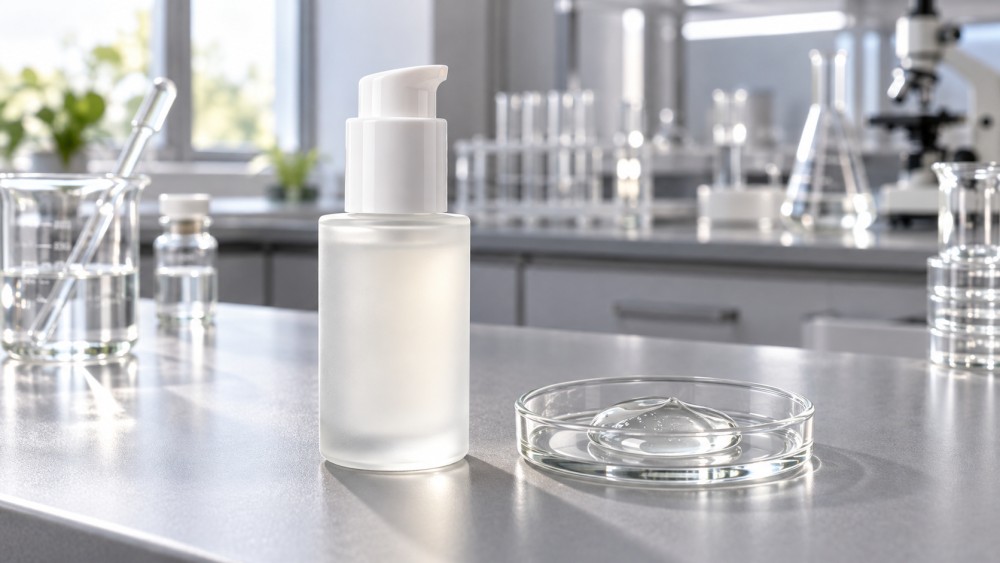
Packaging is another consideration, not a verdict. A well-designed pump or protective container may reduce repeated exposure to air or contamination, but suitability depends on the formula. Packaging cannot replace stability testing, and a luxury bottle does not demonstrate efficacy.
Give the formula a fair trial without changing everything else
Start from a stable routine: gentle cleansing, adequate moisturization, and daily broad-spectrum sunscreen. Sun protection addresses an ongoing cause of visible aging; a peptide serum does not cancel out ultraviolet exposure. Retinoids generally have stronger evidence for photoaging than cosmetic peptides, although irritation and individual circumstances can limit their use.
- Test a small area first. Apply according to the label and watch for irritation over several days. A home spot test cannot rule out every delayed reaction, but it can reveal obvious intolerance before wider use.
- Add only one new product. Keep your cleanser, moisturizer, and other actives unchanged where practical. Otherwise, improvement or irritation becomes difficult to attribute.
- Follow the product’s application directions. Serums commonly go before heavier creams, but texture and manufacturer instructions matter more than a rigid universal order.
- Assess over weeks rather than days. An evaluation around eight to twelve weeks can be practical, though it is not a guaranteed response window and product-specific study timelines may differ.
- Compare under consistent conditions. Use similar lighting, facial expression, camera distance, and time after moisturizing. Keep unfiltered baseline photographs rather than relying on memory.
Separate immediate softness from sustained changes in visible lines. A product can be a successful moisturizer without proving a peptide-specific benefit. Conversely, a subtle improvement may be difficult to judge when lighting and facial expression vary between photographs.
There is no universal rule that all peptides must be separated from vitamin C, retinoids, or exfoliating acids. Compatibility depends on the peptide, pH, formulation, and your skin’s tolerance. Avoid mixing products together in your hand unless directed, and follow specific restrictions from the manufacturer. When irritation occurs, simplifying the routine is more useful than adding another corrective serum.
When a peptide serum is worth buying—and when to pass
A peptide product is a reasonable optional purchase when your basic routine is established, you want a potentially modest improvement in fine lines, and the formula is comfortable and affordable to maintain. Product-specific human evidence makes the decision stronger. A pleasant moisturizer containing peptides can also make sense without requiring an elaborate anti-aging routine.
Pass when the sale depends on promises of muscle paralysis, permanent wrinkle removal, guaranteed collagen rebuilding, or delivery claims unsupported by relevant testing. An expensive multi-peptide blend is not automatically better than a simpler formula, and adding more peptide products has not been established as a reliable way to multiply results.
Stop using a product that causes persistent burning, redness, swelling, or worsening dermatitis. Seek medical advice for significant or ongoing reactions. For deep wrinkles or structural changes that topical care cannot meaningfully address, a qualified dermatologist can explain treatment options and their risks. If a consistent, well-tolerated trial produces no worthwhile visible benefit, there is no need to keep repurchasing solely because the ingredient story sounds convincing.
Related News
- How to choose peptide ingredients for an anti-aging serumNov 06, 2026Cosmeceutical Formulator
- How to assess European bioactive peptide suppliers for batch consistencyOct 29, 2026Cosmeceutical Formulator
- How biomimetic peptides work in anti-aging skincare formulationsOct 27, 2026Cosmeceutical Formulator
- HKBU Showcases DR2 Following NMPA Registration as a New Cosmetic IngredientOct 25, 2026Cosmeceutical Formulator
Related News
- 00
0000-00
China Records 543 New Cosmetic Ingredients, Including 167 in 2026 - 00
0000-00
How to check a fragrance raw material specification for IFRA compliance - 00
0000-00
Australia and New Zealand Weigh Wider Steviol Glycoside Use in Griddle Products - 00
0000-00
How does pH affect plant-based color ingredients in beverages? - 00
0000-00
China Announces Risk-Based Cosmetic Change Reviews and Shorter Timelines
Cosmeceutical Formulator
Weekly Insights
Stay ahead with our curated technology reports delivered every Monday.