





Before cosmetic peptides move from bench work to pilot or commercial output, the real question is not whether the peptide works in vitro. It is whether the molecule remains stable enough to survive formulation, processing, storage, transport, and end use.
For project managers and engineering leads, this is a budget, timeline, and claim-risk issue as much as a formulation issue. A peptide that degrades under heat, drifts in acidic pH, or adsorbs into packaging can derail launch plans after major spending.
In practice, the core search intent behind “cosmetic peptides” and scale-up stability is highly actionable. Readers want to know which pre-scale checks matter most, how to prioritize them, and how to avoid finding fatal instability only after pilot investment.
This guide focuses on the stability checks that support commercial decision-making. Rather than restating peptide basics, it shows how to evaluate thermal, pH, oxidative, process, microbiological, and packaging risks before scale-up locks in unnecessary cost.
What project leaders really need to confirm before scaling cosmetic peptides
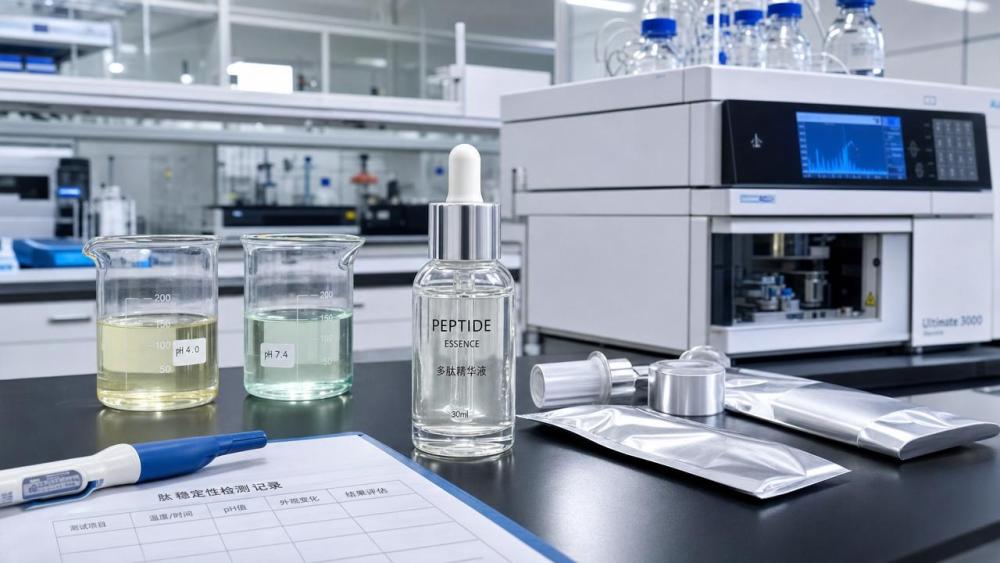
The most important decision is whether the peptide is scale-ready in its intended formula system, not whether it is generally “stable.” Stability is always conditional: concentration, solvent system, pH, excipients, oxygen exposure, filling temperature, and pack type all change the result.
For management teams, the practical objective is to answer five questions early. Will the peptide retain potency through shelf life? Can it tolerate manufacturing conditions? Does the full formula protect or harm it? Can packaging preserve it? Are the claims still defensible at release and at end of life?
If those questions are not resolved before pilot production, teams often face rework in preservative strategy, pH adjustment, mixing order, packaging redesign, or even active replacement. That is why pre-scale stability work is one of the highest-value checkpoints in peptide program governance.
Why cosmetic peptides are unusually sensitive during scale-up
Many cosmetic peptides are structurally elegant but operationally fragile. Compared with simpler cosmetic actives, they can be more vulnerable to hydrolysis, oxidation, deamidation, aggregation, adsorption, or interaction with metal ions and reactive formulation ingredients.
Scale-up increases these risks because the process environment becomes less controlled than the lab. Hold times get longer, vessels expose larger surface areas, shear profiles change, heating and cooling become less uniform, and raw-material variability becomes more visible.
Even when a peptide looks stable in a benchtop serum over a few weeks, production realities can trigger different outcomes. A larger batch may hold at elevated temperature for longer. Transfer lines may introduce oxygen. A different water quality profile may shift degradation kinetics.
This is why scale-up teams should treat peptide stability as a system property, not just an ingredient specification. The peptide, formula, process, packaging, and storage pathway all need to be tested together before commercialization confidence is justified.
The highest-priority stability checks before pilot or commercial production
Not every study deserves equal effort. For project leaders, the best approach is to focus first on the checks most likely to create launch delays, claim weakness, or reformulation cost. In most peptide programs, four checks drive the decision fastest.
First is assay retention of the active peptide over time using a fit-for-purpose analytical method, typically HPLC or LC-based testing. If you cannot measure peptide content and key degradants reliably, every later stability conclusion becomes weaker.
Second is pH stress mapping. Many cosmetic peptides perform acceptably only within a relatively narrow pH window. Testing across the realistic formulation range helps teams identify whether instability is inherent to the active or caused by the chosen product architecture.
Third is thermal exposure testing. This includes both storage heat and process heat. A peptide may remain stable at room temperature but degrade during hot emulsification, bulk holding, or accelerated storage. Short, realistic process simulations are often more useful than generic heat screens.
Fourth is compatibility screening with the full formula matrix. Preservatives, fragrances, botanical extracts, chelators, surfactants, and colorants can all change peptide behavior. Early compatibility testing reduces the chance of discovering hidden antagonism after pilot batches are filled.
How to assess heat and process stress without overtesting
Project teams often overfocus on long-term shelf studies and underfocus on process simulation. For engineering leads, the critical question is whether the peptide can survive actual manufacturing conditions, including mixing energy, deaeration, hold time, and fill temperature.
Start by mapping the real thermal journey of the formula. Record maximum exposure temperature, duration at each step, cooling profile, and time between peptide addition and final filling. Then design bench and pilot simulations around those specific stress points.
For example, if the peptide is added during cooldown at 40°C, but the batch remains in a tank for six hours before filling, that hold condition may be more damaging than a brief higher-temperature event. Stability studies should mirror operational reality, not idealized lab handling.
It is also useful to compare alternative addition strategies. Late-stage addition, concentrated side-stream dosing, nitrogen blanketing, or shortened transfer routes can materially improve peptide survival without requiring a total formula redesign.
pH, oxidation, and metal-ion control often decide success
In many cosmetic peptides programs, the most decisive failures come from pH drift and oxidation rather than headline process temperature. A formula that begins in the correct range may still drift during storage because of preservative systems, botanical components, or packaging interactions.
That makes pH stability a moving target. Teams should test not only the initial pH but also how the formula changes under accelerated and ambient conditions. A peptide that is safe at pH 5.8 may degrade much faster if the product migrates toward 4.8 or 6.5.
Oxidation is equally important, especially for peptides containing oxidation-prone residues. Oxygen ingress, headspace, light exposure, and trace metals can accelerate damage. Screening with chelators, oxygen-reducing process controls, and protective packaging can clarify feasible mitigation options.
Water quality should not be treated as a secondary variable. Metal ions, residual oxidants, and conductivity differences between development water and plant water can produce inconsistent results. If a peptide program looks unstable only after transfer, utility water is a common hidden factor.
Packaging compatibility is not a late-stage check
One costly mistake in cosmetic peptides development is leaving packaging assessment until artwork or procurement milestones are already advanced. Peptides can adsorb to container surfaces, react with closures, or lose protection because the pack allows too much oxygen or light exposure.
Airless systems, opaque packs, glass, multilayer plastics, and low-headspace fills can each improve outcomes, but they also affect cost, line speed, and customer experience. Packaging should therefore be evaluated as part of the active-stability strategy, not after formula approval.
Compatibility work should include assay retention in final pack, not just in bulk. Bulk may test well while filled units underperform because of headspace oxygen, pump exposure, wall adsorption, or repeated consumer-use simulation. This is especially relevant for premium peptide serums.
For project managers, the takeaway is simple: packaging is often a stability control tool. If the peptide requires protective packaging to maintain efficacy claims, that requirement needs to be visible in the business case from the beginning.
What data package supports a confident scale-up decision
A strong pre-scale data package should be decision-oriented, not just technically dense. Management teams need evidence that links molecular stability to manufacturing feasibility, shelf-life confidence, and claim protection. More data is not always better if it does not improve the go/no-go judgment.
At minimum, the package should include peptide assay trend data, degradant observations where relevant, pH drift results, accelerated and real-time stability snapshots, process simulation outcomes, formula compatibility findings, and packaging comparison results.
It should also identify operating limits. These limits may include maximum addition temperature, acceptable pH range, bulk hold time, oxygen-control requirements, compatible preservative systems, and recommended pack formats. Without explicit limits, transfer to operations becomes fragile.
Where possible, convert the technical findings into project language. For example: “Current formula is scaleable only with cold-process addition below 35°C and airless packaging” is more useful to stakeholders than a long list of isolated lab observations.
Common scale-up mistakes that create avoidable peptide failure
The first common error is assuming supplier stability data applies directly to the final formula. Supplier results are often generated in buffered systems or ideal storage conditions, not in the brand’s actual emulsion, gel, essence, or multi-active serum.
The second is adding the peptide too early in process development. Teams sometimes optimize texture or appearance first, then force the peptide into a process window that is already too harsh. For sensitive actives, process design should be built around stability constraints early.
The third is using accelerated testing without understanding degradation mechanisms. Heat-accelerated failure does not always predict ambient failure in the same way. If oxidation or pH drift is the true issue, simple elevated-temperature studies can mislead decision-makers.
The fourth is underestimating interactions with “supporting” ingredients. Fragrance systems, essential oils, plant extracts, surfactants, and preservation boosters may all affect cosmetic peptides unexpectedly. Compatibility screening is cheaper than post-pilot root-cause work.
How project managers can reduce cost and timeline risk
For non-laboratory leaders, the best contribution is to force clarity on decision gates. Before approving larger batches or packaging commitments, require explicit answers on analytical readiness, process tolerance, formula compatibility, and in-pack stability.
It also helps to rank risks by commercial impact. A small assay drop may be manageable if claims remain supported and overage is acceptable. But instability that forces premium packaging, refrigerated storage, or batch-time reduction may materially change product economics.
Cross-functional review is essential. R&D may focus on technical survival of the peptide, while operations focus on line practicality, quality focuses on release limits, procurement focuses on package availability, and marketing focuses on efficacy claims. Scale-up succeeds when these views align early.
Finally, build contingencies. If the lead peptide fails under realistic conditions, teams should know whether the fallback is a different concentration, a derivative, a lower-water system, an adjusted pH architecture, or a different product format altogether.
Final takeaway for cosmetic peptides before scale-up
For peptide-based cosmetics, stability is the commercial gatekeeper between promising lab efficacy and profitable launch. The right question is not whether cosmetic peptides are effective in theory, but whether they stay effective through the exact formula, process, package, and shelf-life pathway.
Project managers and engineering leads should prioritize a short list of decisive checks: quantitative assay retention, realistic process-heat simulation, pH and oxidation control, formula compatibility, and final-pack performance. These checks reveal most scale-up risks before they become expensive.
When done early, stability work protects more than the molecule. It protects development timelines, claim credibility, packaging decisions, and capital efficiency. In premium active categories, that makes pre-scale peptide stability testing not a technical formality, but a strategic management tool.
Related News
- How to assess recombinant collagen ingredients for cream stabilityOct 02, 2026Cosmeceutical Formulator
- How to assess an anti-aging ingredients manufacturer’s batch consistencySep 17, 2026Cosmeceutical Formulator
- How to verify cosmetic peptide delivery compliance before launchAug 30, 2026Cosmeceutical Formulator
- When do biomimetic actives in North America justify a premium in anti-aging formulasAug 25, 2026Cosmeceutical Formulator
Related News
- 00
0000-00
What drives fragrance ingredients price changes in bulk orders? - 00
0000-00
How to assess a food antioxidants distributor’s traceability practices - 00
0000-00
How minimum order quantities shape private label ingredient sourcing costs - 00
0000-00
What drives personal care ingredient price volatility in sourcing - 00
0000-00
What drives micelles price differences in cosmetic formulations?
Cosmeceutical Formulator
Weekly Insights
Stay ahead with our curated technology reports delivered every Monday.