





Image Placement Plan
One image is planned near the opening section to visually support the regulatory update. The suggested image may show cosmetic laboratory testing, skin absorption assessment, or compliance documentation for CPNP notification.
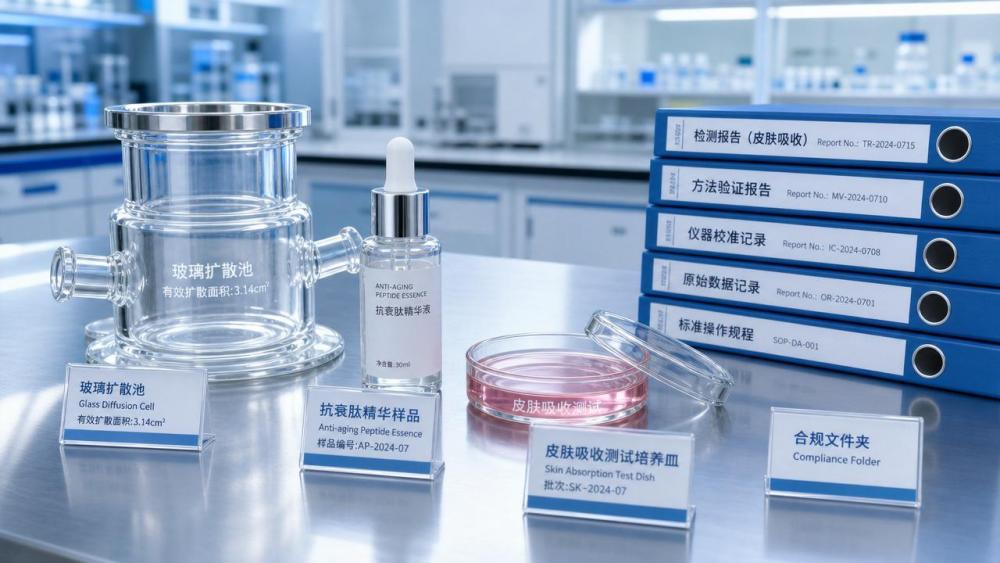
On 1 June 2026, the EU SCCS update on transdermal absorption assessment for anti-aging peptide ingredients took effect, creating a direct compliance impact for imported cosmetics containing active ingredients such as Pro-Xylane, recombinant collagen peptides, and acetyl hexapeptide because CPNP notification now requires additional skin absorption and stratum corneum retention documentation before market access.
What Has Changed Under the SCCS Guideline
The Scientific Committee on Consumer Safety, commonly referred to as SCCS, brought into force SCCS/1643/23 Rev.1: Guideline for the Assessment of Percutaneous Penetration and Stratum Corneum Penetration Kinetics of Anti-Aging Peptide Ingredients on 1 June 2026.
According to the provided event summary, all imported cosmetic products containing active ingredients including Pro-Xylane, recombinant collagen peptides, and acetyl hexapeptide must submit an in vitro skin absorption study based on the revised OECD TG 428 method when completing CPNP notification.
The same notification process must also include a quantitative report on stratum corneum retention. Products that do not provide the required documentation will not be accepted for market placement under the stated requirement.
How the Requirement May Reshape Industry Workflows
Importers and direct trading companies
Direct trading companies are affected because the CPNP notification requirement sits close to the market-entry stage. From an industry perspective, importers may need to verify whether each anti-aging product formula contains the listed active ingredients before shipment planning, customer commitment, or launch scheduling.
The impact is likely to appear in product registration review, documentation collection, customs-facing preparation, and commercial launch timelines. Companies should pay particular attention to whether the in vitro skin absorption study and stratum corneum retention report are available in a format suitable for CPNP submission.
Raw material procurement teams
Raw material procurement companies and purchasing teams may be affected because the requirement is linked to specific active ingredients, including Pro-Xylane, recombinant collagen peptides, and acetyl hexapeptide. Analysis shows that ingredient identification, supplier documentation, and technical data verification may become more important in sourcing decisions.
Procurement teams may need to check whether suppliers can provide ingredient-level information that supports downstream testing and notification. Particular attention should be given to changes in raw material specifications, traceability records, and the consistency of ingredient descriptions used in product files.
Contract manufacturers and processing facilities
Processing and manufacturing companies may be affected because formula composition, batch documentation, and testing coordination are closely connected to the new CPNP evidence requirement. Where anti-aging peptide ingredients are used, manufacturing documentation may need to support both the in vitro absorption assessment and the quantitative stratum corneum retention report.
The impact may be reflected in formula review, sample preparation, technical file coordination, and quality record management. Manufacturers should monitor whether product development timelines need to allow additional time for testing and report preparation before notification.
Supply chain service providers
Supply chain service providers, including compliance support, testing coordination, documentation management, and logistics-linked service companies, may see changes in customer requirements. Observably, the new rule may increase demand for clearer document handover between ingredient suppliers, manufacturers, importers, and notification parties.
The affected business links may include pre-shipment compliance checks, technical document collection, regulatory file preparation, and communication around launch readiness. Service providers should closely follow how clients interpret the revised OECD TG 428 requirement and the quantitative reporting requirement for stratum corneum retention.
Practical Points Companies Should Review Now
Screen formulas for listed peptide-related actives
Companies should first determine whether products intended for CPNP notification contain Pro-Xylane, recombinant collagen peptides, acetyl hexapeptide, or other anti-aging peptide active ingredients covered by the SCCS guideline described in the event summary. This screening should be completed before commercial launch planning, rather than after the product file has already entered the notification workflow.
Align testing plans with the revised OECD TG 428 requirement
The required in vitro skin absorption study must be prepared in line with the revised OECD TG 428 method as stated in the event summary. Companies should review whether existing test reports are methodologically aligned with this requirement or whether new testing coordination is needed before CPNP submission.
Prepare stratum corneum retention quantification as a separate evidence item
The new requirement does not only refer to general skin absorption information. It also requires a quantitative report on stratum corneum retention. This means companies should avoid treating the retention element as a minor annex unless the report clearly supports the CPNP notification requirement.
Recheck launch schedules and document ownership
Because products lacking the required documents will not be allowed onto the market under the described requirement, companies should clarify who is responsible for test commissioning, report review, supplier data collection, and final CPNP file preparation. Export-facing teams may also need to reassess delivery commitments if documentation is incomplete.
Industry Reading: A Higher Evidence Bar for Active Cosmetics
From an industry perspective, this update can be understood as a shift toward more evidence-based review of anti-aging active ingredients in imported cosmetics. The confirmed requirement concerns CPNP documentation, but the broader implication may be that technical substantiation around skin penetration and retention is becoming more central to product compliance.
Analysis shows that companies with stronger formula traceability, testing coordination, and technical file management may be better positioned to respond to this type of regulatory change. However, it is more appropriate to understand this as a compliance preparation issue rather than as a guaranteed market reshuffle, because the provided information does not include market data or company-specific outcomes.
What deserves closer attention is the possible interaction between testing readiness and procurement decisions. If suppliers cannot support ingredient identification and technical documentation, downstream companies may face delays in CPNP notification. This is an analytical observation, not a confirmed result of the guideline.
Closing View
The SCCS guideline taking effect on 1 June 2026 adds a clear documentation condition for imported cosmetics containing specified anti-aging peptide active ingredients. Its industry significance lies in connecting ingredient activity, in vitro skin absorption testing, stratum corneum retention quantification, and CPNP notification into one compliance pathway.
A rational conclusion is that companies should treat the update as a signal to strengthen pre-market technical review and document control. The actual operational impact will depend on how each company manages formula screening, supplier coordination, testing preparation, and notification timing.
Information Basis and Follow-Up Items
This article is based on the provided news title, event date, and event summary concerning the SCCS guideline SCCS/1643/23 Rev.1, its effective date of 1 June 2026, and the stated CPNP documentation requirements for imported cosmetics containing certain anti-aging peptide active ingredients.
Relevant official or authoritative source types for continued verification may include SCCS publications, CPNP-related regulatory guidance, OECD test guideline materials, and official cosmetics compliance communications. Specific official source links were not provided in the input and should be verified continuously.
Further observation is needed on implementation details, certification and notification review practice, changes in technical documentation expectations, updates to tender or specification requirements, and feedback from industry participants involved in testing, manufacturing, procurement, and import compliance.
Related News
- How to assess recombinant collagen ingredients for cream stabilityOct 02, 2026Cosmeceutical Formulator
- How to assess an anti-aging ingredients manufacturer’s batch consistencySep 17, 2026Cosmeceutical Formulator
- How to verify cosmetic peptide delivery compliance before launchAug 30, 2026Cosmeceutical Formulator
- When do biomimetic actives in North America justify a premium in anti-aging formulasAug 25, 2026Cosmeceutical Formulator
Related News
- 00
0000-00
How to assess color stability from a natural food colors manufacturer - 00
0000-00
When does amino acid surfactant powder improve cleanser mildness? - 00
0000-00
How to verify a cosmetic nanotechnology supplier's safety documentation - 00
0000-00
How rheological thickeners for shampoo affect suspension stability - 00
0000-00
How to assess recombinant collagen ingredients for cream stability
Cosmeceutical Formulator
Weekly Insights
Stay ahead with our curated technology reports delivered every Monday.