





At the close of FHC 2025 in November 2025, the debut of dedicated sections for food-medicine ingredients and infant and child food signaled more than a product trend. Based on the event summary, growing buyer attention from Southeast Asia, the Middle East, and Latin America points to a sharper market focus on purity, traceability, and compliant certification for active ingredients. For ingredient suppliers, exporters, buyers, processors, and certification-related service providers, this matters because market access in higher-end channels increasingly appears tied not only to formulation performance, but also to how clearly products can meet documentation, compliance, and sourcing expectations.
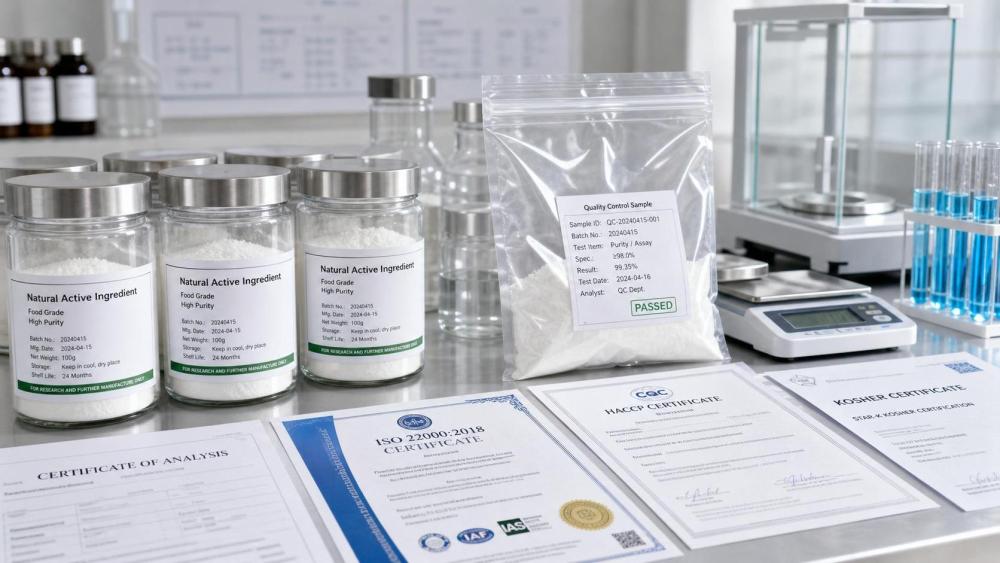
What the FHC 2025 Event Confirmed
Confirmed information from the event shows that FHC 2025, held in November 2025, introduced two new sections focused on food-medicine ingredients and infant and child food. The exhibition attracted more than 180,000 professional buyers. The event summary also states that importers from Southeast Asia, the Middle East, and Latin America raised their inquiries for natural active ingredients, including Anti-aging Peptides, Collagen precursors, and Xanthan-based carrier systems, by 65% year on year. The clearest signal released by the exhibition is that high-purity, traceable, and compliance-certified active ingredients are becoming an access requirement for premium channels in emerging markets.
Where the Pressure May Shift Along the Supply Chain
Export-facing ingredient suppliers may face tighter proof demands
From an industry perspective, suppliers of active ingredients are likely to feel the impact first because the event signal centers on purity, traceability, and compliant certification. The practical effect may appear in pre-sale qualification, technical document preparation, batch traceability records, and buyer review of compliance materials before orders move forward. What deserves closer attention is whether existing product files, test records, and supplier qualification documents are sufficient for buyers targeting higher-end channels.
Buyers and sourcing teams may adjust screening criteria
For procurement teams, the change is not only about finding ingredients with marketable claims. Analysis shows that sourcing decisions may increasingly depend on whether a supplier can provide stable quality evidence, traceable origin information, and certification or compliance documents that align with the buyer's target market requirements. This can affect supplier onboarding, tender documentation, and order approval workflows.
Processors and brand-side manufacturers may see compliance move upstream
Manufacturing companies working with infant and child food or food-medicine related formulations may need to pay closer attention to upstream ingredient substantiation. Observably, if premium channel access is becoming more documentation-driven, manufacturers may need stronger control over ingredient specifications, batch consistency, and supporting technical files before products move into production, export preparation, or channel submission.
Testing and certification service providers may become more involved earlier
Certification-related firms and testing service providers may also be affected because buyer interest is described in terms that go beyond product novelty. From an execution perspective, this may shift some work earlier in the commercial cycle, with more demand for document review, testing support, traceability verification, and compliance file preparation before final commercial delivery.
What Companies Should Watch Next
Check whether compliance materials match buyer expectations
Analysis shows that companies should first review whether product dossiers, testing reports, technical descriptions, and traceability materials are consistent, current, and easy for overseas buyers to assess. The event summary does not provide market-specific rules, so this should be treated as a preparation priority rather than a confirmed new legal requirement.
Watch how premium-channel access language evolves
What deserves closer attention is how buyers, distributors, and channel partners describe access conditions after the exhibition. If purity, traceability, and compliant certification continue to appear in procurement language, supplier questionnaires, or technical requests, that would strengthen the signal that documentation thresholds are rising in practice.
Focus on ingredient categories that drew stronger inquiry
Companies involved in natural active ingredients such as Anti-aging Peptides, Collagen precursors, and Xanthan-based carrier systems should pay particular attention to how inquiries translate into requests for specifications, certificates, batch information, or additional testing support. At this stage, the event indicates stronger market attention, but not a uniform execution standard across all buyers or markets.
Review delivery planning together with supplier qualification
Observably, if buyers increasingly prioritize verified and traceable inputs, delivery planning may become more closely linked to supplier approval, document readiness, and quality release procedures. Companies may therefore need to align procurement timing, supplier selection, and export document preparation more carefully than before.
How This Signal Should Be Read
Analysis shows that this development is better understood as an execution signal from the market rather than as a confirmed new regulation announced at the event itself. The significance lies in the convergence of buyer attention around compliance-certified, traceable, and high-purity active ingredients. That does not automatically establish a unified regulatory change, but it does suggest that commercial access conditions in some emerging-market premium channels may be hardening through procurement practice, document review, and channel acceptance criteria.
Observably, the most important follow-up is not only whether demand remains high, but whether this demand is accompanied by more explicit certification expectations, stricter technical file requests, or changing tender and onboarding language. That is why the event deserves attention from both commercial and compliance teams.
A Practical Reading of the FHC 2025 Message
The most reasonable conclusion at this stage is that FHC 2025 highlighted a market-facing rule shift in how active ingredients may be evaluated for premium channels in emerging markets. It is more appropriate to understand this as a strong commercial and compliance signal, not as a fully defined regulatory outcome. For companies across sourcing, formulation, export, testing, and channel delivery, the immediate task is to monitor how this signal translates into buyer requirements, documentation standards, and supplier qualification practice.
Basis of This Article
This article is generated from the user-provided news title, event date, and event summary. No specific official source link was provided in the input, so any official confirmation path still requires ongoing verification. For this type of development, commonly relevant source categories may include official notices, regulatory releases, customs or trade authority information, industry association updates, standards documents, and reporting from authoritative media. What still needs to be monitored includes possible policy detail, certification interpretation, changes in tender documents, industry feedback, and how companies implement these requirements in practice.
Related News
- Can biomimetic peptides in cosmetics reduce the look of wrinkles?Oct 17, 2026Cosmeceutical Formulator
- How to assess recombinant collagen ingredients for cream stabilityOct 02, 2026Cosmeceutical Formulator
- How to assess an anti-aging ingredients manufacturer’s batch consistencySep 17, 2026Cosmeceutical Formulator
- How to verify cosmetic peptide delivery compliance before launchAug 30, 2026Cosmeceutical Formulator
Related News
- 00
0000-00
Can biomimetic peptides in cosmetics reduce the look of wrinkles? - 00
0000-00
How to assess a bio-based thickener manufacturer's batch consistency - 00
0000-00
Verifying halal status of hydrocolloid ingredients in the Middle East - 00
0000-00
How to interpret active matter on a surfactant specification sheet - 00
0000-00
How Do You Test Hydrocolloid Viscosity After Changing a Thickener?
Cosmeceutical Formulator
Weekly Insights
Stay ahead with our curated technology reports delivered every Monday.