





To verify a supplier’s peptide bioavailability data, trace the evidence from the material tested to the location where it is supposed to act. For a topical cosmetic, that means asking whether the relevant peptide remains intact, reaches the intended skin compartment, and does so under conditions representative of your formula and its use. High purity, a positive cell assay, or an impressive penetration image cannot establish that chain on its own.
A supplier’s dossier can support an initial ingredient decision without proving every aspect of finished-product performance. The practical task is to identify what each study establishes, where its conclusions stop, and which missing evidence could change your sourcing decision. Start with the delivery claim, then examine the study design, measurement method, and formulation relevance.
Define what the supplier means by “bioavailable”
Ask the supplier to state its claim in one precise sentence: which peptide, delivered by which route, reaches which location, in what measurable form? “Enhanced bioavailability” is difficult to evaluate until the endpoint and comparator are named.
For topical products, several different findings may sit behind that phrase. A peptide may remain on the surface, accumulate in the stratum corneum, enter viable skin layers, or pass through the skin into a diffusion cell’s receptor fluid. Each finding answers a different question. Passage into receptor fluid can help characterize permeation, but it does not establish an effective concentration at a particular cellular target.
The desired location depends on the proposed mechanism. An ingredient intended to form a surface film does not need the same delivery evidence as a peptide claimed to influence dermal fibroblasts. Conversely, detecting material in the outer barrier provides limited support for a claim requiring access to deeper tissue.
Keep three evidence categories separate throughout the review:
- Identity and quality: the supplied material contains the specified peptide at the stated concentration and quality.
- Delivery and availability: the relevant molecular species reaches the intended location under the tested conditions.
- Biological or clinical effect: exposure produces a measured response, such as a cellular change or a visible cosmetic outcome.
A cell-culture experiment can support biological plausibility while bypassing the skin barrier entirely. A clinical study can demonstrate a product benefit without identifying which ingredient caused it or proving the proposed delivery mechanism. These studies can complement one another, but their conclusions should retain those boundaries.
If the intended product is oral, the evidence requirements change. Simulated digestion, intestinal transport models, and human exposure measurements address different stages. An oral bioavailability claim needs clarity about whether the measured species is the intact peptide, a particular metabolite, or breakdown products. Evidence from an oral ingredient cannot substantiate topical delivery.
Request the report behind the presentation
Begin with the complete study report rather than a brochure or selected slides. You need enough detail to reconstruct what was tested and how the reported result was calculated. Commercial confidentiality can justify a nondisclosure agreement; it does not make missing methodological information less consequential.
Request the following as a single evidence package:
- The test material’s peptide identity, chemical modifications, batch number, active concentration, carrier composition, and certificate of analysis.
- The protocol, full report, laboratory identity, funding relationship, and any deviations from the planned procedure.
- The tested formulation, applied dose, exposure duration, sampling procedure, controls, and comparator.
- The analytical method, its validation in the relevant sample matrix, and supporting chromatograms or spectra where applicable.
- Individual results, independent donor or sample counts, variability, exclusions, and the statistical analysis.
Check whether the tested material matches the commercial ingredient. A study on a purified peptide dissolved in a laboratory solvent may offer limited support for a diluted commercial blend. Different terminal modifications, counterions, carriers, or encapsulation systems can affect stability and delivery.
Also establish the denominator behind percentages. “Twenty percent penetration” could describe the fraction of the applied dose recovered in skin, the fraction of recovered material found in one compartment, or a change relative to a control. Those calculations have different meanings. Ask for the underlying quantities and units, including the actual peptide dose applied per unit area.
Check whether the experiment represents the intended use
For a topical peptide, examine the skin model before interpreting the delivery result. Excised human skin, animal skin, reconstructed skin, and artificial membranes have different properties and evidentiary limits. Artificial membranes may help compare formulations, but they cannot reproduce all aspects of living skin, including tissue structure and enzymatic degradation.
With excised skin, ask about anatomical source, preparation, thickness, storage, and barrier-integrity checks. A damaged barrier can exaggerate apparent delivery. Dermatomed samples and full-thickness samples also differ in the path a molecule must cross and the tissue in which it may accumulate.
The application conditions deserve equal attention. A large dose, prolonged exposure, occlusion, or a strong penetration-enhancing solvent can produce a result that transfers poorly to an ordinary leave-on cream. Such conditions may be useful for exploratory work, but the supplier should explain their relationship to the intended use.
In a diffusion-cell study, inspect the receptor medium and the rationale for its selection. It must support reliable measurement and appropriate experimental conditions without compromising the barrier. The report should also establish whether the peptide remains stable during exposure, collection, storage, and analysis. Otherwise, measured losses may be mistaken for poor delivery, or degradation products may be mistaken for the original peptide.
Controls should address the mechanism and measurement. A vehicle control helps identify effects from the base formula. Blank tissue reveals background interference. An unencapsulated comparator can help evaluate a delivery-system claim, provided both formulations contain comparable peptide doses and are otherwise suitable for comparison.
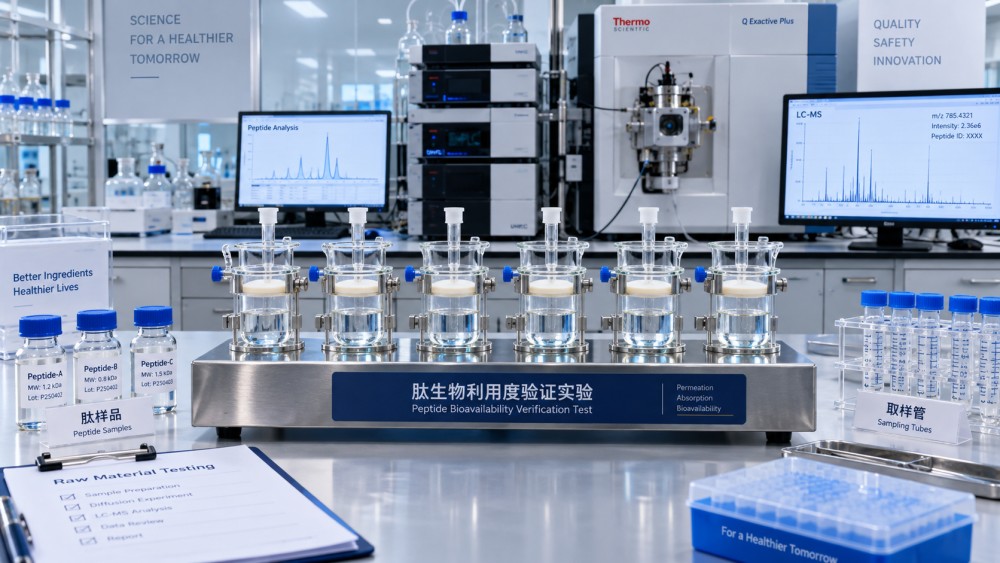
Finally, distinguish independent biological samples from repeated measurements. Multiple diffusion cells prepared from one donor do not establish consistency across different donors. Review the distribution of results, not just the average. A large spread may be important for development decisions even when a statistical comparison is significant.
Verify that the assay detects the relevant peptide
The central analytical question is simple: what exactly generated the signal? A measurement described as “peptide detected” may represent the intact sequence, a fragment, a fluorescent label, or nonspecific peptide-related material.
Fluorescence images can show where a label appears, but labeling may alter a molecule’s properties, and the label may separate from the peptide. Such images are useful supporting evidence when these issues are addressed. Alone, they provide limited grounds for concluding that the original, active peptide reached the target tissue.
For sequence-specific quantitative analysis, ask how the laboratory confirmed identity and distinguished the target from degradation products and background compounds. LC-MS/MS can be appropriate, but naming the instrument does not demonstrate method suitability. The method needs validation for the actual matrices being analyzed, such as skin extracts, receptor fluid, or the finished formulation.
The validation should address:
- Selectivity: whether the method distinguishes the target peptide from interfering substances.
- Quantification limits: whether concentrations near the reported values can be measured reliably.
- Accuracy and precision: whether results are sufficiently close to known values and reproducible.
- Extraction recovery and matrix effects: whether sample preparation loses peptide or the matrix changes the analytical response.
- Stability: whether the analyte survives the study and sample-handling conditions.
These details matter particularly when a report claims low but meaningful tissue exposure. A result below the validated quantification limit should not be presented as a precise concentration. Equally, “not detected” does not prove absence if the assay lacks sufficient sensitivity.
Look for a mass balance that accounts for the applied material across surface washings, skin fractions, receptor fluid, and relevant apparatus residues. Poor recovery creates uncertainty about whether peptide degraded, adhered to equipment, escaped extraction, or entered an unmeasured compartment.
Skin sampling can introduce further ambiguity. Surface residue may contaminate deeper samples during processing. Tape stripping helps investigate distribution within the stratum corneum, but results depend on removal procedures and depth interpretation. Ask how the laboratory minimized carryover and distinguished surface deposits from tissue-associated peptide.
Connect delivery results to your finished formula
Even a sound study has a formulation boundary. Changes in pH, solvents, surfactants, emulsifiers, viscosity, packaging, and manufacturing conditions can affect peptide stability and availability. A carrier that improves delivery in one vehicle may perform differently after incorporation into another.
Compare the supplier’s test formula with your proposed product. Confirm the active peptide concentration rather than the percentage of commercial blend added. Establish whether the peptide stays soluble, associates with other ingredients, or changes during storage. For encapsulated systems, ask whether analysis measures total peptide, released peptide, or both.
Freshly prepared samples provide limited assurance about performance over the product’s intended life. Where degradation or carrier changes could affect the claim, consider testing representative aged formulations as well. The conditions should reflect the development question and intended storage, rather than relying on an arbitrary stress test.
Delivery also needs a biological interpretation. Detecting peptide in tissue does not establish that a relevant target receives sufficient exposure for long enough to respond. Comparing a tissue concentration with an effective cell-culture concentration can help identify questions, but the comparison requires caution: tissue extraction may combine bound, free, and compartmentalized material, whereas cells in culture may receive direct exposure.
Similarly, improved hydration or reduced wrinkle appearance in a multi-ingredient formula does not isolate the peptide’s contribution. A suitable vehicle comparison strengthens attribution. Clinical outcomes and analytical delivery studies answer complementary questions, and neither should be stretched to fill gaps in the other.
Choose the verification work that could change the decision
Independent testing is most useful when it resolves a material uncertainty. If identity is unclear, commission identity and concentration testing first. If the dossier uses an irrelevant vehicle, prioritize delivery testing in a representative formulation. If the method cannot distinguish intact peptide from fragments, repeating the same assay at another laboratory will preserve the underlying problem.
Agree on the protocol and interpretation before testing. Define the target compartment, analyte, application conditions, controls, sample handling, and required analytical performance. Set acceptance criteria around the proposed claim and development needs. There is no universal penetration percentage that makes every cosmetic peptide suitable.
Use the evidence to make a staged decision. A dossier with traceable material, relevant methods, and credible measurements may justify formulation trials. A well-characterized peptide supported mainly by cell studies may justify exploratory development while leaving delivery claims unresolved. Data built around undisclosed methods, unsuitable controls, or signals that cannot identify the peptide provide a weak basis for a delivery premium.
Supplier funding alone does not invalidate a study. Transparent methods, accessible underlying results, and reproducibility carry more weight than the funding label. Independent replication becomes especially valuable when the claimed delivery advantage drives ingredient cost, positioning, or substantial development commitments.
The most useful final request to a supplier is specific: provide evidence that this commercial peptide, in a relevant formulation and at a realistic dose, reaches the location required by the proposed mechanism in a measurable form. If the dossier supports only part of that statement, narrow the claim and make the missing experiment the next development milestone.
Related News
- Can biomimetic peptides improve skin firmness?Nov 13, 2026Cosmeceutical Formulator
- How to choose peptide ingredients for an anti-aging serumNov 06, 2026Cosmeceutical Formulator
- How to assess European bioactive peptide suppliers for batch consistencyOct 29, 2026Cosmeceutical Formulator
- How biomimetic peptides work in anti-aging skincare formulationsOct 27, 2026Cosmeceutical Formulator
Related News
- 00
0000-00
Wissen Research: Global Cosmetics Market to Reach $497.2 Billion by 2031 - 00
0000-00
Can biomimetic peptides improve skin firmness? - 00
0000-00
China Records 543 New Cosmetic Ingredients, Including 167 in 2026 - 00
0000-00
How to check a fragrance raw material specification for IFRA compliance - 00
0000-00
Australia and New Zealand Weigh Wider Steviol Glycoside Use in Griddle Products
Cosmeceutical Formulator
Weekly Insights
Stay ahead with our curated technology reports delivered every Monday.