





How Biomimetic Peptides Work in Anti-Aging Skincare Formulations: Mechanisms, Delivery, and Evidence
Biomimetic peptides can support targeted anti-aging claims, but a plausible molecular mechanism does not establish that a finished skincare product delivers visible benefits consistently.
For technical evaluators assessing cosmetic biomimetics for skincare, the central question is whether biological activity translates into measurable results at a practical, stable formulation dose.
That judgment requires connecting peptide identity, delivery, stability, and human evidence. Weakness in any link can undermine an otherwise compelling ingredient story during technical assessment.
This article examines how selected peptides mimic natural signals, where delivery limits their usefulness, and which evidence helps distinguish credible formulation opportunities from marketing appeal.
What Must Be True for a Biomimetic Peptide to Work?
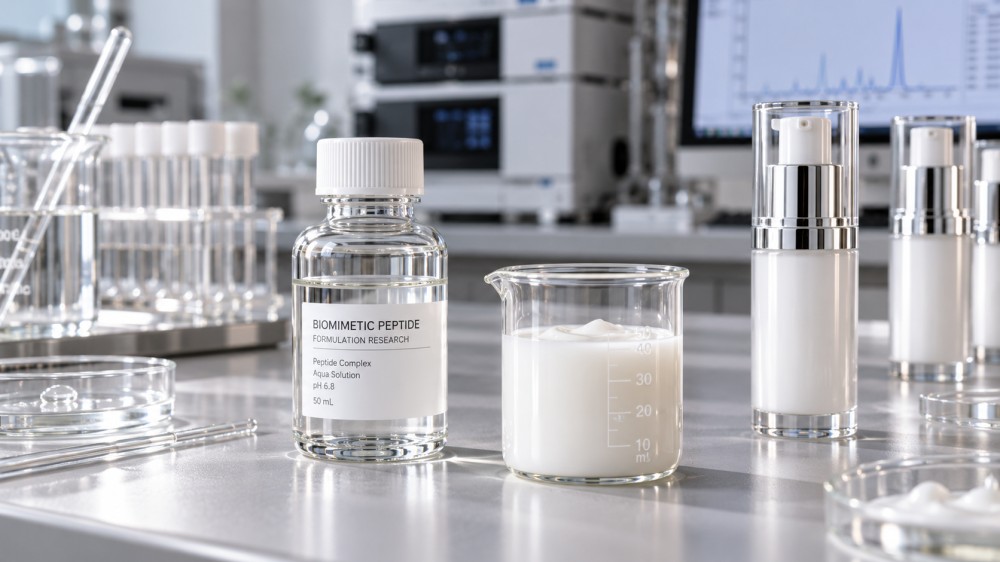
A successful peptide formulation needs a coherent chain of evidence: the correct molecule, sufficient intact exposure, relevant biological activity, and a meaningful cosmetic outcome.
Start by defining the intended benefit precisely. Reduced wrinkle appearance, improved firmness, and better hydration involve different endpoints and may require different supporting mechanisms.
Next, identify where the proposed action occurs. A peptide intended to influence dermal fibroblasts faces a different delivery challenge from an ingredient acting near the surface.
Ask whether the tested material matches the commercial ingredient in sequence, chemical modification, purity, carrier composition, and active concentration. Similar names do not establish equivalence.
Finally, examine the finished formula. Evidence from an isolated peptide cannot automatically substantiate a serum whose vehicle, packaging, manufacturing process, or companion ingredients differ.
This framework makes evaluation practical: establish what must happen biologically, then test whether the proposed product can reasonably produce those conditions during normal consumer use.
How Do Peptides Mimic Natural Skin Signals?
Biomimetic peptides are designed or selected to reproduce aspects of biological molecules or signaling sequences. The term describes an approach, rather than a uniform ingredient class.
Some resemble fragments released during extracellular matrix turnover. These fragments can participate in cellular communication, making them useful starting points for cosmetic ingredient development.
Palmitoyl pentapeptide-4, for example, contains a sequence associated with a fragment of type I procollagen. Its proposed activity concerns matrix-related signaling and skin appearance.
Other peptides target different pathways or carry metal ions. Their sequences, modifications, and intended biological roles vary, so evidence should remain specific to each ingredient.
Binding or signaling activity in cultured cells establishes biological plausibility. It does not demonstrate that topical application produces equivalent exposure within living human skin.
Technical descriptions should therefore separate the molecular hypothesis from demonstrated outcomes. This distinction helps prevent laboratory observations from becoming unsupported claims about wrinkle reversal.
Which Peptide Categories Deserve Different Evaluation Strategies?
Signal peptides are generally investigated for effects on extracellular matrix pathways, including collagen-related responses. Evaluate both the measured biological markers and their clinical relevance.
An increase in collagen-associated gene expression is an intermediate finding. It does not establish increased mature collagen deposition, improved tissue organization, or visibly reduced wrinkles.
Carrier peptides, including copper-binding peptides such as copper tripeptide-1, introduce additional questions about metal coordination, speciation, ingredient interactions, and the identity of the active species.
For these materials, assessing peptide content alone may be insufficient. Relevant specifications can also include metal content, free metal, and changes caused by formulation conditions.
Neurotransmission-modulating peptides, such as acetyl hexapeptide-8, are often positioned for expression lines. Their proposed mechanisms require especially careful scrutiny of delivery and achievable tissue exposure.
Topical cosmetic peptides should not be treated as equivalent to injected botulinum toxin. Differences in delivery, molecular targets, and clinical evidence materially affect expected outcomes.
Enzyme-targeting peptides represent another approach, but inhibition measured in a simplified assay must be evaluated against selectivity, local exposure, and performance in relevant skin models.
Can the Peptide Reach Its Intended Site of Action?
The stratum corneum restricts penetration of many peptides because molecular size, polarity, charge, and hydrogen bonding often limit passive movement through its lipid-rich structure.
The frequently cited 500-dalton rule is a useful screening heuristic, not an absolute cutoff. Molecular weight alone cannot predict delivery from a specific cosmetic vehicle.
Palmitoylation can increase lipophilicity and alter partitioning into skin. It does not guarantee that an intact peptide reaches viable epidermis or dermis at effective concentrations.
Liposomes, emulsions, and other delivery systems may improve solubility, protection, or skin deposition. Each proposed advantage requires evidence for the particular peptide and formulation.
Greater deposition in the stratum corneum does not necessarily mean greater delivery to deeper tissue. The relevant measurement depends on the intended biological target.
For penetration studies, request the skin model, application dose, exposure duration, recovery data, and analytical method. Human skin experiments generally offer greater relevance than synthetic membranes.
Fluorescent labels can change peptide behavior or remain detectable after degradation. Where feasible, use validated analytical methods that distinguish intact peptide from fragments and carriers.
Will the Peptide Survive Manufacturing and Shelf Life?
Peptide stability depends on sequence and formulation conditions. Hydrolysis, oxidation, aggregation, or surface adsorption may reduce available activity without producing an obvious change in appearance.
Residues susceptible to oxidation or other reactions require particular attention. A stable color, odor, and viscosity profile does not prove that the peptide remains intact.
Establish a compatible pH range using supplier data and formulation testing. Avoid assuming that every peptide performs best under the same mildly acidic conditions.
Processing temperature and addition order also matter. Follow ingredient-specific handling guidance, then confirm that the actual manufacturing process preserves peptide content and acceptable product quality.
Evaluate interactions with preservatives, surfactants, chelators, oxidants, and metal ions where relevant. Compatibility concerns should follow the peptide’s chemistry rather than generic ingredient pairing rules.
Test the final packaging because adsorption, oxygen exposure, and container interactions can affect performance. Airless packaging may help particular systems but cannot substitute for stability data.
Use accelerated studies to identify risks, supported by real-time stability. Analytical testing should distinguish intact peptide from degradation products wherever the method and formulation permit.
What Dose Is Actually Being Delivered?
One common evaluation error is confusing the percentage of a commercial peptide solution with the percentage of active peptide contained in the finished formulation.
If a supplied solution contains 0.05% peptide and is added at 2%, the finished product contains 0.001% peptide, equivalent to 10 parts per million.
That calculation establishes nominal loading, not bioavailability. Subsequent losses during processing, storage, application, or skin transport can further reduce exposure at the proposed target.
Compare proposed loading with the dose used in supporting studies. Check whether the study reports pure peptide, a commercial blend, or an incompletely described preparation.
Request an assay specification, batch documentation, relevant impurities, and storage conditions. Where justified, confirm identity and content independently instead of relying solely on trade-name consistency.
Cost comparisons should use equivalent active content and relevant performance evidence. A lower price per kilogram of solution may conceal a higher cost per effective application.
Which Studies Support a Credible Anti-Aging Claim?
Cell studies help investigate mechanisms and screen candidates. Reconstructed skin and ex vivo models add context, while controlled human studies address actual cosmetic outcomes.
For product claims, prioritize studies using the finished formulation or a closely justified equivalent. Ingredient studies remain useful, but their applicability requires explicit technical reasoning.
A vehicle-controlled design helps separate peptide effects from hydration, emolliency, and other benefits of the base formula. Blinding and randomization further reduce avoidable bias.
Look for predefined endpoints, appropriate sample size, suitable study duration, and transparent statistical methods. Small exploratory trials can guide development but leave substantial uncertainty.
Wrinkle topography, standardized imaging, and validated grading can support appearance claims. Elasticity measurements may add information, provided testing conditions and interpretation are adequately controlled.
Assess effect size alongside statistical significance. A measurable difference may be too small to matter visually, while uncontrolled photographs can exaggerate apparently impressive changes.
Check participant characteristics, baseline photoaging, concurrent skincare, and environmental controls. Findings from one population or regimen may not generalize to every intended consumer group.
Studies lasting several weeks may capture hydration effects more readily than slower structural changes. Match the claimed mechanism and promised timing to the actual observations.
How Should Safety and Claims Be Assessed?
Safety assessment should cover the ingredient and finished product at intended exposure, considering impurities, local tolerance, sensitization potential, preservation, and relevant consumer use conditions.
A biomimetic sequence is not automatically non-irritating or risk-free. Chemical modifications, manufacturing residues, carriers, and accompanying ingredients can change the overall safety assessment significantly.
Claims also require market-specific review. Statements about improving the appearance of wrinkles differ from claims to treat disease or produce drug-like physiological effects in skin.
In the European Union, CPNP notification is an administrative requirement, not evidence of approval or efficacy. Food-related GRAS status does not establish cosmetic peptide suitability.
In the United States, intended use and claim wording can affect whether a product falls within cosmetic or drug requirements. Review proposed language before launch.
Technical teams should supply claims reviewers with the actual study endpoints and limitations. Precise evidence summaries support defensible language and reduce later reformulation or relabeling.
When Does a Peptide Merit Formulation Investment?
Prioritize candidates with clear identity, feasible loading, credible target exposure, acceptable stability, and relevant human evidence. Strong performance in one category cannot erase another critical gap.
For FFAI’s technical audience, the most useful supplier dossier connects mechanism, analytical specifications, formulation guidance, safety, and clinical findings into a consistent, independently assessable argument.
When evidence is incomplete, define the next experiment around the uncertainty that could change the decision. This may involve peptide recovery, penetration, or vehicle-controlled efficacy.
Cosmetic biomimetics for skincare offers credible development opportunities when molecular design survives practical formulation constraints. Select peptides whose delivered performance supports the exact benefit being promised.