





How to Assess an Anti-Aging Ingredients Manufacturer’s Batch Consistency
For quality and safety teams, a supplier’s batch consistency is not a paperwork exercise. It determines whether a peptide serum performs the same six months after launch, whether an antioxidant remains within specification through distribution, and whether a formula that passed safety review can be manufactured again without unexpected rework.
This is particularly sensitive with high-end anti-aging actives. A small shift in peptide assay, molecular-weight profile, solvent residue, color, odor, pH, or microbial status may affect formula appearance, compatibility, claim substantiation, or consumer tolerability. The certificate of analysis (CoA) matters, but it is only a snapshot. To assess an anti-aging ingredients manufacturer properly, buyers need to understand how that result was produced, how often it is reproducible, and what happens when it is not.
The practical question is not “Can this supplier provide a compliant batch today?” It is “Can this supplier repeatedly provide material that behaves the same way in our process and finished product?” That distinction separates a promising development source from a reliable commercial partner.
Start with the critical attributes that actually affect your formula
Not every test item deserves equal weight. Before comparing suppliers, define the critical quality attributes (CQAs) for the specific active and intended formulation. For a standardized botanical extract, marker-compound content may be central, but so may the solvent system, pesticide-risk controls, color range, and seasonal raw-material variation. For a signal peptide, identity, purity, related substances, residual reagents, counterion content, and potency-relevant characterization may be more revealing than a broad “active content” figure.
For ingredients such as recombinant collagen, fermented bioactives, hyaluronic-acid derivatives, ceramides, retinoid systems, or antioxidant complexes, composition alone rarely tells the whole story. Molecular distribution, particle characteristics, carrier composition, water activity, oxidation markers, and microbial control can change how an ingredient disperses, survives processing, or interacts with emulsifiers and preservatives.
A useful supplier discussion begins with a formula-specific risk map. Ask the manufacturer which attributes are controlled because they are critical to the ingredient itself, and which are controlled because customers commonly encounter formulation issues. If the answer is limited to the CoA template, the technical conversation is not deep enough yet.
Read the CoA as evidence, not as a promise
A clean CoA can conceal a wide operating range. If the specification permits a broad assay interval, every batch may pass while the delivered material varies enough to matter in a high-load or low-tolerance formula. The same issue arises when results are consistently reported as “conforms” without numerical values, when test methods are unnamed, or when the method’s detection limits are unclear.
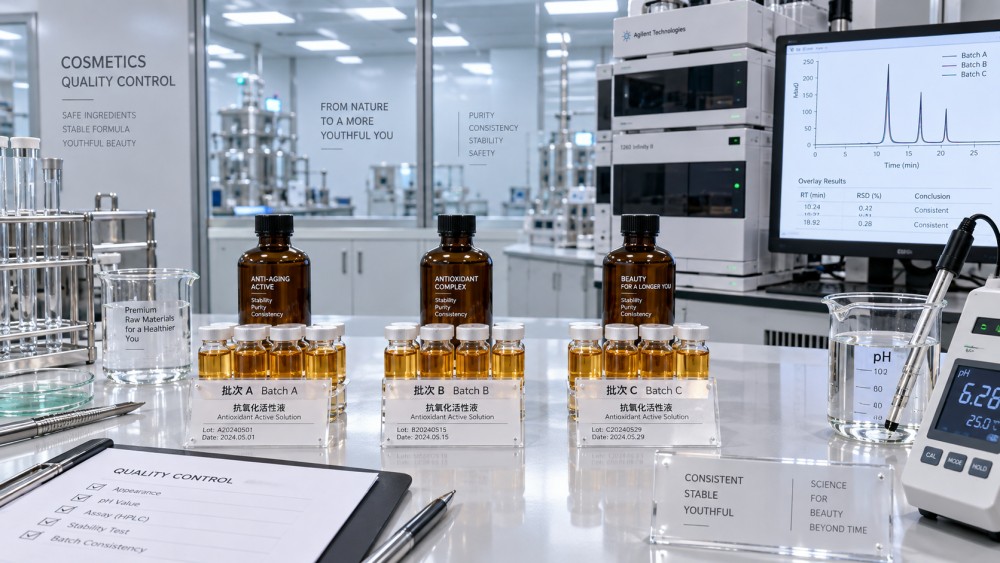
Request a meaningful batch history for the grade under consideration. The objective is not to demand confidential manufacturing records; it is to see whether the supplier can discuss normal variability openly. Review a representative series of recent CoAs, including different production dates where possible. Look for trends in assay, pH, water content, color, viscosity, density, particle size, microbial results, and any active-specific indicators. A value that moves around within limits is not automatically a problem. It becomes a problem when the supplier cannot explain the drivers, or when your own formulation is sensitive to that movement.
Also check whether the declared method is fit for the decision being made. A general spectrophotometric assay may be useful for routine release of some materials, but it may not distinguish closely related species in a complex peptide or oxidation-prone active. For sophisticated actives, ask what orthogonal evidence supports identity and purity. The manufacturer does not need to disclose every proprietary detail, but it should be able to explain why its analytical package can detect the failures that matter.
Method changes deserve the same attention as raw-material changes. A supplier can appear to have improved batch performance simply because it changed an assay, reference standard, sample preparation, or calculation basis. Quality teams should require notification and a comparability discussion for changes that could alter reported results or product behavior.
Trace the variability back to raw materials and process control
The most convincing evidence of consistency sits upstream of final release testing. An anti-aging ingredients manufacturer should be able to describe how it qualifies critical raw materials, manages alternate sources, confirms incoming identity, and prevents mix-ups. This is especially relevant for botanicals, naturally derived lipids, fermentation media, and specialized intermediates sourced through global supply chains.
Ask a direct question: “Which incoming materials have the greatest influence on this active’s finished quality?” A manufacturer that understands its process will usually identify a short list and describe proportionate controls. A generic statement that “all materials are inspected” is less useful. Inspection is not the same as a risk-based control strategy.
Process consistency should be assessed at the points where variation can be created or amplified: reaction conditions, purification stages, filtration, drying, blending, encapsulation, homogenization, and filling. For oxidation-sensitive actives, exposure to air and light during handling may be more important than the final assay. For water-dispersible polymers and hydrocolloid-supported delivery systems, hydration behavior and mixing history can influence performance even when the basic chemical numbers look acceptable.
This broader perspective is familiar across FMCG ingredients. Food antioxidants must retain function through heat and storage; fragrance materials need sensory reproducibility despite natural-source variation; thickeners must deliver repeatable rheology at very low use levels. Cosmetic actives demand the same discipline, with the added burden that changes may affect both efficacy narratives and skin-safety assessments.
Do not separate stability from consistency
A batch can meet release specifications and still be a poor commercial choice if it degrades unpredictably in transit or in the finished formula. Stability data should be reviewed in the form in which the material is actually supplied: powder, aqueous solution, oil dispersion, liposomal system, or other carrier format. Packaging is part of the control system, not an afterthought.
Ask what the supplier monitors over time and what storage excursions it considers meaningful. The data should connect to known risks: light for certain vitamins and retinoids, oxygen for many antioxidants, temperature for some peptide and fermentation-derived systems, and moisture for hygroscopic powders. “Store in a cool, dry place” is not a stability strategy.
Then run your own compatibility work using more than one production lot. A single laboratory sample may confirm initial solubility but reveal little about lot-to-lot color, odor, pH contribution, emulsion stability, or preservative interaction. If the active is expensive, it is tempting to minimize trials. That can be false economy when a later lot forces reformulation, additional safety review, or a claim-support repeat.
Evaluate how the supplier handles deviations, complaints, and change
No manufacturing system is deviation-free. The relevant question is whether the supplier detects a departure early, investigates it with appropriate technical depth, and communicates before it becomes your production problem. During qualification, request an overview of deviation management, out-of-specification handling, corrective and preventive action processes, and complaint investigation pathways. Sensitive details may be restricted, but the workflow should be clear.
Pay close attention to change notification. Changes in manufacturing site, equipment scale, raw-material source, synthetic route, fermentation conditions, preservation system, packaging, test method, or specification can all affect equivalence. The change-control agreement should define what requires advance notice, what supporting comparability information is expected, and whether you need to approve the change before supply continues.
A common procurement mistake is to treat the sample, pilot, and commercial material as automatically identical. They may not be. Ask explicitly whether the development sample came from the intended commercial process and site. If scale-up is still pending, identify what will be re-evaluated once commercial lots are available.
Build supplier qualification around evidence that can be maintained
The strongest qualification package combines documents, technical dialogue, and incoming verification. It typically includes an agreed specification, current CoA format, test-method summary, safety and regulatory documentation relevant to the destination market, traceability expectations, storage and transport requirements, stability information, allergen or impurity statements where applicable, and a written change-notification process. Regulatory status must be checked ingredient by ingredient and market by market; a cosmetic notification process, for example, should not be treated as proof that an ingredient has been formally approved for every use.
For strategic actives, set incoming testing based on risk rather than habit. Identity confirmation may be appropriate for every receipt. Other tests can be periodically verified or triggered by supplier changes, unusual CoA trends, visual differences, transport excursions, or finished-product instability. Retain samples from qualified lots under suitable conditions. When a complaint emerges months later, retained samples often provide the fastest route to distinguishing formula failure, storage damage, and genuine ingredient variability.
An intelligence-led review is useful here because quality decisions sit at the intersection of chemistry, transdermal performance, safety, and supply-chain reality. FFAI’s work across preservation systems, rheology modifiers, sensory materials, surfactants, and premium cosmetic compounds reflects a practical principle: molecular performance is only valuable when it remains reproducible after shipping, blending, filling, and normal consumer use.
A defensible decision is based on trend control, not polished documents
When choosing an anti-aging ingredients manufacturer, do not reward the supplier with the most impressive presentation alone. Favor the one that can explain its process risks, show how its methods detect meaningful variation, provide traceable batch information, and respond candidly when a limit is challenged. Consistency is demonstrated through controlled history and sensible change management, not through a single perfect CoA.
Before approving commercial supply, test multiple lots in the actual formula whenever timing permits. Define the narrow operating ranges your product truly needs, document them in the quality agreement, and keep reviewing delivered-batch trends after launch. That ongoing discipline is what protects an anti-aging claim from becoming a batch-to-batch gamble.
Related News
- How to assess recombinant collagen ingredients for cream stabilityOct 02, 2026Cosmeceutical Formulator
- How to assess an anti-aging ingredients manufacturer’s batch consistencySep 17, 2026Cosmeceutical Formulator
- How to verify cosmetic peptide delivery compliance before launchAug 30, 2026Cosmeceutical Formulator
- When do biomimetic actives in North America justify a premium in anti-aging formulasAug 25, 2026Cosmeceutical Formulator
Related News
- 00
0000-00
What drives fragrance ingredients price changes in bulk orders? - 00
0000-00
How to assess a food antioxidants distributor’s traceability practices - 00
0000-00
How minimum order quantities shape private label ingredient sourcing costs - 00
0000-00
What drives personal care ingredient price volatility in sourcing - 00
0000-00
What drives micelles price differences in cosmetic formulations?
Cosmeceutical Formulator
Weekly Insights
Stay ahead with our curated technology reports delivered every Monday.