





A cream can look acceptable when it leaves the lab yet become thinner, grainy, yellowed, or phase-separated after a few weeks of storage. When recombinant collagen is involved, the first instinct is often to question the emulsion system. That can be correct, but the ingredient itself may be contributing through incomplete dissolution, molecular aggregation, pH sensitivity, electrolyte interactions, or incompatibility with the preservation system.
The practical way to assess recombinant collagen ingredients for creams is to treat them as functional biopolymers rather than as a single “active” category. A high purity claim does not establish cream stability. The material should be evaluated for identity, molecular profile, water behavior, formula compatibility, processing tolerance, and performance in the finished emulsion under both normal and accelerated storage. The decision should be based on the finished formula, not on a supplier specification sheet alone.
Start by defining what “stable” means for the intended cream
Before screening samples, establish the acceptable failure limits for the product. A light gel-cream and a rich anhydrous-feel emulsion will not respond to collagen in the same way. The evaluation criteria should reflect the intended sensorial profile, packaging, expected storage conditions, and active system.
For most emulsified creams, the relevant stability observations include:
- absence of visible oil-water separation, creaming, syneresis, or sedimentation;
- acceptable viscosity and yield behavior over storage;
- no objectionable change in color, odor, or clarity of the aqueous phase;
- no grit, stringiness, surface film, or gel particles after cooling;
- stable pH within the product’s internal acceptance range;
- preserved microbiological quality when the formula is challenged by its intended use conditions;
- maintained appearance after heating, cooling, shipping-like agitation, and repeated temperature cycling.
This definition matters because recombinant collagen can be acceptable in one type of cream while unsuitable in another. A material that produces a desirable cushion and film in a high-viscosity cream may cause drag, tack, or air entrapment in a pumpable lotion. Likewise, a collagen ingredient that remains visually stable at room temperature may lose uniformity during a freeze-thaw cycle.
Verify the ingredient beyond its headline assay
“Recombinant collagen” can describe materials with different sequences, chain lengths, assembly states, modifications, solvent systems, and physical forms. Some are supplied as powders; others arrive as aqueous solutions. Some behave mainly as humectant film formers, while others contribute more noticeably to viscosity or interfacial behavior. Product naming alone cannot predict performance.
Molecular weight and distribution
Molecular weight affects dissolution rate, film formation, viscosity contribution, and diffusion within the aqueous phase. A narrow, well-characterized distribution tends to make batch-to-batch behavior easier to control. A broad distribution may still be suitable, but it increases the need to monitor rheology and appearance across lots.
Higher molecular fractions may create more body or elasticity, yet they can also hydrate slowly and form localized agglomerates. Smaller fractions often dissolve more readily but may offer less viscosity support. The useful question is not whether one molecular weight is universally superior; it is whether the material gives repeatable texture without destabilizing the emulsion at the intended use level.
Solids content, water activity, and carrier composition
For liquid grades, verify the actual collagen solids concentration and any carriers, humectants, salts, preservatives, or pH adjusters present in the supplied material. A nominal addition level based on total solution can be misleading. Two samples added at the same percentage may introduce very different collagen loads, water loads, or electrolyte loads.
Carrier composition is especially important in formulas that already contain high levels of glycerin, glycols, betaine, organic acids, or electrolytes. Extra humectant may alter viscosity and skin feel; salts can affect carbomer, acrylate copolymers, natural gums, and certain lamellar emulsifier systems. If the supplier provides only a broad composition description, request enough detail to calculate the real contribution to the formula.
Appearance, odor, and color drift
Inspect both the raw material and a simple water dilution before placing it in a full cream prototype. Haze, insoluble fibers, off-notes, or initial yellow coloration are not automatic disqualifiers, but they should be understood. In an opaque cream, mild color may be masked initially and become more visible after oxidation, heat exposure, or interaction with botanical extracts. A formula containing bright white pigments or low-color fragrance systems leaves little room for drift.
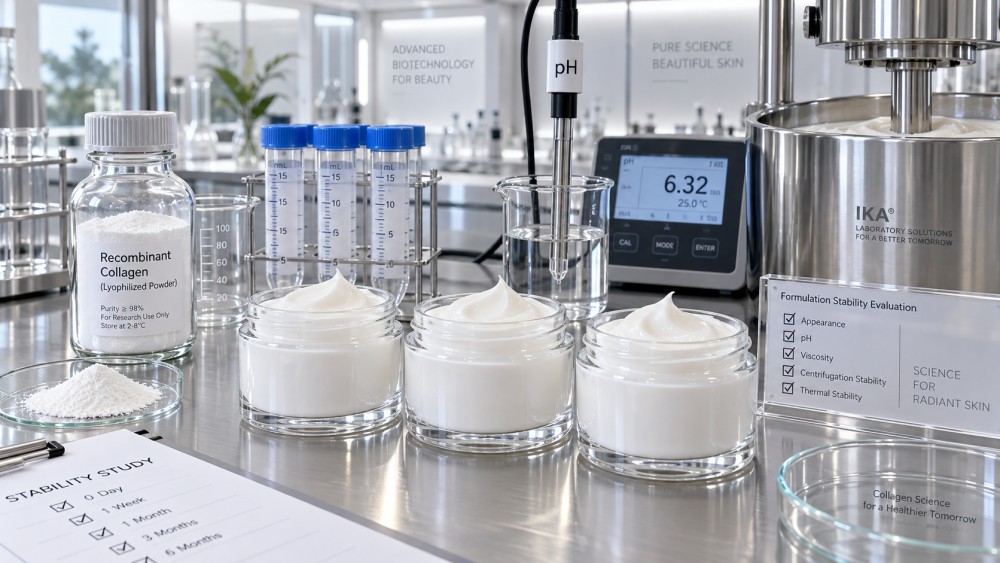
Assess hydration and addition order before changing the emulsifier
Many apparent compatibility failures are actually processing failures. Recombinant collagen powder added directly into a viscous water phase can form a hydrated outer shell around a dry core. The batch may appear smooth immediately after homogenization, then reveal particles or viscosity inconsistency after standing. Excessive shear can also introduce air or alter the structure of a sensitive polymer network.
A sensible early screen uses the intended process water and a controlled hydration procedure. Add the collagen slowly to the designated aqueous phase under moderate agitation, allowing sufficient wetting time before high shear is applied. Where practical, pre-disperse the powder in a compatible humectant or a portion of water, but confirm that the pre-dispersion medium does not reduce later hydration. For liquid grades, add slowly enough to avoid local concentration zones.
Record the following rather than relying only on visual impressions:
- time required to obtain a uniform solution or dispersion;
- temperature at which the material is added;
- mixing speed and duration;
- foam generation and deaeration behavior;
- pH before and after collagen addition;
- any viscosity change after overnight equilibration.
Overnight observation is valuable because hydration, polymer relaxation, and air release may continue after the batch initially looks finished. A material that produces no immediate defect can still create delayed stringiness, sediment-like specks, or a measurable pH shift.
Map pH tolerance against the actual formula window
Collagen-derived proteins and peptides are amphoteric materials. Their charge state changes with pH, which can alter solubility, conformation, aggregation tendency, and interaction with charged polymers. The formula’s target pH should therefore be considered together with its likely drift during stability storage.
Do not test only at one nominal pH. Prepare small aqueous systems or simplified emulsions across a practical window surrounding the target. Observe clarity, precipitation, viscosity, and pH movement after equilibration. The most vulnerable point is often not the target pH itself, but a zone near the protein’s reduced-solubility region where slight acid or base adjustment leads to turbidity or aggregation.
Acid-containing creams deserve particular attention. Alpha hydroxy acids, polyhydroxy acids, ascorbic acid derivatives, and some acidic preservation strategies can change the environment around the collagen. At the other end, neutralization of acrylic rheology modifiers may push local pH upward during manufacturing. Adding the collagen before final pH adjustment can expose it briefly to conditions it will not tolerate in the finished product.
Use gradual pH correction and allow the system to equilibrate after each adjustment. A sharp pH correction made in one spot can create local protein stress even if the final bulk pH appears acceptable.
Test compatibility with the structure-forming ingredients
The stability of a cream depends on a network: emulsifiers create droplets, fatty alcohols and waxes build internal structure, polymers control flow, and aqueous ingredients influence ionic balance. Recombinant collagen may interact with each part of that network differently.
Run a staged compatibility screen rather than changing several variables at once. Start with the base emulsion, then compare a control with the collagen-containing version at the expected use level. Next, add potentially difficult co-actives one by one: acids, niacinamide, mineral-rich extracts, peptides, high electrolyte botanical fractions, or charged polymers. This sequence makes the source of instability easier to identify.
When viscosity falls after collagen addition, do not automatically increase the thickener. First determine whether the loss comes from electrolyte loading, pH movement, emulsion disruption, or a true incompatibility. Adding more polymer may temporarily restore a single measurement while worsening rub-out texture, pilling, or long-term syneresis.
Use stability testing that can reveal the relevant failure mode
Room-temperature storage is necessary, but it is too slow to be the only screen. Accelerated conditions should be selected to expose likely weaknesses without treating every stressed sample as a prediction of exact shelf life. The purpose is comparative: identify which collagen grade or formula version retains its intended structure more reliably.
A useful protocol commonly includes controlled room-temperature storage, elevated-temperature storage, low-temperature exposure, and repeated freeze-thaw cycles where the intended distribution environment justifies them. Centrifugation can be used as a quick emulsion stress indicator, but it should not replace real-time storage because it may exaggerate some separation mechanisms and miss slow chemical changes.
At each pull point, evaluate more than visual phase separation. Measure pH and viscosity using the same spindle, speed, temperature, and equilibration time. If rheology equipment is available, compare flow curves or at least low- and high-shear viscosity to distinguish a simple thickening change from loss of yield structure. Inspect a thin film of cream on a glass plate for particles, watery release, or oil bleed that may be hidden in the bulk container.
Packaging should be included early if the formula is sensitive to air exposure or water loss. A jar, airless pump, tube, and transparent package can produce different outcomes through repeated headspace exposure, shear during dispensing, light exposure, or evaporation at the closure. A collagen-containing cream that is stable in a tightly sealed laboratory vessel may behave differently in its final pack.
Interpret common failure patterns
Fine particles appear after several days
Investigate incomplete hydration, pH-related aggregation, or interaction with a charged polymer. Review the addition temperature and whether the ingredient was introduced before the aqueous phase was fully mixed. Microscopic inspection, if available, can help distinguish undissolved material from wax crystallization or polymer clumps. Reformulating before confirming the particle source often leads to unnecessary changes.
The cream becomes thinner under heat
Check pH drift, electrolyte contribution, and loss of lamellar structure. Compare the collagen grade in a simple thickened-water system and in the full emulsion. If thinning occurs only in the full cream, the issue is more likely connected to the emulsifier-rheology network than to collagen hydration alone. A revised addition point, a lower active level, or a more electrolyte-tolerant thickener may be more effective than increasing wax content.
The product becomes stringy or overly elastic
This can indicate excessive polymer-protein interaction or an overly high molecular fraction for the targeted sensorial profile. Confirm whether the effect develops immediately or after storage. Reducing the collagen level may help, but first compare with a lower-viscosity grade or adjust the balance of associative thickener and gum. Texture should be assessed during application, not only from a viscosity reading.
Color or odor changes during storage
Separate ingredient-related drift from oxidation of oils, fragrances, and botanical co-actives. Test the collagen in water at the same pH and temperature used in the cream. If the aqueous control remains unchanged while the finished product shifts, inspect the oil phase antioxidant strategy, fragrance compatibility, metal contamination risk, and package light transmission. Do not assume that a proteinaceous active is the sole cause simply because it is the newest addition.
Set release criteria that reflect manufacturing reality
A promising laboratory sample should be checked against normal manufacturing variation: water quality, mixing time, order of addition, batch temperature, and raw-material lot differences. Recombinant collagen ingredients can be consistent, yet a formula may still be sensitive to small operational changes. Define the process limits that preserve acceptable results instead of documenting only the ideal bench procedure.
The final assessment should link raw-material controls with finished-cream behavior. Keep records of identity documentation, solids content, appearance, odor, pH, dissolution behavior, and any known carrier materials for each incoming lot. Pair these with finished-batch observations such as viscosity, pH, centrifuge response, accelerated storage appearance, and application feel. This creates a useful basis for investigating later deviations without treating every change as an emulsion failure.
A recombinant collagen ingredient is a stronger candidate when it dissolves predictably, remains compatible across the formula’s pH range, does not introduce disruptive ionic or sensory effects, and retains a uniform cream structure under relevant stress conditions. That evidence is more meaningful than purity in isolation, because stability is ultimately a property of the ingredient inside the complete formulation.
Related News
- How to assess recombinant collagen ingredients for cream stabilityOct 02, 2026Cosmeceutical Formulator
- How to assess an anti-aging ingredients manufacturer’s batch consistencySep 17, 2026Cosmeceutical Formulator
- How to verify cosmetic peptide delivery compliance before launchAug 30, 2026Cosmeceutical Formulator
- When do biomimetic actives in North America justify a premium in anti-aging formulasAug 25, 2026Cosmeceutical Formulator
Related News
- 00
0000-00
What drives fragrance ingredients price changes in bulk orders? - 00
0000-00
How to assess a food antioxidants distributor’s traceability practices - 00
0000-00
How minimum order quantities shape private label ingredient sourcing costs - 00
0000-00
What drives personal care ingredient price volatility in sourcing - 00
0000-00
What drives micelles price differences in cosmetic formulations?
Cosmeceutical Formulator
Weekly Insights
Stay ahead with our curated technology reports delivered every Monday.