





Peptide synthesis sits at the intersection of chemistry, manufacturing strategy, and commercial reality. In food-adjacent health products, premium cosmetics, and active ingredient development, the chosen route shapes far more than yield.
Purity profiles, impurity control, scale-up feasibility, and cost per gram all shift with the method. That is why peptide synthesis decisions often determine whether a candidate remains a promising concept or becomes a reliable product.
For businesses tracked by FFAI, especially those focused on high-end cosmetic actives and performance-led formulations, peptide synthesis also connects to claims support, safety positioning, and long-term supply resilience.
Why synthesis method matters now
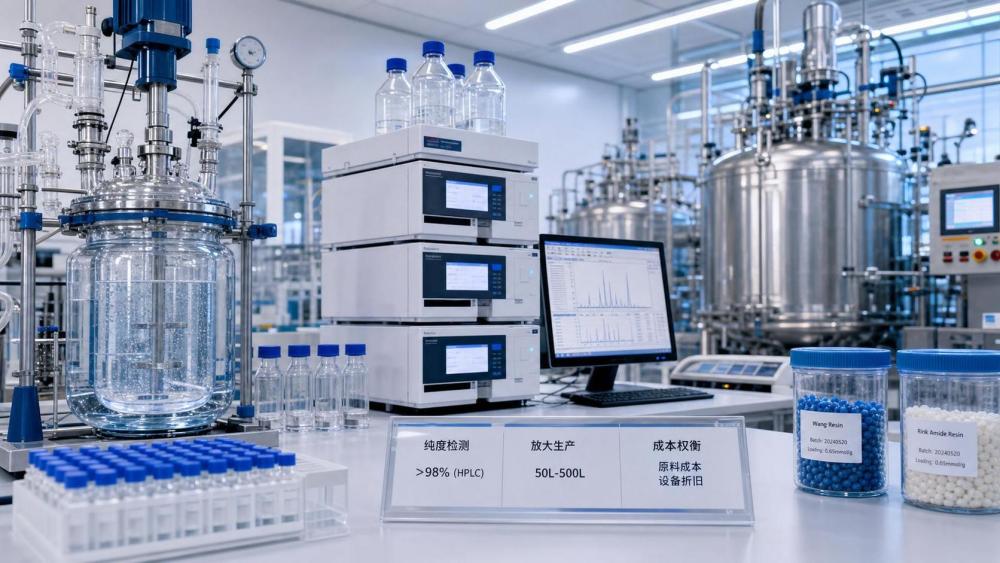
Peptides are no longer niche research materials. They are increasingly used in anti-aging serums, scalp care, nutricosmetic concepts, biomedical testing, and advanced formulation platforms.
That wider use raises the bar. Buyers and formulators want cleaner analytical data, tighter batch consistency, and better transparency on residual solvents, counterions, and process-related impurities.
At the same time, market pressure runs in two directions. Premium brands expect very high purity, while procurement and operations teams still need predictable economics and dependable lead times.
In peptide synthesis, those goals do not always align. A method that performs beautifully at milligram scale may become expensive, slow, or difficult to purify at kilogram scale.
The main peptide synthesis routes in practical terms
Most commercial peptide synthesis work is built around two broad approaches: solid-phase peptide synthesis and solution-phase peptide synthesis. Hybrid strategies also appear in longer or more complex sequences.
Solid-phase peptide synthesis
Solid-phase peptide synthesis, or SPPS, anchors the growing chain to a resin. Reagents and protecting groups are cycled through coupling, washing, and deprotection steps.
The big advantage is speed and operational simplicity during sequence assembly. Excess reagents can drive reactions forward, and washing helps remove many unreacted materials between steps.
SPPS is often preferred for discovery work, custom sequences, and medium-length peptides where flexibility matters more than raw material economy.
Solution-phase peptide synthesis
Solution-phase peptide synthesis builds fragments in liquid phase and isolates intermediates between steps. It usually demands more purification discipline and tighter process control.
However, for selected short peptides or well-optimized fragment strategies, it can lower resin dependence and improve material efficiency at larger scale.
This route becomes attractive when the target sequence is stable, the chemistry is mature, and the manufacturing objective favors scale economics over rapid sequence switching.
Hybrid and fragment condensation strategies
A growing number of suppliers combine methods. They may use peptide synthesis on solid support for critical fragments, then finish assembly in solution.
This can reduce cumulative side reactions in longer sequences. It may also improve throughput when repetitive full-length SPPS becomes too slow or too wasteful.
Purity is more than a single number
In commercial discussions, purity is often reduced to one HPLC percentage. That metric matters, but it does not tell the entire peptide synthesis story.
A peptide at 98% area purity may still carry problematic residuals if the impurity profile is poorly understood. Deleted sequences, epimerization, truncations, salts, and solvent traces all matter.
For cosmetic actives and sensitive health-related applications, the relevant question is whether the purity package supports the intended use, stability expectations, and regulatory pathway.
In other words, strong peptide synthesis evaluation looks at analytical completeness, not only a headline purity claim.
Scale changes the chemistry economics
A synthesis route that is acceptable at five grams may break down at five kilograms. Reagent excess, solvent consumption, resin loading, and cycle time quickly become economic bottlenecks.
SPPS often shines in development because it shortens route design and simplifies switching between candidates. Yet solvent use and resin costs can become substantial at manufacturing scale.
Solution-based peptide synthesis may appear slower early on, but it can provide lower cost of goods when a stable target and repeatable downstream purification are already established.
This trade-off matters in FFAI-covered sectors. High-end cosmetic peptides may tolerate a premium if efficacy, sensory fit, and branding justify it. Commodity-oriented formats usually cannot.
Where cost really comes from
Peptide synthesis cost is rarely explained by amino acid price alone. The larger cost drivers are cumulative yield loss, purification complexity, failed batches, and waste handling.
- Protecting group strategy influences step count and side reactions.
- Coupling efficiency determines how much deletion impurity accumulates.
- Cleavage and deprotection conditions affect degradation risk.
- Purification format shapes solvent use, time, and product recovery.
- Analytical release requirements can materially increase batch cost.
More importantly, the cheapest quote may carry the highest total cost. If a lower-cost source delivers unstable batches or inconsistent impurity fingerprints, reformulation and requalification erase any nominal savings.
Application context changes the preferred route
Different end uses create different peptide synthesis priorities. A route suitable for screening reference material may not fit a consumer-facing active ingredient with strict quality documentation.
Cosmetic actives and transdermal claims
In anti-aging skincare, purity and batch consistency support both efficacy testing and brand credibility. Small changes in impurity distribution may affect stability, odor, color, or compatibility with preservative systems.
Because FFAI tracks premium actives and compliance-sensitive formulation trends, peptide synthesis evaluation should include counterion selection, residual solvent limits, and stability in finished systems.
Nutraceutical and food-adjacent innovation
Where peptides move toward ingestible or food-adjacent concepts, process traceability becomes more important. Documentation expectations can shift quickly depending on market, claims, and regional regulation.
Here, a robust peptide synthesis route is not just about making the molecule. It must also support impurity justification and repeatable quality under commercial supply conditions.
Fragrance, sensory, and multifunctional formulation systems
Even where peptides are not the dominant active, they may sit inside formulations shaped by fragrance oils, thickeners, antioxidants, and surfactants. Compatibility can become a hidden source of failure.
That means peptide synthesis choices should be reviewed alongside formulation matrix behavior, not only as isolated laboratory chemistry.
How to compare options with fewer blind spots
A useful comparison framework keeps technical and commercial questions in the same view. This reduces the risk of selecting a route that looks efficient on paper but struggles in execution.
- Check crude and final purity together, not separately.
- Ask which impurities are most likely at larger scale.
- Review solvent, resin, and chromatography intensity.
- Confirm whether the route has been demonstrated beyond pilot batches.
- Match specification limits to real application risk, not habit.
- Evaluate documentation quality as part of supply reliability.
Often, the best peptide synthesis route is not the most elegant chemically. It is the one that keeps quality, manufacturability, and business continuity in balance.
A practical next step for evaluation
Before narrowing to one supplier or route, map the target peptide against five filters: sequence complexity, required purity, expected annual volume, formulation context, and regulatory exposure.
That simple exercise usually clarifies whether fast SPPS flexibility, larger-scale solution efficiency, or a hybrid peptide synthesis strategy makes the most sense.
From there, side-by-side data on impurity profile, scalability evidence, and cost structure will be more useful than broad marketing claims. In a category where performance and trust travel together, method choice deserves that level of discipline.
Related News
- How to assess recombinant collagen ingredients for cream stabilityOct 02, 2026Cosmeceutical Formulator
- How to assess an anti-aging ingredients manufacturer’s batch consistencySep 17, 2026Cosmeceutical Formulator
- How to verify cosmetic peptide delivery compliance before launchAug 30, 2026Cosmeceutical Formulator
- When do biomimetic actives in North America justify a premium in anti-aging formulasAug 25, 2026Cosmeceutical Formulator
Related News
- 00
0000-00
Verifying halal status of hydrocolloid ingredients in the Middle East - 00
0000-00
How to interpret active matter on a surfactant specification sheet - 00
0000-00
What Quality Checks Should You Run on Fragrance Ingredient Suppliers? - 00
0000-00
How to assess a flavor chemistry manufacturer's batch consistency - 00
0000-00
What drives fragrance ingredients price changes in bulk orders?
Cosmeceutical Formulator
Weekly Insights
Stay ahead with our curated technology reports delivered every Monday.