





Scientific Anti-Aging Compounds: How to Compare Efficacy Claims and Evidence
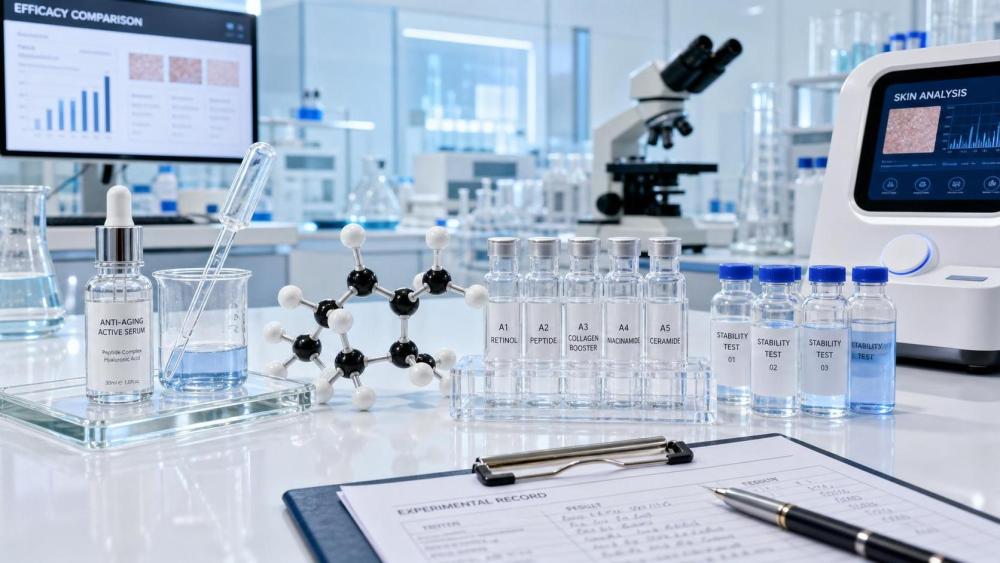
In the crowded market for scientific anti-aging compounds, bold efficacy claims often move faster than solid proof.
That gap creates real commercial risk.
A polished deck can make weak data look persuasive.
For scientific anti-aging compounds, the better question is simple: what kind of evidence actually supports the claim being sold?
This matters in sourcing, formulation, pricing, compliance, and portfolio planning.
A strong active is not just trendy.
It should show a credible mechanism, relevant dose, usable stability, acceptable safety, and realistic consumer benefit.
That is where disciplined comparison creates an advantage.
Start With the Claim, Not the Ingredient Story
Many scientific anti-aging compounds are introduced with a mechanism-heavy narrative.
That narrative may sound advanced, but the claim itself still needs to be defined clearly.
Ask whether the supplier is claiming wrinkle reduction, elasticity improvement, barrier repair, hydration support, pigment control, or oxidative defense.
Each outcome needs different evidence.
A collagen-stimulation claim cannot be validated with hydration data alone.
Likewise, a DNA-protection story does not automatically prove visible anti-aging performance.
In practical evaluation, separate the language into three layers.
- Mechanism claim: what the molecule is said to do biologically.
- Performance claim: what measurable skin change is expected.
- Commercial claim: what premium or differentiation the ingredient supports.
When these three layers are mixed together, weak evidence often hides inside strong wording.
Rank Evidence by Relevance, Not by Volume
A thick technical dossier is not always a strong one.
For scientific anti-aging compounds, relevance beats quantity.
A useful way to compare evidence is to stack it by distance from real product use.
- In silico or theoretical modeling.
- In vitro cell assays.
- Ex vivo skin models.
- Small human instrumental studies.
- Controlled clinical studies in finished formulas.
The higher the evidence sits on this ladder, the more useful it is for business decisions.
Cell data can show promise.
It rarely proves visible anti-aging outcomes on human skin.
More importantly, check whether the tested concentration matches the proposed use level.
If an effect appears at 2%, but the ingredient will be used at 0.1%, the evidence is commercially thin.
A Quick Comparison Framework
Check Mechanism Credibility and Skin Delivery
Scientific anti-aging compounds often win attention through elegant molecular stories.
Still, a mechanism only matters if the compound can reach the relevant biological target.
This is where many comparisons become sharper.
Peptides, botanical fractions, fermented actives, and sugar derivatives all behave differently in the skin.
The stratum corneum remains a major barrier.
So ask practical questions.
- Is the molecule size compatible with topical delivery?
- Is there penetration data, not just theory?
- Does the formula use carriers, encapsulation, or pH support?
- Is the active stable during processing and shelf life?
This matters because unstable anti-aging compounds can lose potency before consumers see any effect.
For example, antioxidants may degrade under heat, light, or oxygen exposure.
Some peptides can also be highly sensitive to formulation stress.
Recent market movement makes this even more important.
Buyers now expect not only a promising molecule, but a reliable delivery system.
Distinguish Statistical Significance From Commercial Meaning
A result can be statistically significant and still commercially weak.
That is one of the most common traps in evaluating scientific anti-aging compounds.
A 3% improvement in one parameter may pass a test.
It may still be invisible to consumers and useless for premium positioning.
Focus on effect size, study duration, and endpoint relevance.
A wrinkle-depth study over eight to twelve weeks usually tells more than a short hydration snapshot.
Pay attention to baseline conditions too.
Results in mildly dry skin may not translate to mature skin with deeper structural aging.
The stronger signal is whether the data can support a believable market story without overstretching.
That also affects claim language, launch timing, and channel strategy.
Review Safety, Regulatory Fit, and Documentation Depth
Efficacy alone does not make scientific anti-aging compounds viable.
Documentation quality often decides whether a promising active can move across markets.
Look for a complete technical package.
- INCI identity and composition clarity.
- Specification ranges and impurity profile.
- Safety assessment or toxicology summary.
- Patch test, irritation, and sensitization data.
- Region-specific compliance support.
This is especially relevant when claims touch renewal, repair, reversal, or biological stimulation.
Aggressive wording can create regulatory pressure even when the ingredient is technically sound.
A supplier that understands FDA, EU cosmetics, and claim substantiation standards adds real value.
That is one reason intelligence-led platforms such as FFAI matter in ingredient screening.
They connect molecular performance with safety, compliance, and pricing logic instead of treating them separately.
Compare Total Business Value, Not Only Lab Performance
In real evaluation work, the best scientific anti-aging compounds are rarely chosen on efficacy alone.
They are chosen because the total package makes sense.
That package includes cost-in-use, formulation compatibility, sensory impact, supply reliability, and claim flexibility.
A premium peptide with unstable supply may create more risk than value.
A slightly less dramatic active with stronger documentation may perform better in the market.
This is also where pricing experts and formulation teams need the same scorecard.
Without that alignment, one side buys a scientific story while the other inherits a delivery problem.
A Practical Decision Checklist
- Define the exact anti-aging claim needed for the product.
- Check whether evidence matches that claim directly.
- Verify dose, delivery, and formula stability.
- Review human data before accepting premium pricing.
- Screen safety and regulatory documents early.
- Compare cost against realistic market differentiation.
A Smarter Way to Read Scientific Anti-Aging Compounds
The market for scientific anti-aging compounds will keep getting louder.
That makes disciplined comparison more valuable, not less.
The strongest decisions usually come from a balanced reading of mechanism, human relevance, safety, stability, and commercial fit.
When evidence is mapped this way, inflated claims become easier to spot.
More importantly, high-potential actives stand out for the right reasons.
A practical next step is to build a shared internal scoring model for scientific anti-aging compounds.
That creates faster screening, cleaner supplier conversations, and more defensible product decisions.
Related News
- How to assess recombinant collagen ingredients for cream stabilityOct 02, 2026Cosmeceutical Formulator
- How to assess an anti-aging ingredients manufacturer’s batch consistencySep 17, 2026Cosmeceutical Formulator
- How to verify cosmetic peptide delivery compliance before launchAug 30, 2026Cosmeceutical Formulator
- When do biomimetic actives in North America justify a premium in anti-aging formulasAug 25, 2026Cosmeceutical Formulator
Related News
- 00
0000-00
Verifying halal status of hydrocolloid ingredients in the Middle East - 00
0000-00
How to interpret active matter on a surfactant specification sheet - 00
0000-00
What Quality Checks Should You Run on Fragrance Ingredient Suppliers? - 00
0000-00
How to assess a flavor chemistry manufacturer's batch consistency - 00
0000-00
What drives fragrance ingredients price changes in bulk orders?
Cosmeceutical Formulator
Weekly Insights
Stay ahead with our curated technology reports delivered every Monday.