





Why Synthetic Peptides Matter Now
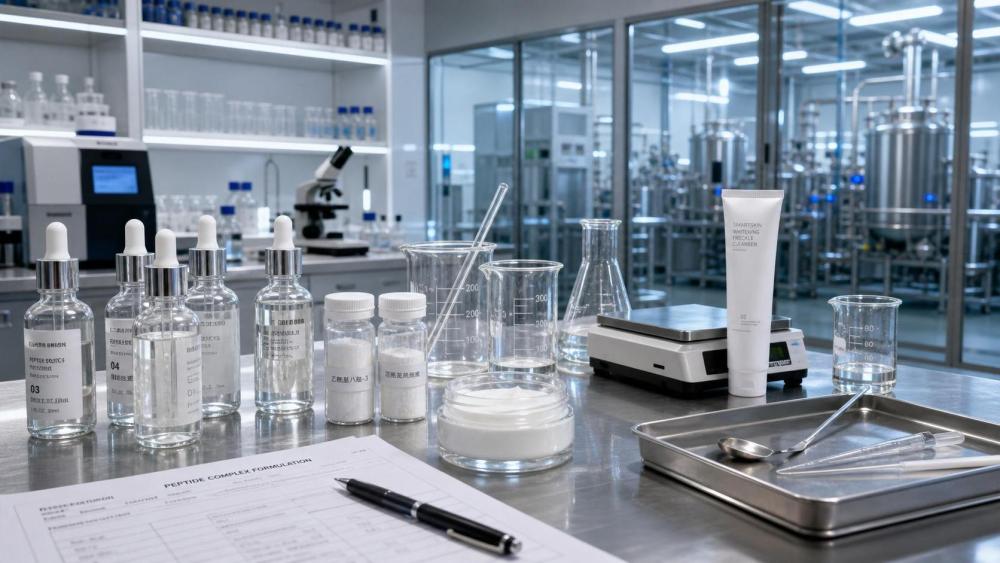
Synthetic peptides sit at the intersection of efficacy storytelling, formulation science, and margin discipline.
They are no longer niche actives reserved for prestige launches or laboratory curiosity.
In cosmetics, nutraceuticals, and adjacent FMCG innovation, they increasingly shape premium claims.
That shift brings real opportunity, but also sharper trade-offs.
A peptide that performs well in a paper or pilot batch may struggle in full-scale manufacturing.
A molecule that supports anti-aging positioning may also raise sourcing, stability, and compliance complexity.
For platforms such as FFAI, this is exactly where ingredient intelligence becomes commercially useful.
The conversation is not only about activity at the molecular level.
It is about whether synthetic peptides can survive real formulas, real timelines, and real price expectations.
What Synthetic Peptides Actually Represent
Synthetic peptides are short chains of amino acids designed and manufactured for targeted functional outcomes.
Their appeal comes from precision.
Unlike broader botanical extracts, they are often built to influence specific biological pathways or visible performance markers.
In skin care, they may support barrier repair, wrinkle reduction, firmness, or hydration signaling.
In nutraceutical development, peptide systems may be explored for bioactive positioning or specialized delivery concepts.
Their relevance also extends to broader formulation strategy.
A peptide is rarely just an ingredient line on a specification sheet.
It often becomes the anchor for product architecture, clinical substantiation, pricing logic, and brand differentiation.
That explains why synthetic peptides attract so much attention in high-end active ingredient portfolios.
Performance Is Powerful, but Never Isolated
The first attraction is performance.
Well-selected synthetic peptides can support sharper efficacy narratives than many commodity actives.
They may help justify claims around visible renewal, smoother texture, or age-defying support.
That matters in categories where consumers increasingly expect proof, not poetic language.
Still, performance should be read in context.
A peptide with excellent in vitro data may underdeliver if penetration is weak or the formula matrix is hostile.
Heat, pH, metal ions, oxidation, and incompatible preservatives can all change the practical result.
This is why peptide evaluation belongs beside the same technical rigor used for antioxidants, thickeners, and surfactants.
In FFAI terms, efficacy is only credible when molecular promise connects with formulation reality.
Where performance often breaks down
- Insufficient skin penetration or poor bioavailability in the final delivery system.
- Loss of activity during heating, homogenization, or long storage cycles.
- Incompatibility with fragrance systems, emulsifiers, chelators, or preservation packages.
- Marketing claims that outrun available technical and regulatory support.
The Real Cost Equation
Cost is usually discussed too narrowly.
The price per kilogram matters, but it rarely tells the whole business story.
Synthetic peptides carry upstream and downstream costs that can reshape the economics of a launch.
Purity targets, synthesis complexity, yield loss, and analytical testing all affect the final ingredient cost.
Then come reformulation trials, stability work, claims support, packaging adjustments, and inventory risk.
A higher-cost peptide may still be rational if it enables premium pricing or category entry.
But that only holds when the performance story survives operations and scale.
This broader lens matters in premium FMCG, where ingredient cost and sensory delivery must coexist.
Formulation Trade-Offs Deserve Early Attention
Synthetic peptides are often chosen for advanced performance, yet they can be sensitive guests inside a formula.
Their success depends on the surrounding system.
Texture modifiers, solvents, fragrance materials, surfactants, and preservatives may all influence peptide behavior.
This creates a practical tension familiar across FFAI categories.
The same formula needs elegant sensory character, robust shelf life, and active integrity.
In anti-aging skin care, for example, a peptide may require a narrow pH range.
That may conflict with preservation efficiency or with other actives in a multi-benefit serum.
In rinse-off systems, residence time may be too short to support the intended value proposition.
In ingestible formats, taste masking and process stress can complicate use even further.
Questions worth asking before lock-in
- Does the formula environment protect peptide stability over target shelf life?
- Will processing conditions degrade the active before filling?
- Can the sensory profile remain premium after adding support systems?
- Is the peptide still differentiated at the intended use level?
Where Synthetic Peptides Create the Most Business Value
Not every category needs peptide complexity.
The strongest fit appears where visible efficacy, premium positioning, and technical substantiation matter together.
High-end skin care remains the clearest example.
Here, synthetic peptides can help support product stories around repair, firmness, contour, and age-related concerns.
They also pair well with clinically oriented branding strategies.
Beyond cosmetics, peptide systems may influence specialized nutraceutical concepts and adjacent wellness products.
The logic is similar across these spaces.
If a product needs a defensible efficacy moat, synthetic peptides deserve review.
If the category mainly competes on low cost or simple function, they may add burden without enough return.
Signals That Separate a Strong Peptide Program from a Weak One
The most effective programs treat synthetic peptides as part of a system, not a slogan.
That means combining molecular selection, formulation discipline, compliance review, and pricing logic from the beginning.
It also means avoiding false shortcuts.
A cheaper peptide source can become expensive if batch variability forces repeated reformulation.
A strong efficacy claim can become fragile if regional regulatory language is not aligned.
This is where cross-functional intelligence has real value.
FFAI’s wider lens is useful because peptide success rarely exists in isolation from preservatives, rheology, sensory systems, or market access requirements.
- Prioritize supplier transparency on sequence, purity, residuals, and batch consistency.
- Run stability screening in realistic finished bases, not only simplified lab media.
- Evaluate claims against regional compliance pathways early, especially in export markets.
- Model commercial upside against total development cost, not ingredient cost alone.
- Check how the peptide interacts with the broader sensory and preservation strategy.
How to Frame the Next Decision
Synthetic peptides can be excellent growth tools, but only when they are chosen with discipline.
The better question is not whether peptides are attractive.
It is whether a specific peptide can carry its scientific promise through formulation, compliance, and commercialization.
That evaluation should start with intended claim, target format, use level, stability limits, and acceptable cost of proof.
From there, compare suppliers, validate compatibility, and pressure-test the margin story under realistic scale assumptions.
For organizations tracking the future of taste, beauty, and active ingredient performance, this is where synthetic peptides move from trend to strategy.
A clear next step is to build a decision framework that weighs efficacy evidence, formulation fit, compliance readiness, and pricing power together.
That framework will usually reveal whether synthetic peptides are a premium advantage, an unnecessary cost, or the foundation of the next differentiated launch.
Related News
- How to assess recombinant collagen ingredients for cream stabilityOct 02, 2026Cosmeceutical Formulator
- How to assess an anti-aging ingredients manufacturer’s batch consistencySep 17, 2026Cosmeceutical Formulator
- How to verify cosmetic peptide delivery compliance before launchAug 30, 2026Cosmeceutical Formulator
- When do biomimetic actives in North America justify a premium in anti-aging formulasAug 25, 2026Cosmeceutical Formulator
Related News
- 00
0000-00
Verifying halal status of hydrocolloid ingredients in the Middle East - 00
0000-00
How to interpret active matter on a surfactant specification sheet - 00
0000-00
What Quality Checks Should You Run on Fragrance Ingredient Suppliers? - 00
0000-00
How to assess a flavor chemistry manufacturer's batch consistency - 00
0000-00
What drives fragrance ingredients price changes in bulk orders?
Cosmeceutical Formulator
Weekly Insights
Stay ahead with our curated technology reports delivered every Monday.