





Acceptable peptide purity for cosmetic manufacturing is a documented specification that supports the ingredient’s intended use. There is no single percentage that makes every cosmetic peptide suitable. A material must have the correct identity, sufficient active content, controlled impurities, and stability under the conditions in which it will be manufactured, stored, and applied.
If you are comparing materials advertised as 95%, 98%, or 99% pure, those figures need a measurement method and a clear reporting basis before they mean much. A high percentage from high-performance liquid chromatography (HPLC) does not, by itself, establish how much peptide is present by weight or whether the material is safe for a finished cosmetic.
FFAI’s approach to evaluating cosmetic actives starts with that distinction: connect analytical results to the actual formula. The practical task is to define what the ingredient needs to deliver, identify which impurities matter, and set acceptance limits that can be checked consistently.
Understand what the supplier’s purity percentage measures
“Peptide purity” can describe several different measurements. Confusing them can lead to incorrect dosing, misleading price comparisons, or an incomplete safety assessment.
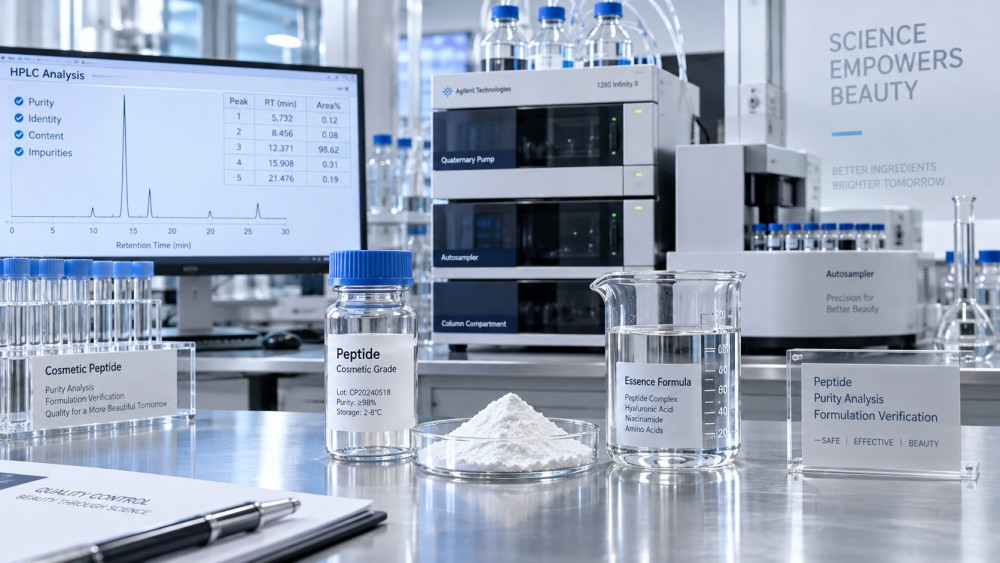
HPLC area purity often divides the target peak area by the total integrated peak area. That calculation depends on separation, detection, and integration settings. Different compounds can produce different detector responses, while some components may not appear meaningfully in the chromatogram.
A powder with high HPLC purity can still contain water, counterions, or residual solvents. These affect the material’s composition without necessarily appearing as peptide-related impurity peaks. Ask whether the quantitative assay is reported on an as-supplied, dried, or another defined basis.
A peptide solution needs a different reading. Water, glycerin, and other declared carriers are intentional ingredients. Their presence does not make the peptide impure. The relevant questions are how much peptide the solution contains, how its quality is controlled, and whether the carrier system works in your formula.
Set the specification around the intended use
The first decision is which material you are qualifying: an isolated synthetic peptide, a peptide complex, a formulated solution, or a protein hydrolysate containing a mixture of peptides. A single-sequence purity specification may suit an isolated peptide but poorly describe a deliberately mixed hydrolysate.
Define the exact identity, including relevant modifications, salt form, and complexation state. Lipid modification or metal coordination can affect solubility, analytical behavior, and formulation compatibility. Similar ingredient names do not guarantee interchangeable materials.
Then establish the intended peptide concentration in the finished product, application area, frequency of use, and whether the product is rinsed off or left on. These conditions shape exposure and the safety assessment. A specification developed for one application should not automatically carry over to another.
A purity limit should be justified by the material’s impurity profile and use conditions. Raising a headline requirement from 95% to 99% may reduce some related substances, but the benefit depends on which substances are removed. A small amount of an impurity with a significant hazard can deserve more attention than a larger amount of a well-characterized, lower-concern component.
A lower-purity grade may be acceptable when its composition is sufficiently understood, its impurities are controlled at appropriate limits, and the intended use is supported by the safety assessment. An unidentified or inconsistent impurity profile weakens that justification, even when the headline purity looks attractive.
Review the certificate of analysis beyond the purity line
A certificate of analysis (CoA) should connect a specific batch to agreed specifications. A brochure stating “high purity” or a generic example certificate cannot establish the quality of the batch being purchased.
Check the batch identifier, test methods, acceptance criteria, results, and relevant manufacturing or retest information. Distinguish a numerical result from a simple “passes” statement. Both can serve a purpose, but numerical results make trends easier to assess.
The supporting documentation should address the following areas:
- Identity: Analytical evidence appropriate to the peptide, including expected molecular mass where relevant. Mass alone may not distinguish every closely related structure.
- Quantitative assay: Target peptide content with a stated reporting basis and a method suitable for measuring it.
- Related substances: Controls for relevant synthesis by-products, shortened sequences, oxidation products, or other degradation products.
- Process residues: Risk-based limits for solvents, reagents, and other substances associated with manufacture.
- Water and counterions: Measurements or compositional information where these influence dosing, handling, or compatibility.
- Microbiological quality: Criteria appropriate to the ingredient form and intended use, particularly for aqueous blends.
- Storage and packaging: Conditions supported by stability information.
Not every peptide requires the same test panel. Manufacturing route and composition determine what matters. Fermentation-derived materials may need controls for process-related residues different from those associated with chemical synthesis. A metal-complexed peptide also needs suitable control of its intended composition.
For an unfamiliar supplier or a material central to product performance, independent testing can help establish confidence in identity and assay. Use methods capable of answering the actual question; repeating an unsuitable purity method adds little assurance.
Translate raw-material results into the finished formula
Once the material is characterized, calculate the amount of peptide the formula will actually contain. Use quantitative peptide content rather than assuming that HPLC area purity equals a weight fraction.
For a supplied solution, the basic relationship is:
Finished-product peptide concentration = ingredient addition rate × peptide concentration in the supplied ingredient.
Keep units consistent. The addition rate of a commercial peptide blend is not the concentration of pure peptide in the finished product. This distinction affects formulation records, ingredient comparisons, and the interpretation of performance evidence.
For a powder, account for its assayed peptide content on the relevant basis. Two materials with the same HPLC purity can deliver different amounts of peptide per gram because of differences in moisture, counterions, or other components.
The same calculation helps assess impurity exposure. An impurity’s concentration in the ingredient and the ingredient’s addition rate determine its nominal concentration in the formula. Its significance also depends on hazard, application conditions, and whether degradation during storage creates additional substances.
Low dosage alone does not establish acceptability. Dilution can reduce exposure, but it does not identify an unknown impurity or replace a safety assessment. Likewise, increasing the ingredient dose to compensate for low assay also increases exposure to everything supplied with it.
Check whether the peptide survives manufacturing and storage
A peptide can meet its incoming specification and lose quality after incorporation. Raw-material purity therefore needs to be paired with a formulation compatibility assessment.
Start with the supplier’s supported processing conditions, then assess the actual formula. Depending on the peptide, heat, pH, oxygen, light, or other ingredients may promote degradation or interfere with availability. Lipid-modified peptides can also behave differently from readily water-soluble peptides.
When supported by the ingredient’s handling guidance, addition during a cooler manufacturing stage may help limit heat exposure. However, cooling alone cannot resolve poor solubility, an unsuitable pH, or an incompatible ingredient combination.
Evaluate the finished product for changes in appearance, precipitation, odor, viscosity, and peptide content where a suitable analytical method is available. A visually stable serum can still experience chemical degradation, so appearance alone is insufficient.
Packaging belongs in this assessment. A container that limits light or air exposure may benefit a sensitive formula, but packaging choices need to follow the peptide’s identified vulnerabilities. A more protective-looking pack does not automatically improve stability.
For aqueous products, assess preservation in the finished formula. Low incoming microbial counts do not demonstrate that a cream or serum will remain adequately protected throughout use.
Make the purchasing specification clear enough to enforce
A useful specification states more than “cosmetic grade” or “minimum purity.” Those descriptions leave too much room for different interpretations.
Build the specification around defined identity, assay, chromatographic purity where relevant, impurity controls, microbiological criteria, and storage requirements. Each acceptance limit should have an appropriate method and reporting basis. Analytical methods should be sufficiently selective and reliable for their intended purpose.
Supplier comparisons also need consistent measurement conditions. Two HPLC results may differ because the methods use different columns, detection settings, or integration rules. A higher reported percentage does not always establish a cleaner material when the methods are not comparable.
Agree on how changes will be communicated. A new synthesis route, purification process, manufacturing site, carrier composition, or packaging system can affect the ingredient even if its name and headline purity remain the same.
Separate qualification from routine release. Initial qualification establishes whether the material and supplier are suitable. Routine batch checks then confirm continued compliance, while periodic review looks for drift in assay, impurities, or other relevant results.
An unexpectedly low assay or new impurity peak warrants investigation before a batch is used. Simply increasing the dose can obscure the cause and alter the formula’s impurity exposure.
Balance purity, compliance, and cost using the same evidence
The cheapest kilogram may not provide the cheapest usable peptide. Compare materials using assayed active content, compatibility, handling requirements, and the evidence supporting their use. A readily dispersible blend may offer practical value even when its price per unit of peptide is higher.
Conversely, paying for additional purification has limited value if the main problem is incorrect identity, inadequate assay control, or degradation in the formula. Higher purity can improve consistency when relevant impurities are reduced; it does not establish skin penetration or cosmetic efficacy.
Regulatory suitability is another separate question. A research-use label does not provide a cosmetic safety dossier, and a “cosmetic grade” claim does not replace one. EU cosmetic notification is not an approval of peptide purity, while food-related safety status does not automatically establish suitability for topical use.
Before approving a grade, make the decision reviewable: define the material, calculate the delivered peptide concentration, assess relevant impurities, and demonstrate compatibility with the intended product. Those records provide a defensible reason to accept a particular purity specification—and a clear basis for rejecting a batch that fails it.
Related News
- Can biomimetic peptides improve skin firmness?Nov 13, 2026Cosmeceutical Formulator
- How to choose peptide ingredients for an anti-aging serumNov 06, 2026Cosmeceutical Formulator
- How to assess European bioactive peptide suppliers for batch consistencyOct 29, 2026Cosmeceutical Formulator
- How biomimetic peptides work in anti-aging skincare formulationsOct 27, 2026Cosmeceutical Formulator
Related News
- 00
0000-00
Wissen Research: Global Cosmetics Market to Reach $497.2 Billion by 2031 - 00
0000-00
Can biomimetic peptides improve skin firmness? - 00
0000-00
China Records 543 New Cosmetic Ingredients, Including 167 in 2026 - 00
0000-00
How to check a fragrance raw material specification for IFRA compliance - 00
0000-00
Australia and New Zealand Weigh Wider Steviol Glycoside Use in Griddle Products
Cosmeceutical Formulator
Weekly Insights
Stay ahead with our curated technology reports delivered every Monday.