





Technical evaluators searching for guidance on recombinant proteins for skincare usually want a screening framework, not marketing language. Their core intent is to understand what must be verified before a protein is accepted into a cosmetic formula, where the real technical risks sit, and how to distinguish a genuinely usable active from one that only looks promising on a supplier deck.
For this audience, the biggest concerns are practical and decision-driven: expression system credibility, impurity profile, structural integrity, biological relevance in topical use, formulation stability, compatibility with preservatives and processing conditions, safety documentation, and regulatory fit across target markets. They also need to know whether claimed efficacy survives real formulation stress and whether the added cost is justified.
The most useful content, therefore, is a due-diligence checklist with technical reasoning behind each checkpoint. What helps them most is a structured way to evaluate specification sheets, analytical data, supplier quality systems, and formulation trial results. Broad educational background on proteins should stay brief, while detailed discussion of characterization, contamination, stability, delivery limits, and validation workflow should take priority.
In the article itself, the emphasis should be on pre-formulation assessment, analytical verification, risk control, and decision criteria for go or no-go selection. Generic commentary about biotechnology trends, anti-aging market growth, or vague efficacy benefits should be minimized unless directly tied to technical selection risk.
What to check before using recombinant proteins for skincare formulas
Before selecting recombinant proteins for skincare formulas, technical evaluators need to look beyond efficacy claims and verify purity, structural stability, bioactivity, safety, regulatory fit, and formulation compatibility. Even promising actives can underperform if expression systems, contamination risks, or delivery conditions are overlooked. This guide outlines the critical checkpoints that help teams assess recombinant proteins for skincare with greater scientific confidence and lower development risk.
Start with the real question: can this protein survive and function in a cosmetic system?
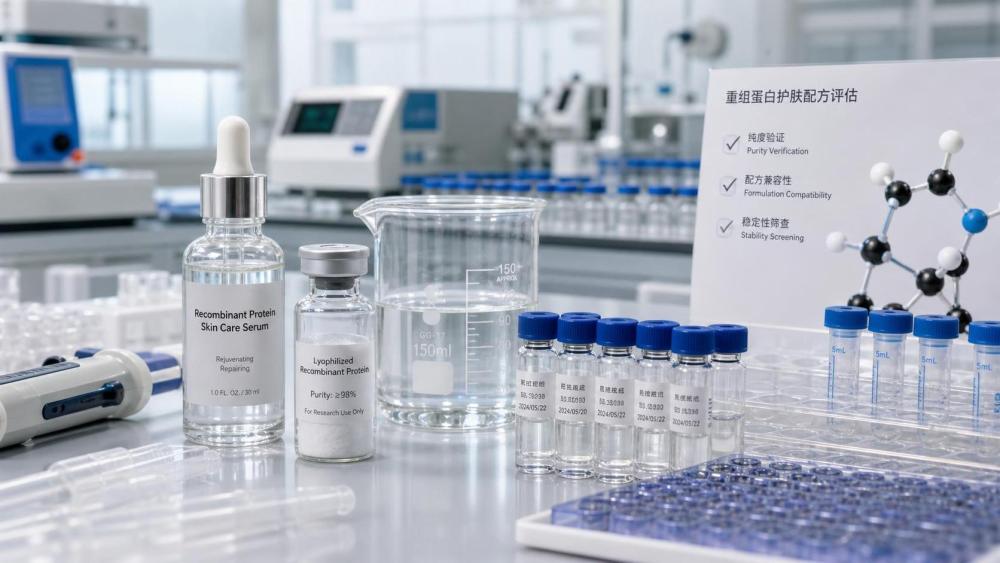
The first screen should be brutally practical. A recombinant protein may look impressive in supplier literature, but that does not mean it remains active, stable, or relevant once dispersed into a finished skincare base.
Technical evaluators should first define the intended role of the ingredient. Is it expected to support barrier repair, hydration, soothing, antioxidant defense, or signaling activity linked to visible anti-aging outcomes?
That intended role determines the evidence threshold. A film-forming recombinant collagen fragment, for example, can be assessed differently from a growth-factor-like protein that claims to influence skin-cell behavior.
This distinction matters because the higher the biological claim, the stronger the burden of proof. Many recombinant proteins for skincare sound potent in theory, yet their real topical performance is limited by size, instability, or low skin availability.
Before moving deeper, ask three basic questions. Does the molecule have a plausible topical mechanism, can it remain intact in the target formula, and can it deliver measurable value at its proposed use level?
Check the expression system, because origin affects risk, purity, and perception
The production host is not a minor detail. It shapes impurity risk, post-translational modifications, endotoxin burden, allergen concerns, and even how the material will be positioned in different markets.
Common recombinant systems include E. coli, yeast, fungal hosts, plant platforms, and mammalian cells. Each has advantages, but each also creates specific analytical and regulatory questions that must be answered before selection.
E. coli systems are efficient and cost-effective, but they raise clear concerns around endotoxins, host-cell proteins, and limited post-translational modification. If the protein depends on complex folding or glycosylation, bacterial expression may be problematic.
Yeast and fungal systems may improve folding for some proteins, yet they can introduce different glycosylation patterns and residual impurities. Mammalian systems may better reproduce native structures, but they tend to be expensive and more complex to control.
Technical evaluators should request explicit information on the host organism, fermentation controls, purification sequence, and whether the final protein contains tags, carriers, or residual processing aids. Do not rely on umbrella terms like biotech-derived or bio-identical.
If the supplier cannot clearly explain the expression platform and purification logic, that is already a meaningful risk signal. For high-value actives, opacity around upstream processing often predicts downstream trouble.
Verify purity beyond the headline specification
A certificate of analysis that lists high protein content is not enough. Purity must be understood in compositional terms, because biological residues and trace contaminants can affect safety, stability, odor, color, and formula robustness.
Ask what the reported purity actually means. Is it protein assay purity, chromatographic purity, electrophoretic band purity, or a nitrogen-based estimate? Those numbers are not interchangeable and can create false confidence.
At minimum, evaluators should review data from methods such as SDS-PAGE, HPLC or UPLC, peptide mapping, and where relevant, mass spectrometry. These help confirm whether the expected molecular species dominates the sample.
Host-cell proteins deserve particular attention, especially for proteins used at low inclusion rates with strong biological positioning. Small residual amounts may still matter if they alter irritation potential or create inconsistency between lots.
Endotoxin testing is another non-negotiable checkpoint for many recombinant proteins for skincare, especially when produced in gram-negative bacterial systems. Cosmetic use does not remove the need for strict scrutiny if a protein is intended for frequent skin contact.
Also check residual solvents, heavy metals, microbial limits, bioburden, and preservative residues carried over from manufacturing. A premium protein active loses value quickly if hidden contaminants complicate formulation or safety assessment.
Confirm structural identity and folding, not just amino acid sequence
A recombinant protein can have the correct sequence and still be functionally wrong. Misfolding, aggregation, truncation, oxidation, deamidation, or incorrect disulfide pairing may reduce activity or increase instability in the final product.
For this reason, sequence confirmation should be paired with structural characterization. Depending on the ingredient type, useful tools may include circular dichroism, SEC for aggregate profiling, thermal shift data, or bioassays linked to the proposed mechanism.
Aggregation is especially important in skincare development. Protein aggregates may reduce reproducibility, alter appearance, increase haze, destabilize emulsions, or affect tolerability. They can also worsen over time under normal storage stress.
Technical teams should ask how the supplier controls oxidation and conformational drift during manufacturing and storage. If the protein is sensitive to pH, ionic strength, light, or trace metals, those limits must be documented clearly.
Lot-to-lot consistency matters as much as single-batch quality. If one batch behaves differently in solubility or potency, the issue often traces back to structural variation that was never adequately monitored.
Test whether the claimed bioactivity is relevant to topical skincare use
One of the most common mistakes is accepting biological claims from non-topical contexts. A protein that performs in cell culture, injectable research, or wound models may not deliver equivalent value in a cosmetic formulation.
Technical evaluators should ask whether the supplier’s bioactivity data reflects cosmetic use conditions. Was the ingredient tested at realistic concentrations, under topical exposure scenarios, and against endpoints relevant to finished-product claims?
For example, if a recombinant peptide or growth-factor-like protein claims anti-aging performance, the evidence should connect the ingredient to meaningful markers such as collagen-related signaling, barrier support, hydration metrics, or visible wrinkle-linked outcomes.
Just as important, the activity should be retained after incorporation into the intended formula type. A result generated from a buffered aqueous stock does not prove the same result in a surfactant cleanser, gel serum, or preserved emulsion.
Because skin penetration is limited for many larger proteins, be realistic about what level of activity is plausible. In some cases, surface conditioning or indirect soothing effects may be more credible than deep regenerative claims.
That does not make the ingredient useless. It means evaluators should align expectations with physical reality and claim strategy, rather than paying for biological complexity the formulation cannot actually exploit.
Stress-test formulation compatibility early
Many recombinant proteins fail not because they lack intrinsic value, but because the formula environment quietly destroys them. Early compatibility work prevents expensive late-stage surprises.
Start with pH tolerance. Proteins can unfold, precipitate, or lose activity outside a narrow range. A supplier’s recommended pH window should be verified inside the target base, not treated as a theoretical note.
Next, check ionic strength and excipient interactions. Salts, polyols, glycols, surfactants, chelators, and some botanical extracts can change folding behavior, adsorption, or solubility. Interactions may be subtle at first and worsen during aging.
Preservatives deserve focused attention. Phenoxyethanol, organic acids, alcohol systems, or multifunctional boosters may affect protein stability directly. Even if the protein survives initial mixing, long-term potency loss can still be severe.
Processing conditions also matter. High shear, heating, vacuum deaeration, freeze-thaw cycles, and filling conditions can all damage sensitive proteins. If cold-process handling is required, that constraint must be operationally acceptable.
Run accelerated and real-time stability testing with the protein inside the actual prototype. Monitor not only appearance and odor, but also potency, aggregate formation, pH drift, viscosity effects, and microbial preservation performance.
Review safety data with cosmetic exposure in mind
Recombinant origin does not automatically mean safer or riskier. What matters is the full safety package, exposure context, impurity profile, and intended population.
For technical assessment, request toxicological summaries, skin irritation and sensitization data, ocular tolerance where relevant, and any information on repeated-use exposure. If the ingredient is used around compromised skin claims, caution should increase.
Immunogenicity is often discussed more in pharmaceutical settings, but it should not be ignored entirely for cosmetic proteins, especially where the protein is novel, highly active, or structurally close to signaling molecules.
Allergen risk may also come indirectly from production residues rather than the target protein itself. This is another reason host-cell impurities and purification efficiency need proper review.
Safety evaluation should include the whole formula context. A stable protein in isolation may degrade into fragments in a finished system, and those degradation products should not be treated as irrelevant without evidence.
Match the ingredient to regulatory and claim boundaries
Technical fit is only half the decision. Recombinant proteins for skincare must also fit the regulatory framework and claim strategy of the target market.
Check INCI naming status, documentation needed for cosmetic product files, regional restrictions, and whether the ingredient’s mechanism risks drifting into drug-like positioning. This is especially relevant for proteins associated with repair, regeneration, or cell signaling.
Marketing teams may want bold language around skin renewal or biomimetic repair, but evaluators should test whether the evidence supports cosmetic wording without creating compliance exposure.
For multinational launches, verify whether supplier dossiers are complete enough for EU, US, and other target-market expectations. Missing traceability, impurity justification, or safety rationale can delay commercialization long after formulation work is finished.
Evaluate supplier quality systems, not just the ingredient sample
A strong lab sample is useful, but repeatable commercialization depends on manufacturing discipline. Technical evaluators should inspect the supplier’s quality system with the same seriousness given to the protein itself.
Ask about batch traceability, change-control procedures, retention samples, specification revision practices, deviation handling, and long-term supply continuity. Small process changes can alter a recombinant material more than expected.
It is also worth reviewing packaging format, cold-chain requirements, shelf life, and reconstitution instructions if the ingredient is supplied as a lyophilized powder. These details affect factory practicality and failure risk.
If an ingredient needs exceptional handling to remain viable, its operational burden may outweigh its theoretical benefit. A technically elegant active is still a poor choice if it cannot survive routine industrial use.
Use a go or no-go framework before full development
The most effective way to screen recombinant proteins for skincare is to formalize decision gates. This helps teams avoid being pulled forward by novelty, premium positioning, or incomplete supplier data.
A practical framework includes six gates: identity and structure confirmed, impurity risks understood, bioactivity relevant to topical use, prototype compatibility demonstrated, safety package sufficient, and regulatory pathway clear.
If one of these gates remains weak, the ingredient should stay in limited evaluation rather than moving into expensive claim development or scale-up. This protects both budget and launch timelines.
For many teams, the smartest outcome is not immediate rejection or approval, but a targeted data request list. When suppliers can answer those points with credible analytics, the ingredient can be reassessed on stronger technical ground.
Conclusion
Choosing recombinant proteins for skincare formulas is ultimately a risk-management exercise grounded in science. The right question is not whether a protein sounds advanced, but whether it is well-characterized, stable, safe, compliant, and truly useful in the finished formula.
For technical evaluators, the most reliable decisions come from connecting molecular data with formulation reality. When expression system, purity, folding, topical relevance, compatibility, and regulatory fit are all verified, recombinant proteins can become credible high-value actives rather than expensive formulation liabilities.
Related News
- How to assess recombinant collagen ingredients for cream stabilityOct 02, 2026Cosmeceutical Formulator
- How to assess an anti-aging ingredients manufacturer’s batch consistencySep 17, 2026Cosmeceutical Formulator
- How to verify cosmetic peptide delivery compliance before launchAug 30, 2026Cosmeceutical Formulator
- When do biomimetic actives in North America justify a premium in anti-aging formulasAug 25, 2026Cosmeceutical Formulator
Related News
- 00
0000-00
Verifying halal status of hydrocolloid ingredients in the Middle East - 00
0000-00
How to interpret active matter on a surfactant specification sheet - 00
0000-00
What Quality Checks Should You Run on Fragrance Ingredient Suppliers? - 00
0000-00
How to assess a flavor chemistry manufacturer's batch consistency - 00
0000-00
What drives fragrance ingredients price changes in bulk orders?
Cosmeceutical Formulator
Weekly Insights
Stay ahead with our curated technology reports delivered every Monday.