





From 1 July 2026, the EU Cosmetics Products Notification Portal (CPNP) will require a new layer of ingredient traceability for certain imported cosmetics. The change matters because products containing Pro-Xylane, Acetyl Hexapeptide-8, or recombinant collagen will need batch-level purity documentation at the notification stage, linking compliance, laboratory testing, product release timing, and distributor launch preparation more tightly than before.
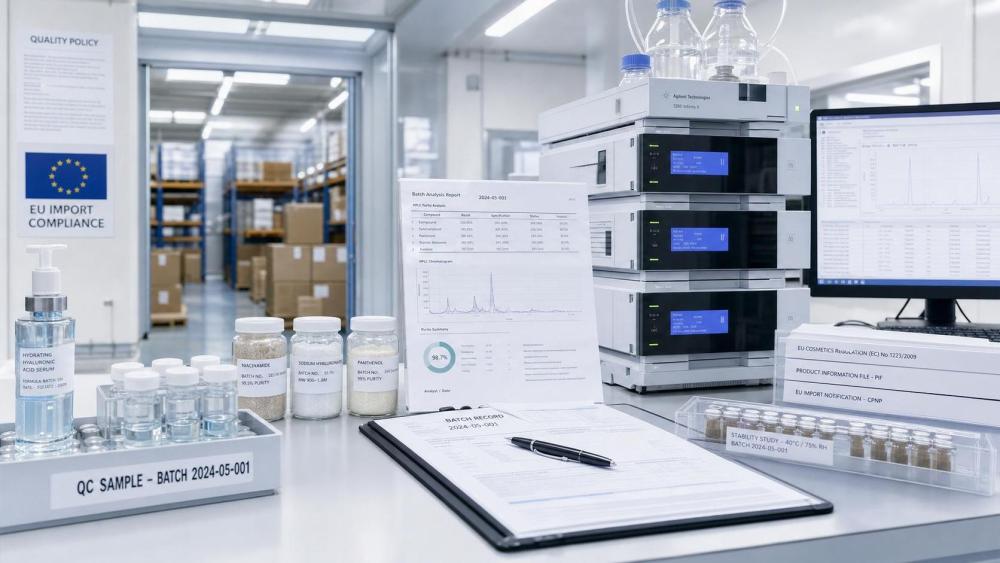
What the CPNP v3.2 change requires
According to the information provided, CPNP will mandatorily switch to version 3.2 on 1 July 2026. The updated system adds an “Active Ingredient Purity Traceability” field. For imported products containing Pro-Xylane, Acetyl Hexapeptide-8, or recombinant collagen, the notification process must include a batch-level HPLC purity report issued by an ISO/IEC 17025 accredited laboratory, with a stated accuracy of plus or minus 0.2%.
The same information also indicates that this requirement is expected to significantly extend product launch preparation time for European distributors.
Where the operational pressure is likely to appear
Import notification and distributor onboarding
From an industry perspective, European distributors and import-side compliance teams are likely to feel the impact first because the new requirement sits directly inside the notification workflow. The immediate pressure point is not only whether a product contains one of the named actives, but whether the matching batch-level purity report is ready in time for filing. That makes documentation readiness part of launch scheduling rather than a back-end quality record.
Raw material sourcing and supplier coordination
Analysis shows that sourcing teams and ingredient suppliers may also face tighter coordination demands. If a finished product includes one of the listed actives, buyers may need to pay closer attention to whether upstream suppliers can support batch-linked purity evidence in a form that can be used for CPNP submission. The practical issue here is less about broad product claims and more about document consistency between purchased material, laboratory output, and import filing records.
Manufacturing and batch release planning
For manufacturers and exporters, the change can affect batch release sequencing and shipment preparation. Where a product is intended for EU import, the usable batch may now depend not only on production completion but also on the availability of an HPLC purity report from an ISO/IEC 17025 accredited laboratory. Observably, this can push testing documentation closer to the critical path for delivery.
Testing and compliance support services
Testing service providers and compliance support firms are also connected to this development because the new field explicitly ties notification acceptance to a specific type of laboratory evidence. What deserves closer attention is whether companies have stable access to laboratories whose reports match the stated accreditation and precision requirements, since any mismatch in document format or scope could create filing delays even before broader market feedback becomes visible.
What companies should watch now
Check whether affected SKUs are already in scope
Companies handling imports into the EU should first identify which products contain Pro-Xylane, Acetyl Hexapeptide-8, or recombinant collagen, because the requirement is ingredient-specific rather than a general filing update. This is the starting point for deciding which portfolios may need revised submission preparation.
Review whether batch documents can follow the shipment timeline
Analysis shows that firms should pay close attention to the timing relationship between production batches, HPLC testing, and CPNP submission. Since the input information states that distributor preparation time will be significantly extended, a practical concern is whether current procurement and delivery schedules leave enough room for batch-linked documentation to be completed before launch planning milestones.
Confirm laboratory qualification and report usability
Another point worth monitoring is whether existing testing arrangements can meet the stated ISO/IEC 17025 and accuracy expectations in a way that supports notification use. The information provided does not describe the full execution format, so companies should treat report acceptance, wording, and submission compatibility as items requiring continued verification rather than assumed compliance.
Track follow-on interpretation in filing and commercial documents
Because the confirmed facts only establish the system change and the new upload requirement, companies should continue watching for how this may be reflected in filing checklists, customer document requests, supply agreements, and launch preparation workflows. It would be premature to describe a settled market practice at this stage, but the rule change is already clear enough to justify earlier internal review.
Why this reads as an execution signal
Observably, this update is more than a technical portal revision because it places batch-level purity evidence directly into the notification process for a defined group of active ingredients. Analysis shows that the main significance lies in execution: documentation, laboratory accreditation, and batch traceability appear to be moving closer to the front end of market access preparation. At the same time, it is still necessary to watch how consistently this requirement is interpreted in day-to-day filings and how market participants adjust their timelines.
How the market is likely to read it for now
It is more appropriate to understand this development as a landed compliance change with immediate operational implications, rather than as a general policy discussion. The confirmed facts already point to longer preparation time for European distributors, while the broader commercial impact will depend on how companies organize sourcing, testing, and submission sequencing. The most rational reading for now is that this is an execution-stage rule signal that deserves close monitoring as implementation practice forms around it.
Basis of this article and what still needs verification
This article is based on the user-provided news title, event date, and event summary. For developments of this kind, relevant source types typically include official platform notices, regulator releases, trade or customs authority updates, industry association communications, standards documentation, and reporting by established professional media. A specific official source link was not provided in the input, so the exact primary reference still needs to be verified on an ongoing basis.
What still warrants follow-up includes any further detail on implementation wording, document acceptance practice, filing interpretation, tender or commercial document changes, industry feedback, and how companies execute the requirement in actual shipment and launch cycles.
Related News
- How to evaluate anti-aging cosmetic compounds for wrinkle careOct 01, 2026Cosmeceutical Formulator
- How scientific anti-aging skincare targets wrinkles at the cellular levelSep 22, 2026Cosmeceutical Formulator
- What drives Pro-Xylane price differences between cosmetic suppliers?Sep 09, 2026Cosmeceutical Formulator
- Pro-Xylane in Skincare: What Sets Its Anti-Wrinkle Claims ApartJul 15, 2026Cosmeceutical Formulator
Related News
- 00
0000-00
Can biomimetic peptides in cosmetics reduce the look of wrinkles? - 00
0000-00
How to assess a bio-based thickener manufacturer's batch consistency - 00
0000-00
Verifying halal status of hydrocolloid ingredients in the Middle East - 00
0000-00
How to interpret active matter on a surfactant specification sheet - 00
0000-00
How Do You Test Hydrocolloid Viscosity After Changing a Thickener?
Cosmeceutical Formulator
Weekly Insights
Stay ahead with our curated technology reports delivered every Monday.