





On July 13, 2026, the U.S. FDA accepted GRAS Notice No. GRN 1321 for a recombinant pro-xylane analog, marking a concrete regulatory development for topical anti-aging cosmetic ingredients entering the U.S. market. The change is worth attention because it does not only address product safety at a defined use level, but also affects import pathways, labeling compliance, and sourcing decisions for API suppliers, formulators, procurement teams, and cross-border trade participants working around anti-wrinkle cosmetic actives.
What the notice confirms at this stage
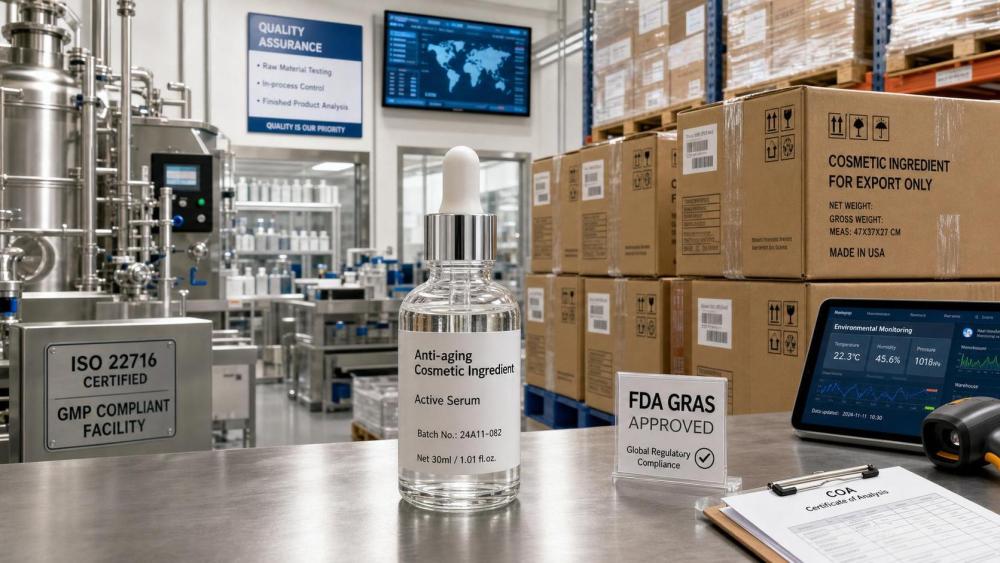
The accepted notice concerns a novel recombinant pro-xylane derivative identified as CAS 1289374-82-1. According to the provided information, the FDA confirmed its safety for use at levels up to 0.5% in topical anti-aging cosmetics. The notice also states that the ingredient may be imported into the United States without premarket approval, provided that labeling complies with 21 CFR §170.30. The same information indicates that this creates a more streamlined supply path for Chinese and Korean API manufacturers serving U.S. cosmeceutical formulators.
Where the practical effects are likely to appear
Cross-border supply of cosmetic actives
From an industry perspective, exporters and direct trade companies are among the first to feel the effect of this development because the notice speaks directly to import eligibility without premarket approval under a defined compliance condition. The operational focus is likely to shift toward whether shipment documents, product descriptions, and labeling-related materials remain aligned with the accepted use context and the cited regulatory provision.
Procurement and sourcing decisions by formulators
U.S. formulators and ingredient buyers may treat this notice as a clearer basis for evaluating supply options for a high-purity anti-wrinkle active. Analysis shows that the impact is less about broad market expansion in the abstract and more about reduced uncertainty in supplier screening, specification review, and sourcing discussions for an ingredient that now has an identified regulatory position tied to topical anti-aging use up to 0.5%.
Manufacturing and supply chain coordination
Chinese and Korean API manufacturers may see this as a more workable route into U.S.-bound cosmetic ingredient supply, but the practical effect will likely depend on execution at the manufacturing and delivery level. What deserves closer attention is whether internal product documentation, batch traceability, and customer-facing technical files are prepared in a way that supports the accepted use conditions and avoids inconsistency between ingredient positioning, shipment paperwork, and downstream formulation use.
Compliance and support services around market entry
Testing, regulatory support, and supply chain service providers may also see follow-on demand where customers need help aligning labels, technical files, and import documentation. Observably, the notice does not eliminate compliance work; it changes the point of emphasis from premarket approval to accurate conformity with the stated use conditions and labeling requirements.
What companies should watch next in day-to-day execution
Keep labeling review tied to the accepted use conditions
Analysis shows that labeling is the most explicit compliance trigger in the information provided. Companies involved in export, import, and formulation should therefore pay close attention to how the ingredient is described in labels and related commercial documents, especially where wording could affect whether the product presentation remains consistent with 21 CFR §170.30 and the stated topical anti-aging use context.
Check whether technical and trade files tell the same story
For procurement teams and suppliers, a practical point is document consistency. Product specifications, safety summaries, sales materials, and shipment records should not create a mismatch with the accepted scope described in the notice. The provided information does not set out detailed filing or documentary requirements beyond labeling, so this should be treated as a compliance focus area rather than a confirmed checklist.
Reassess supplier qualification for U.S.-bound business
For buyers considering Chinese or Korean API sources, this development may justify a fresh review of supplier readiness for U.S.-bound orders. It is more appropriate to understand this as a sourcing and qualification signal: not every commercial pathway is automatically simplified in practice, but the notice gives procurement and regulatory teams a clearer basis for assessing whether a supplier can support compliant import and downstream use.
Monitor how the market applies the notice in real transactions
What deserves closer attention is not only the text of the notice, but also how it is reflected in customer requirements, purchasing documentation, and routine compliance review. The provided information does not confirm how different market participants will interpret or operationalize the notice, so companies should continue watching for changes in customer review standards, contract language, and supporting documentation requests.
Why this looks more like an execution signal than a broad rule rewrite
Observably, this update is best read as a specific regulatory execution signal rather than a sweeping change to the overall cosmetic compliance framework. The accepted GRAS notice gives a defined ingredient, a defined use ceiling, and a defined condition tied to labeling. From an industry perspective, that matters because it can lower friction in trade and sourcing decisions for this ingredient category, while still leaving room for practical variation in how buyers, importers, and service providers implement compliance checks.
How the market is likely to read this development for now
At this stage, the event is more appropriately understood as a concrete but bounded market access clarification for one recombinant anti-wrinkle active. It signals that a usable regulatory pathway is available under stated conditions, especially for suppliers targeting U.S. cosmeceutical formulators. At the same time, it should not be overstated as a complete answer to all downstream compliance, procurement, or delivery questions, which will still depend on how companies manage labeling, documentation, and transaction-level execution.
Basis of this article and points that still require verification
This article is generated based on the user-provided news title, event date, and event summary. For developments of this type, relevant source categories typically include official regulatory notices, publications from supervisory authorities, customs or trade administration information, industry association updates, standards-related documents, and reporting by established professional media. No specific official source link was provided in the input, so the exact primary publication path still requires follow-up verification. It also remains necessary to monitor any later clarification on implementation details, compliance interpretation, procurement documentation, market feedback, and how companies apply the notice in actual supply and delivery arrangements.
Related News
- How to evaluate anti-aging cosmetic compounds for wrinkle careOct 01, 2026Cosmeceutical Formulator
- How scientific anti-aging skincare targets wrinkles at the cellular levelSep 22, 2026Cosmeceutical Formulator
- What drives Pro-Xylane price differences between cosmetic suppliers?Sep 09, 2026Cosmeceutical Formulator
- Pro-Xylane in Skincare: What Sets Its Anti-Wrinkle Claims ApartJul 15, 2026Cosmeceutical Formulator
Related News
- 00
0000-00
What drives fragrance ingredients price changes in bulk orders? - 00
0000-00
How to assess a food antioxidants distributor’s traceability practices - 00
0000-00
How minimum order quantities shape private label ingredient sourcing costs - 00
0000-00
What drives personal care ingredient price volatility in sourcing - 00
0000-00
What drives micelles price differences in cosmetic formulations?
Cosmeceutical Formulator
Weekly Insights
Stay ahead with our curated technology reports delivered every Monday.