





How to Evaluate Anti-Aging Cosmetic Compounds for Wrinkle Care
Evaluating anti-aging cosmetic compounds for wrinkle care requires more than reviewing marketing claims or headline concentrations. Technical assessors must connect molecular mechanism, skin delivery, clinical evidence, formulation compatibility, safety, and regulatory readiness to determine whether an active can deliver credible results.
This guide outlines a practical framework for comparing wrinkle-care compounds, from peptides and retinoid alternatives to hyaluronic-acid stimulators, while balancing efficacy, stability, sensory performance, and commercial value.
Start with the Actual Decision, Not the Ingredient Story
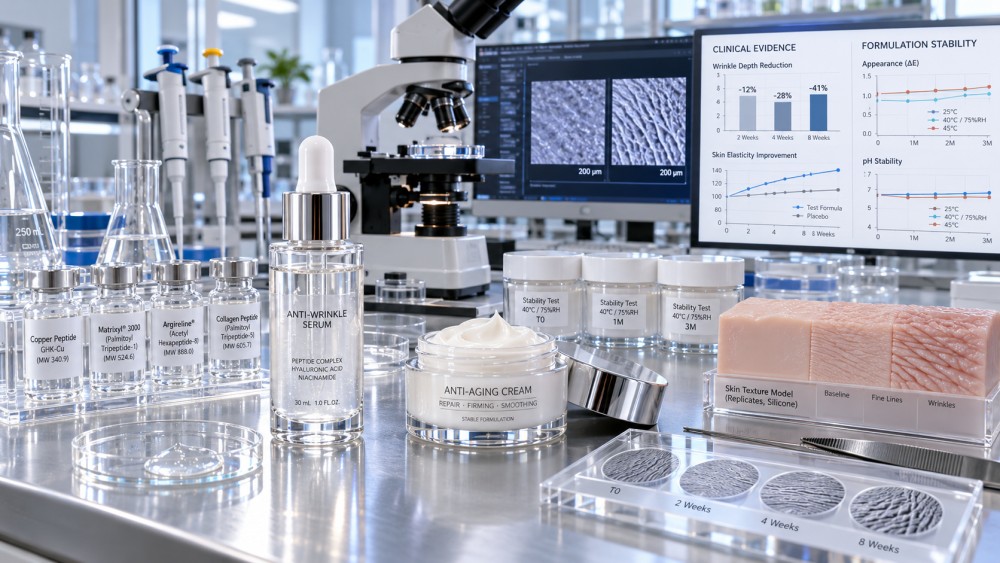
The core search intent behind anti-aging cosmetic compounds for wrinkle care is practical evaluation: determining whether an ingredient deserves inclusion, further testing, supplier qualification, or rejection.
Technical assessors usually need evidence that connects an active material with a measurable wrinkle-related outcome under realistic formulation and consumer-use conditions.
They are rarely looking for another broad explanation of skin aging. Their concern is whether a proposed compound has defensible efficacy, manageable risk, and viable economics.
A reliable assessment therefore begins with a written product brief. Define the wrinkle type, target user, application area, product format, claims ambition, and launch markets.
Fine dehydration lines, expression lines, photoaging-related roughness, and deep structural wrinkles do not respond equally to the same biological pathway or ingredient platform.
For example, a hydrating polymer may visibly improve superficial lines quickly, while a collagen-signaling peptide may require longer use before delivering modest structural improvement.
Without this distinction, technical teams can overvalue ingredients that produce attractive laboratory data but do not match the product's intended wrinkle-care claim.
Assessors should also separate immediate optical smoothing from biological anti-aging activity. Both can be commercially useful, but they require different evidence and different claim language.
The strongest evaluation decisions identify the active's likely role precisely: instant line softener, hydration enhancer, retinoid alternative, extracellular-matrix support, or dermal-density stimulant.
Translate the Molecular Mechanism into a Relevant Skin Outcome
Mechanistic plausibility is the first technical screen, but it should never be treated as proof that an anti-aging cosmetic compound reduces wrinkles in finished products.
Review the active's proposed target and ask whether that target is meaningfully connected to wrinkle appearance, skin elasticity, epidermal renewal, barrier quality, or dermal architecture.
Common pathways include collagen synthesis signaling, matrix metalloproteinase inhibition, antioxidant defense, glycation reduction, hyaluronic-acid production, inflammatory modulation, and keratinocyte turnover regulation.
Peptides are often positioned as signaling compounds. Their value depends on sequence specificity, exposure at the relevant skin layer, resistance to enzymatic breakdown, and concentration at use.
Compounds marketed as hyaluronic-acid stimulators may offer a more biologically durable proposition than topical hyaluronic acid, yet their clinical evidence must demonstrate that distinction.
Retinoids remain important benchmark materials because their effects on epidermal turnover and dermal remodeling are comparatively well established, although tolerability can constrain formulation choices.
Bakuchiol, retinal alternatives, botanical extracts, and antioxidant complexes should be assessed against the same standard: a defined mechanism, credible exposure, and relevant human results.
Be cautious when a supplier presents broad gene-expression panels without clarifying effect size, biological relevance, test concentration, donor variability, or comparison with established reference actives.
A statistically significant change in one collagen marker may not translate into a noticeable wrinkle benefit. Mechanistic data should prioritize relevance over volume.
Use a mechanism-to-claim map. For each active, record the biological target, expected consumer-visible benefit, onset period, supporting evidence, and conditions required for performance.
Evaluate Whether the Active Can Reach Its Intended Site
Skin delivery is frequently the weak link in anti-aging cosmetic compounds for wrinkle care. An excellent mechanism has limited value when the molecule remains inactive on the surface.
The stratum corneum is a formidable barrier, especially for large, hydrophilic, charged, unstable, or poorly soluble compounds. Delivery claims need specific supporting data.
Assess molecular weight, lipophilicity, polarity, ionization state, and partition behavior. These properties influence whether an active can distribute into the upper epidermis or beyond.
For peptides, molecular size alone is not enough to predict performance. Sequence, charge, carrier technology, encapsulation, and the surrounding formula all influence skin availability.
Ask suppliers whether penetration was measured using tape stripping, Franz diffusion cells, confocal imaging, reconstructed skin, ex vivo human skin, or another recognized approach.
Each method has limitations. Diffusion cell studies can support comparative delivery, but they do not automatically establish a clinical dermal effect in normal daily use.
Delivery systems such as liposomes, nanoemulsions, cyclodextrins, lipid particles, and polymeric encapsulation can improve stability or deposition, but should not be accepted on terminology alone.
Request information on particle size, active loading, release profile, storage behavior, preservation compatibility, and whether the carrier itself affects skin irritation or sensory feel.
Also examine the product's application context. A leave-on night cream can support a different delivery strategy than a lightweight serum, eye gel, sunscreen, or rinse-off cleanser.
An active should be evaluated within its final dosage form. Ingredient-level delivery performance may change substantially when emulsifiers, oils, humectants, pH, or electrolytes are introduced.
Rank Clinical Evidence by Decision Value
Human clinical evidence should carry the greatest weight when selecting wrinkle-care actives. However, technical assessors must distinguish robust trials from promotional studies with limited interpretive value.
First, confirm whether the tested material is chemically identical to the proposed commercial ingredient. Similar botanical species, peptide families, or delivery systems are not interchangeable evidence.
Then compare the study formula with the intended formula. Concentration, vehicle, pH, packaging, application frequency, and study duration may all affect translation to launch products.
A useful wrinkle study normally includes an adequate sample size, defined inclusion criteria, controlled application instructions, baseline measurements, and appropriate statistical analysis.
Instrumental methods such as profilometry, cutometry, corneometry, high-resolution imaging, and standardized photography can add objectivity when properly designed and reported.
Clinical grading remains valuable, particularly when performed by trained evaluators under controlled lighting. Consumer perception data adds commercial context but cannot substitute for objective endpoints.
For wrinkle claims, inspect the endpoint carefully. “Improved skin appearance” is broader and weaker than quantified reductions in wrinkle depth, volume, roughness, or visible line count.
Timepoint matters as well. Four-week improvements may reflect hydration, while eight- to twelve-week results are generally more informative for remodeling-oriented anti-aging claims.
Controlled split-face or vehicle-controlled designs can be especially valuable because they reduce subject-to-subject variation. Open-label studies should be interpreted more cautiously.
Do not rely only on percentage improvement. Review absolute change, confidence intervals, baseline severity, evaluator consistency, consumer relevance, and whether results were clinically perceptible.
A small percentage improvement can be statistically significant but commercially weak. Conversely, a visible hydration benefit may support a modest claim if messaging remains precise.
Check Formula Compatibility Before Treating Efficacy as Real
An active's efficacy dossier only matters if the compound survives manufacturing, storage, distribution, and consumer use. Stability testing is therefore part of efficacy evaluation, not a separate task.
Review thermal stability, oxidation sensitivity, photostability, hydrolysis risk, pH tolerance, metal-ion sensitivity, and interactions with common emulsion or gel-network components.
Many high-value peptides are vulnerable to hydrolysis, oxidation, aggregation, or adsorption onto packaging and processing surfaces. These risks can reduce delivered dose without obvious visual change.
Retinoids and certain antioxidant systems require particular attention to oxygen, light, heat, and trace metals. Encapsulation may help, but real-time verification remains necessary.
Assess the proposed use level against the active assay over shelf life. A nominal addition rate does not prove that the label-relevant concentration remains available at expiry.
Analytical capability is important here. Suppliers should provide a suitable assay method, impurity profile, batch specification, and guidance for monitoring degradation where practical.
Consider formula pH early. A compound may be stable at one pH range but ineffective, poorly soluble, irritating, or incompatible with the broader formulation at another.
Compatibility also includes sensory performance. High active loads, solvent systems, encapsulation carriers, and botanical extracts can create tackiness, odor, pilling, color drift, or poor spreadability.
These effects matter because consumers use anti-aging products consistently only when the experience is acceptable. Poor sensory performance can undermine real-world efficacy through reduced compliance.
Run screening stability tests in the actual base formula before making expensive claim-support investments. Include accelerated storage, freeze-thaw cycles, light exposure, and packaging compatibility where relevant.
Balance Efficacy with Tolerability and Safety Margins
Wrinkle-care products are commonly used daily, often on the face and around the eyes. Even effective compounds can fail commercially when irritation compromises repeat use.
Evaluate irritation, sensitization, photoreactivity, comedogenicity concerns, eye-area suitability, and interactions with other likely consumer routines, including acids, retinoids, and sunscreens.
Botanical origin should not be treated as a safety conclusion. Plant extracts may contain variable allergen profiles, residual solvents, pesticide residues, color bodies, or sensitizing fragrance constituents.
For synthetic or biotechnology-derived actives, review purity, residual monomers, fermentation residues, endotoxin controls where applicable, heavy metals, and microbiological specifications.
Safety assessment should reflect exposure realistically. Use level, application area, frequency, rinse-off versus leave-on status, vulnerable populations, and foreseeable misuse all affect risk characterization.
A technically strong supplier provides complete safety documentation rather than only a marketing statement. This may include toxicological summaries, impurity information, challenge-test compatibility, and dermatological data.
Evaluate irritation in the final formula whenever possible. A mild ingredient can become problematic within a strongly acidic, highly fragranced, or multi-active anti-aging system.
Technical teams should define an acceptable tolerability threshold before selecting the compound. This avoids pursuing maximum biological activity at the expense of routine consumer adherence.
Confirm Regulatory and Claims Readiness Across Target Markets
Regulatory readiness can determine whether an otherwise promising anti-aging active reaches commercialization on schedule. Ingredient evaluation should begin with the intended geographical markets, not end there.
For the European Union, assess cosmetic ingredient status, safety-report requirements, labeling considerations, allergen implications, CPNP notification readiness, and claim substantiation obligations.
In the United States, distinguish cosmetic claims from drug-like claims carefully. Statements implying treatment, repair of disease, or permanent structural reversal may create regulatory exposure.
Claims such as “reduces the appearance of wrinkles” are generally easier to support than statements claiming to rebuild dermal tissue, reverse aging, or deliver pharmaceutical-level outcomes.
China, ASEAN markets, Japan, South Korea, and Middle Eastern markets may introduce additional requirements concerning ingredient inventories, new-ingredient registration, documentation, labels, or efficacy substantiation.
Ask whether the supplier can provide INCI naming, composition information, origin declarations, certificates of analysis, safety data, allergen information, and market-specific regulatory support.
Novel delivery technologies require additional scrutiny. The regulatory acceptability of nanomaterials, biotechnology-derived substances, and certain encapsulation systems may vary between jurisdictions.
A claim must match the evidence level. Technical assessors should work with regulatory and marketing teams to build a claims matrix that identifies approved wording and supporting studies.
Compare Suppliers on Reproducibility, Not Only Price
For high-end cosmetic actives, supplier quality is inseparable from product performance. Batch consistency matters particularly for peptides, fermentation-derived ingredients, standardized extracts, and encapsulated systems.
Request complete technical documentation, including manufacturing origin, specification limits, assay methods, impurity controls, microbiological standards, storage conditions, and recommended retest or expiry periods.
Examine whether assay values represent active content, total solids, extract ratio, carrier-adjusted concentration, or a proprietary activity unit. Ambiguous specifications create comparison errors.
A lower price per kilogram can be misleading when the active assay is lower, the required dose is higher, or the material creates processing, stability, or regulatory burdens.
Calculate cost in use rather than material price alone. Include recommended dosage, active concentration, process loss, packaging requirements, testing needs, claim-support cost, and expected yield.
Supply resilience should also be evaluated. Consider lead times, minimum order quantities, geographic concentration, cold-chain dependence, intellectual-property restrictions, and contingency sourcing options.
For premium wrinkle-care positioning, a supplier's clinical dossier and technical support may justify a higher unit cost when they reduce development time and strengthen claim credibility.
Use a Weighted Scorecard to Make the Selection Defensible
A weighted scorecard converts complex evidence into a comparable decision record. It prevents individual factors, such as supplier reputation or a striking clinical percentage, from dominating the selection.
For a premium leave-on wrinkle serum, clinical relevance and formulation stability may deserve the highest weights, followed by safety, delivery evidence, regulatory readiness, and cost in use.
One practical model assigns 25 percent to human clinical evidence, 20 percent to formulation stability, 15 percent to mechanistic relevance, and 15 percent to safety and tolerability.
The remaining score can cover delivery evidence, regulatory documentation, supplier consistency, sensory impact, sustainability credentials, and commercial feasibility according to the project brief.
Define pass-fail gates before calculating weighted totals. For example, an active without basic safety documentation, acceptable stability, or regulatory viability should not advance on efficacy alone.
Use consistent scoring definitions. A score of five for clinical evidence should require a well-designed, relevant, controlled human study, rather than simply any consumer-use test.
Record uncertainties separately from weaknesses. A compound with limited evidence may warrant a pilot study, while one with poor safety or incompatible chemistry may require immediate exclusion.
The scorecard should be updated after prototype testing. Early supplier data is useful for screening, but final selection should reflect evidence generated in the intended finished product.
Build an Efficient Evaluation Workflow
Begin by defining product objectives and non-negotiable constraints. These commonly include target claim, market access, dosage form, price architecture, ingredient philosophy, and required launch timing.
Next, conduct a documentary screen covering mechanism, clinical evidence, safety, stability, regulatory status, and supplier specifications. Eliminate candidates with obvious gaps before laboratory work begins.
Shortlist a manageable number of compounds, typically two to five, that address the same intended benefit through different mechanisms or delivery strategies.
Develop comparable prototypes using equivalent product bases whenever possible. This reduces the risk that formulation differences are mistaken for active-ingredient performance differences.
Run preliminary physical stability, odor, color, viscosity, pH, microbial compatibility, and packaging checks. Measure active retention when a suitable analytical method is available.
Then select the most credible prototype for human testing. The study design should match the claim ambition, expected onset of benefit, consumer population, and product use instructions.
Finally, consolidate evidence into a decision package containing technical rationale, data limitations, risk controls, approved claim language, cost-in-use analysis, and next development actions.
Conclusion: Evaluate the Whole Performance System
The best anti-aging cosmetic compounds for wrinkle care are not necessarily those with the most sophisticated mechanism, highest concentration, or most persuasive supplier presentation.
They are the compounds that deliver a relevant benefit in the final formula, remain stable throughout shelf life, are tolerated by users, and support compliant, credible claims.
For technical assessors, the central question is simple: can this ingredient create a measurable and commercially meaningful wrinkle-care outcome under realistic conditions of use?
A disciplined framework linking mechanism, delivery, clinical evidence, stability, safety, regulation, sensory quality, and cost will produce stronger selections and more defensible product decisions.