





On July 1, 2026, the Korean MFDS rule change around Pro-Xylane in functional anti-wrinkle cosmetics became a point of immediate compliance attention for ingredient suppliers, cosmetic manufacturers, importers, and quality teams. The revision raises the minimum purity requirement, adds mandatory HPLC-UV spectrum and isomer ratio documentation, and applies to both imported and domestic products, making it relevant not only as a technical specification update but also as a practical change for procurement terms, testing files, and delivery acceptance.
What the amendment changes
According to the provided information, the Ministry of Food and Drug Safety (MFDS) of Korea issued amendment K-MFDS-2026-042 on June 30, 2026. The amendment revises the standard for Pro-Xylane in functional anti-wrinkle cosmetics.
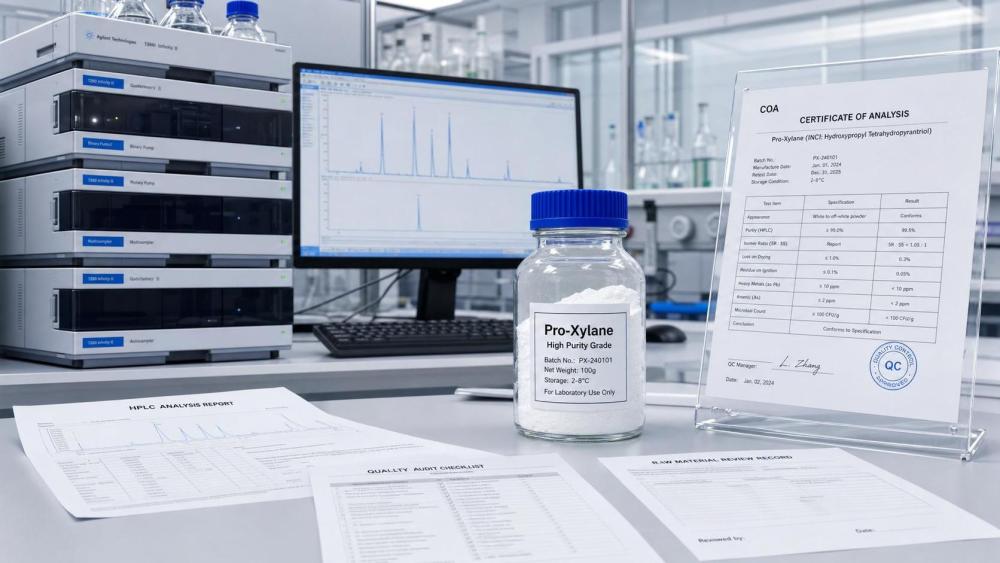
The confirmed changes are threefold. First, the minimum purity requirement for Pro-Xylane has been raised from 98.0% to 99.5%. Second, submission of an HPLC-UV spectrum is now mandatory. Third, an isomer ratio report is also required.
The new rule applies to all imported and domestically manufactured products. The provided summary also indicates that the change directly affects the quality control standards and contract delivery terms of Chinese raw material exporters.
Where the pressure is likely to appear first
Raw material exporters face a tighter release standard
From an industry perspective, exporters supplying Pro-Xylane into the Korean market may be affected first because the revised threshold changes what can be accepted as compliant material. The impact is likely to be concentrated in batch release, certificate support, product specification alignment, and contract language tied to acceptance criteria.
What deserves closer attention is whether current shipment documents and internal quality files clearly support the new purity floor and the newly required analytical materials. For suppliers already serving Korean buyers, this is also relevant to delivery risk if contract wording still reflects the previous 98.0% threshold.
Importers and purchasing teams need stronger document control
For importers and procurement teams, the issue is not only the ingredient itself but also the completeness of the supporting file set. Because the rule expressly requires HPLC-UV spectra and isomer ratio reporting, purchasing decisions may now depend more heavily on whether suppliers can provide documentation in a form acceptable for review and product release.
Analysis shows that this can affect supplier qualification, incoming material checks, and the handling of purchase orders for functional anti-wrinkle formulations using Pro-Xylane. In practice, documentation gaps may become as important as material quality gaps.
Manufacturers may need to revisit formulation intake and batch acceptance
Manufacturers of functional anti-wrinkle cosmetics may feel the effect at the stage of raw material intake and production release. Since the amendment applies to domestic and imported products alike, factories cannot treat imported and local sourcing under different compliance assumptions for this ingredient standard.
Observably, the main operational concern is whether incoming raw material review, quality specifications, and production-related technical files remain aligned with the revised MFDS requirement. Any mismatch between supplier specifications and manufacturing acceptance standards could create avoidable hold points.
Testing and compliance service providers may see demand shift toward supporting evidence
Testing service providers and compliance support teams may also be affected because the rule change explicitly names analytical evidence that must be provided. The immediate relevance is less about broader market expansion and more about the need for usable supporting documents tied to purity and isomer profile requirements.
For businesses supporting trade, registration, or quality review, the practical issue is whether existing reporting formats and technical submissions are sufficient for counterparties working under the new standard.
What companies should review now
Check whether technical specifications still match contractual terms
Analysis shows that companies trading or purchasing Pro-Xylane should review whether product specifications, quality clauses, and delivery acceptance terms still reflect the previous requirement. Where contracts, purchase orders, or technical attachments still reference 98.0% purity, the compliance and delivery position may no longer be aligned with the rule taking effect in July.
Confirm the readiness of HPLC-UV and isomer ratio documentation
What deserves closer attention is document readiness. The amendment does not only tighten the purity requirement; it also makes HPLC-UV spectra and isomer ratio reports mandatory. Companies should therefore focus on whether these materials are available, current, and consistently linked to the relevant batches or supplied material descriptions.
Track implementation language in buyer review and submission files
Because the provided information does not include detailed enforcement mechanics, it would be premature to describe a settled implementation outcome. More appropriately, companies should monitor how the revised requirement is reflected in buyer document requests, internal review procedures, and any technical file checklists used for anti-wrinkle cosmetic products containing Pro-Xylane.
Assess delivery timing and acceptance risk in ongoing transactions
For exporters and cross-border supply chain teams, the immediate business issue may be whether materials already prepared for shipment can satisfy the revised specification and documentation expectations. Observably, this is relevant to shipment approval, acceptance disputes, and handover timing, especially where supply contracts were negotiated before the new threshold was announced.
Why this reads as an execution signal
Analysis shows that this development is better understood as more than a general policy direction. The amendment identifies a specific ingredient, sets a revised numerical purity requirement, and adds named analytical documentation requirements. That gives the market a concrete execution signal rather than a broad statement of regulatory intent.
At the same time, it would be too strong to claim that all implementation questions are already settled. The provided information confirms the rule change and its direct relevance to exporters and product compliance, but further observation is still needed on review practice, documentation expectations in transactions, and how consistently the new standard is reflected across commercial and technical workflows.
How the market should read the change at this stage
From an industry perspective, the most reasonable reading is that the MFDS amendment marks an already landed compliance change for Pro-Xylane used in functional anti-wrinkle cosmetics, with immediate relevance for quality thresholds and supporting documents. The practical impact is likely to appear first in supplier qualification, technical documentation, contract alignment, and delivery acceptance rather than in abstract policy discussion.
It is more appropriate to understand this as a rule implementation signal with operational consequences, while still keeping close watch on how market participants and counterparties apply the new requirements in day-to-day execution.
Basis of this article and what still needs verification
This article is based on the user-provided news title, event date, and event summary. The information supplied identifies the amendment number, the issuing authority, the date of issuance, the revised purity requirement, the mandatory HPLC-UV spectrum and isomer ratio report, and the stated impact on imported and domestic products as well as Chinese raw material exporters.
For developments of this type, relevant source categories usually include official regulatory notices, publications from supervisory authorities, customs or trade administration information, industry association updates, standard-setting documents, and reporting by authoritative trade media. A specific official source link was not provided in the input, so that point still requires ongoing verification.
Further observation is still needed regarding detailed implementation language, certification or compliance review practice, changes in tender or procurement documentation, industry feedback, and how companies adjust execution and delivery arrangements under the revised standard.
Related News
- How to evaluate anti-aging cosmetic compounds for wrinkle careOct 01, 2026Cosmeceutical Formulator
- How scientific anti-aging skincare targets wrinkles at the cellular levelSep 22, 2026Cosmeceutical Formulator
- What drives Pro-Xylane price differences between cosmetic suppliers?Sep 09, 2026Cosmeceutical Formulator
- Pro-Xylane in Skincare: What Sets Its Anti-Wrinkle Claims ApartJul 15, 2026Cosmeceutical Formulator
Related News
- 00
0000-00
Verifying halal status of hydrocolloid ingredients in the Middle East - 00
0000-00
How to interpret active matter on a surfactant specification sheet - 00
0000-00
What Quality Checks Should You Run on Fragrance Ingredient Suppliers? - 00
0000-00
How to assess a flavor chemistry manufacturer's batch consistency - 00
0000-00
What drives fragrance ingredients price changes in bulk orders?
Cosmeceutical Formulator
Weekly Insights
Stay ahead with our curated technology reports delivered every Monday.