





Transdermal Penetration Enhancers for Anti-Aging: Efficacy and Irritation Risks
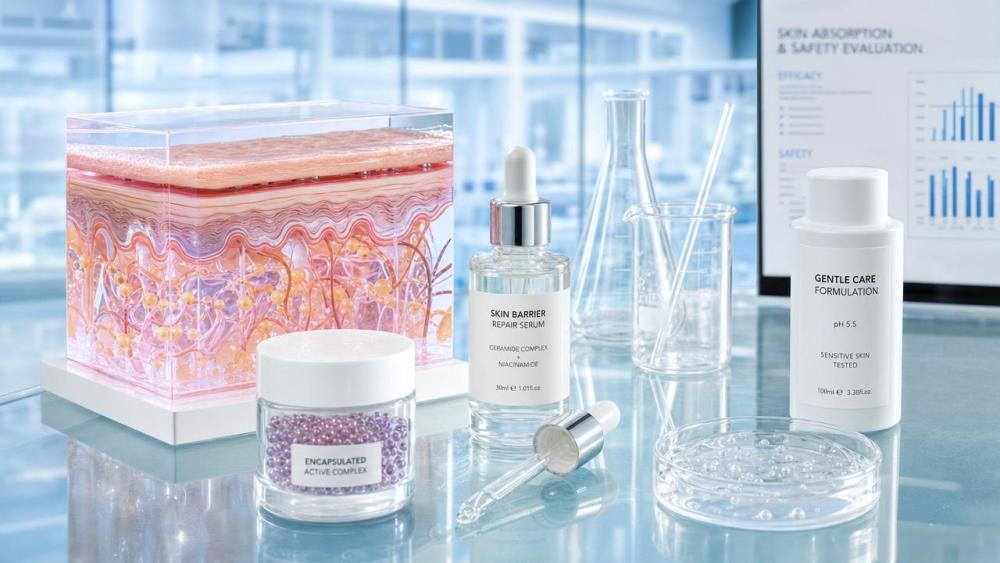
Selecting a transdermal penetration enhancer for anti-aging is no longer a simple efficacy decision.
It is a risk-balanced formulation challenge involving stratum corneum disruption, active stability, dose efficiency, and irritation control.
For technical evaluation, the central question is clear.
Can an enhancer improve peptide, retinoid, or botanical active delivery without weakening barrier integrity or triggering visible sensitivity?
In anti-aging cosmetics, this question directly affects efficacy claims, consumer tolerance, regulatory confidence, and long-term brand trust.
Functional Basis of a Transdermal Penetration Enhancer for Anti-Aging
The stratum corneum protects the body through tightly packed corneocytes and ordered intercellular lipids.
This barrier is excellent for safety, but difficult for high-value cosmetic actives.
A transdermal penetration enhancer for anti-aging modifies this barrier in a controlled, temporary, and formulation-dependent manner.
Common mechanisms include lipid fluidization, keratin interaction, hydration increase, solvent partitioning, and vesicular transport support.
The goal is not maximum disruption.
The goal is targeted flux improvement while preserving acceptable skin comfort and recovery.
This distinction is critical for retinoids, peptides, niacinamide derivatives, antioxidants, and plant-based anti-aging molecules.
Each active differs in polarity, molecular size, stability, solubility, and irritation profile.
Therefore, no universal transdermal penetration enhancer for anti-aging fits every premium serum, cream, mask, or ampoule system.
Key Mechanistic Families
- Solvents improve active solubility and partitioning into skin layers.
- Fatty acids disturb lipid packing and increase diffusion pathways.
- Terpenes may enhance penetration, but odor and sensitivity need control.
- Surfactants can increase delivery, yet often carry higher irritation risk.
- Liposomes, niosomes, and nanoemulsions assist deposition and release modulation.
Industry Signals Driving Penetration Enhancement Decisions
Anti-aging formulas increasingly combine biological ambition with consumer expectations for gentleness.
This creates pressure to justify every transdermal penetration enhancer for anti-aging through measurable benefit and acceptable risk.
Several market and technical signals are shaping ingredient selection.
The most competitive systems are no longer built around one dramatic enhancer.
They combine mild enhancement, active encapsulation, pH control, humectant support, and barrier-friendly lipids.
This layered approach reduces dependence on a harsh transdermal penetration enhancer for anti-aging.
Efficacy Metrics Beyond Simple Absorption
Higher penetration does not automatically mean better anti-aging performance.
A transdermal penetration enhancer for anti-aging should be assessed through delivery relevance, not only total permeated quantity.
For cosmetics, desirable outcomes often involve epidermal or upper dermal deposition.
Excessive systemic permeation may be unnecessary or undesirable, especially for potent actives.
Useful efficacy metrics include active retention in target layers, release kinetics, and stability after formulation aging.
Franz diffusion testing can compare enhancer systems under controlled conditions.
Tape stripping helps estimate stratum corneum distribution and early deposition behavior.
Confocal Raman spectroscopy can support non-invasive distribution insights for selected molecules.
Cell-based assays may confirm whether delivered actives still influence collagen, elastin, pigmentation, or oxidative stress pathways.
A strong transdermal penetration enhancer for anti-aging keeps the active functional after delivery.
This matters for peptides that may degrade, oxidize, aggregate, or bind unfavorably inside the formula.
Practical Efficacy Questions
- Does the enhancer increase delivery at the intended skin depth?
- Does the active remain chemically and biologically stable?
- Is the same effect possible at a lower active dose?
- Does performance remain after heat, light, and storage stress?
- Does improvement justify irritation and compliance burden?
Irritation Risks and Barrier Liability
Irritation is the primary limitation for any transdermal penetration enhancer for anti-aging.
The same mechanisms that improve delivery may also disturb barrier lipids and increase inflammatory signaling.
Visible redness, burning, dryness, scaling, and tightness reduce adherence to anti-aging routines.
Even mild discomfort can damage product perception when formulas target daily or long-term use.
Risk depends on enhancer type, concentration, exposure time, pH, active potency, and skin condition.
Surfactant-based systems are efficient, but they can extract lipids and denature proteins.
Alcohol-heavy systems may feel elegant, yet can worsen dryness in vulnerable users.
Terpenes and essential oil components require careful allergen and fragrance evaluation.
A responsible transdermal penetration enhancer for anti-aging should include irritation mitigation from the beginning.
Barrier-supporting lipids, panthenol, beta-glucan, ectoin, ceramides, and controlled release can improve tolerance.
Safety Indicators Worth Monitoring
- Transepidermal water loss before and after repeated exposure.
- Erythema scoring under dermatologist-controlled conditions.
- Subjective stinging during early application windows.
- Cumulative irritation over two to four weeks.
- Compatibility with retinoids, acids, and fragrance components.
Typical Anti-Aging Applications and Enhancer Fit
Different anti-aging products need different delivery logic.
A transdermal penetration enhancer for anti-aging should match the active category and intended user experience.
Peptide systems often benefit from carriers that protect structure and improve residence time.
Retinoid systems require stricter irritation management because the active already challenges barrier tolerance.
Botanical actives may need solubility support, but allergen and oxidation risks must be considered.
The best transdermal penetration enhancer for anti-aging is rarely the most aggressive option.
It is the option that supports stable, repeatable, and consumer-acceptable performance.
Formulation Criteria for Balanced Performance
Evaluation should begin before prototype screening.
A transdermal penetration enhancer for anti-aging must be judged within a complete formula architecture.
Polarity, oil phase composition, emulsifier choice, preservative system, rheology, and packaging all influence delivery.
A low-irritation enhancer may fail if it destabilizes the active or separates during storage.
Likewise, a powerful enhancer may be unacceptable if it increases stinging in repeated-use tests.
Recommended Selection Framework
- Define the target layer and desired biological endpoint.
- Map active solubility, charge, size, and degradation pathways.
- Screen multiple enhancer families at conservative concentrations.
- Compare deposition, not only total permeation.
- Run stability and compatibility tests under accelerated conditions.
- Measure TEWL, erythema, and user sensation across repeated use.
- Build claims around substantiated delivery and visible performance.
This framework prevents enhancer choice from becoming a single-variable decision.
It also supports clearer compliance documentation and stronger technical storytelling.
Compliance, Claims, and Consumer Trust
Claims around a transdermal penetration enhancer for anti-aging require careful language.
Cosmetic positioning should avoid drug-like implications unless the relevant jurisdiction permits them.
Terms such as “supports skin delivery” or “improves active deposition” may be safer than therapeutic wording.
Evidence should connect the enhancer to measurable cosmetic benefits, not unsupported biological exaggeration.
Ingredient transparency is also important.
Consumers increasingly connect strong actives with possible sensitivity.
A clear safety narrative can reduce anxiety and improve product adherence.
For global portfolios, regional review should include cosmetic notification, allergen labeling, preservative limits, and restricted substance checks.
The transdermal penetration enhancer for anti-aging must fit both technical performance and market-entry requirements.
Practical Development Recommendations
A safer development path starts with conservative enhancement.
Use the minimum effective concentration and validate whether dose reduction of the active becomes possible.
Combine delivery improvement with barrier care rather than treating irritation as a late-stage correction.
Avoid stacking multiple irritant technologies without cumulative testing.
Retinoids, exfoliating acids, fragrance allergens, and aggressive enhancers can create hidden tolerance problems.
Prototype screening should include normal, dry, oily, and sensitive skin panels when positioning requires broad use.
Packaging should protect oxygen-sensitive actives and prevent enhancer evaporation or phase shift.
When possible, benchmark against a no-enhancer control and a market reference formula.
This shows whether the transdermal penetration enhancer for anti-aging delivers meaningful competitive advantage.
Conclusion and Next-Step Evaluation
A transdermal penetration enhancer for anti-aging can transform formula performance when selected with scientific discipline.
Its value lies in targeted delivery, active protection, dose efficiency, and visible consumer-relevant outcomes.
Its risk lies in barrier disruption, stinging, redness, instability, and overextended claims.
The most reliable systems integrate mild enhancement with barrier support, stability design, and repeated-use tolerance data.
For practical evaluation, begin with active mapping, enhancer screening, deposition testing, irritation measurement, and compliance review.
This sequence supports stronger anti-aging formulas and safer long-term consumer experiences.
FFAI tracks the molecular, regulatory, and commercial logic behind advanced cosmetic actives and delivery systems.
Use this perspective to compare each transdermal penetration enhancer for anti-aging with evidence, caution, and formulation realism.
Related News
- How to evaluate anti-aging cosmetic compounds for wrinkle careOct 01, 2026Cosmeceutical Formulator
- How scientific anti-aging skincare targets wrinkles at the cellular levelSep 22, 2026Cosmeceutical Formulator
- What drives Pro-Xylane price differences between cosmetic suppliers?Sep 09, 2026Cosmeceutical Formulator
- Pro-Xylane in Skincare: What Sets Its Anti-Wrinkle Claims ApartJul 15, 2026Cosmeceutical Formulator
Related News
- 00
0000-00
Verifying halal status of hydrocolloid ingredients in the Middle East - 00
0000-00
How to interpret active matter on a surfactant specification sheet - 00
0000-00
What Quality Checks Should You Run on Fragrance Ingredient Suppliers? - 00
0000-00
How to assess a flavor chemistry manufacturer's batch consistency - 00
0000-00
What drives fragrance ingredients price changes in bulk orders?
Cosmeceutical Formulator
Weekly Insights
Stay ahead with our curated technology reports delivered every Monday.