





Choosing a cosmetic active delivery system for sensitive skin now sits at the intersection of efficacy, toxicological caution, and commercial credibility. In practice, the decision is rarely about penetration alone. It is about whether an active can remain stable, reach the intended skin layer, and still support a low-irritation profile under real formulation and compliance conditions.
That balance matters more as premium actives become more concentrated and claim-driven. Across the FMCG landscape tracked by FFAI, the same pattern appears in foods, fragrances, and cosmetics: performance only creates value when safety and stability hold up through storage, transport, and end use.
Why delivery choice matters more for sensitive skin
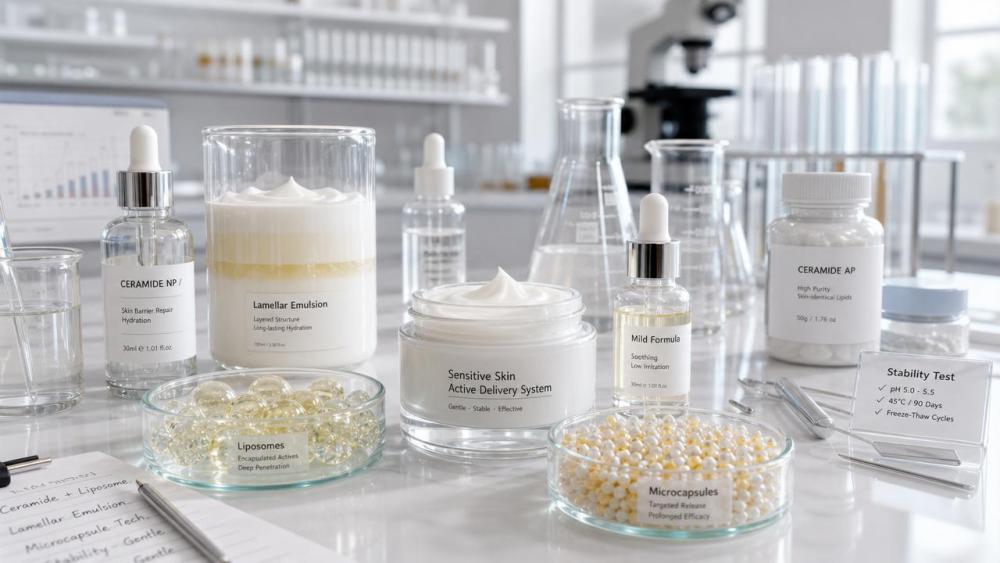
Sensitive skin is not a single diagnosis. It is a practical risk category shaped by impaired barrier function, neurosensory reactivity, inflammation tendency, and intolerance to formulation stressors.
A cosmetic active delivery system for sensitive skin must therefore do two jobs at once. It should improve bioavailability, while also limiting the triggers that often come with stronger delivery technologies.
This is where many projects become complicated. A system that boosts penetration may also increase sting, redness, or barrier disruption. A system that looks elegant on paper may destabilize when paired with preservatives, fragrance traces, or pH-sensitive actives.
In anti-aging formulas, this trade-off is especially visible. Peptides, retinoid alternatives, ferments, ceramides, and biomimetic lipids can justify premium positioning, yet their value weakens quickly if the finished product creates discomfort in repeat use.
What a delivery system actually controls
When discussing a cosmetic active delivery system for sensitive skin, it helps to move beyond marketing terms. The delivery system influences several technical outcomes at the same time.
- How well the active survives oxygen, heat, light, and water activity.
- How quickly the active is released after application.
- How deeply the active travels within the stratum corneum.
- How the system interacts with surfactants, solvents, and preservatives.
- How strongly the final product challenges the skin barrier.
Simple delivery formats may be enough for barrier-repair lipids or humectants. More fragile molecules, such as certain peptides or oxidation-prone antioxidants, often need encapsulation, lamellar carriers, or polymer-assisted deposition.
The key point is that “stronger delivery” is not always “better delivery.” For sensitive skin, controlled release and exposure moderation often outperform aggressive penetration strategies.
Current technologies and where irritation risk can rise
Several delivery approaches are common in modern cosmetic development, but their suitability changes with the active, format, and claim level.
From a safety perspective, the irritation issue often comes from the support architecture rather than the headline active. Solubilizers, penetration enhancers, ethanol levels, and surfactant packages may contribute more to intolerance than the peptide or botanical itself.
A practical way to assess low-irritation suitability
A cosmetic active delivery system for sensitive skin should be judged as a full formula pathway, not as an isolated ingredient. That means looking at exposure, compatibility, and stress conditions together.
Start with barrier logic
Barrier-compromised skin responds poorly to repeated disruption. Systems that rely on high solvent loads or strong penetration enhancers should face extra scrutiny, even when efficacy data looks attractive.
Check the full excipient map
The carrier, emulsifier, antioxidant, chelator, preservative, and fragrance residue all influence tolerance. For sensitive applications, hidden irritancy frequently comes from cumulative formula burden rather than one single component.
Review release behavior under use conditions
A controlled-release profile can soften exposure peaks. That matters when working with acids, brightening agents, or anti-aging actives that are effective at low doses but uncomfortable in rapid contact.
Stress test the formula, not only the raw material
Heat, freeze-thaw cycles, light exposure, and packaging interaction may alter droplet size, capsule integrity, or oxidation state. A delivery system that shifts during storage can create both efficacy loss and new irritation signals.
Where compatibility decisions shape risk
In real development work, compatibility decisions often determine whether a cosmetic active delivery system for sensitive skin stays mild enough for launch. Several pairings deserve close attention.
- Peptides with acidic systems may lose stability or change sensory feel.
- Encapsulated oils may need antioxidant support to avoid rancid off-notes and reactive byproducts.
- Botanical actives can bring allergens, color drift, or trace solvent residue.
- Preservative systems may partition differently inside vesicles or multilayer emulsions.
- Fragrance, even at low level, can undermine a sensitive-skin positioning.
This wider compatibility view aligns with the FFAI approach across ingredients sectors. Whether preserving food texture, protecting volatile aromas, or stabilizing cosmetic actives, formulation success depends on understanding how the whole matrix behaves under pressure.
What to prioritize in documentation and validation
Low-irritation claims need more than supplier brochures. A cosmetic active delivery system for sensitive skin should be backed by technical evidence that translates into internal review and regulatory readiness.
Useful documentation usually includes carrier composition, particle or droplet distribution, preservative efficacy impact, stability profile, and compatibility with the intended pH window.
Human tolerance support matters as well. Repeat insult patch testing, ophthalmic caution for near-eye use, and use-condition studies can reveal whether mildness remains consistent over time.
For global launches, compliance confidence is part of risk control. This is where the FFAI intelligence model becomes relevant. Ingredient review is stronger when toxicology, regulatory pathways, stability science, and commercial positioning are examined together rather than in separate silos.
How to compare options without losing commercial realism
The most expensive delivery technology is not automatically the safest or the most convincing. Selection becomes clearer when each option is scored against a few business-critical questions.
- Does it reduce irritation risk at the finished-formula level?
- Does it preserve active integrity through shelf life?
- Can the manufacturing process reproduce the same structure consistently?
- Does the packaging protect the system from oxygen, light, and contamination?
- Do the claims remain supportable across target markets?
In many cases, a lamellar emulsion with a moderate active load is more credible than an aggressive nano-system built around a strong marketing claim. Sensitive-skin success usually comes from disciplined optimization, not from maximum technical complexity.
A useful next step for decision-making
When choosing a cosmetic active delivery system for sensitive skin, the strongest next step is to build an internal comparison framework before screening suppliers. Include barrier impact, release profile, excipient burden, stability behavior, and evidence quality in the same review sheet.
That approach makes cross-functional decisions easier and helps separate true low-irritation design from claim-heavy complexity. It also creates a clearer path for evaluating premium anti-aging actives without weakening safety confidence.
As the market continues to reward both efficacy and absolute safety, the right delivery system is the one that performs quietly, remains stable, and respects sensitive skin under everyday use. That is usually where the best long-term product value begins.
Related News
- How high purity actives for serums reduce formula instability riskSep 30, 2026Cosmeceutical Formulator
- How to evaluate ingredient solution references for skincare claimsSep 27, 2026Cosmeceutical Formulator
- What does hyaluronic acid serum grade mean for cosmetic formulators?Sep 05, 2026Cosmeceutical Formulator
- Which transdermal delivery ingredients for skincare improve actives absorption without raising irritation riskAug 17, 2026Cosmeceutical Formulator
Related News
- 00
0000-00
What drives fragrance ingredients price changes in bulk orders? - 00
0000-00
How to assess a food antioxidants distributor’s traceability practices - 00
0000-00
How minimum order quantities shape private label ingredient sourcing costs - 00
0000-00
What drives personal care ingredient price volatility in sourcing - 00
0000-00
What drives micelles price differences in cosmetic formulations?
Cosmeceutical Formulator
Weekly Insights
Stay ahead with our curated technology reports delivered every Monday.