





In skincare assessment, delivery claims often sound precise while the supporting evidence varies widely. That gap matters because the dermal bioavailability of actives determines whether a promising molecule actually reaches the relevant skin layer in a meaningful amount.
For premium cosmetic actives, this is more than a formulation detail. It sits at the intersection of efficacy, sensory design, compliance, price justification, and brand credibility across the broader FMCG innovation landscape.
Within FFAI’s research lens, transdermal performance is part of the same intelligence chain that connects ingredient chemistry, product stability, and market value. A formula can only claim advanced anti-aging performance when delivery evidence is stronger than its language.
What dermal bioavailability actually means in formula comparison
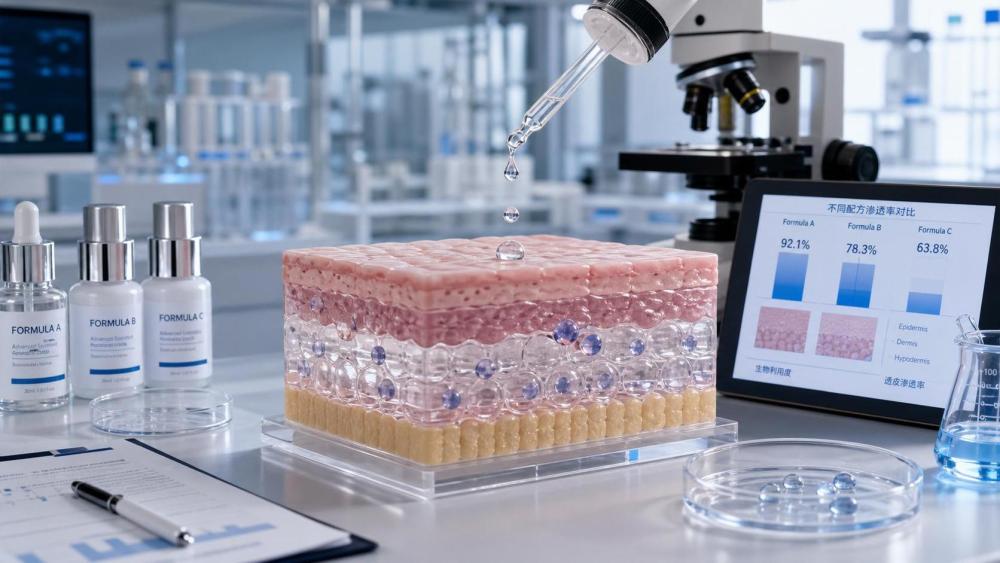
Dermal bioavailability of actives refers to the fraction of an applied ingredient that becomes available within skin tissue after topical use. It does not simply mean that an ingredient touches the surface or appears in a dramatic microscopy image.
The key distinction is between presence, penetration, and useful exposure. A molecule may enter the stratum corneum, remain trapped there, and still fail to influence viable epidermis or dermal targets.
This is why comparing formulas requires more than checking the active list. Vehicle architecture, solvent balance, emulsifier choice, molecular size, ionization, and application conditions can all shift delivery outcomes.
In practice, dermal bioavailability of actives is about dose at site, over time, under realistic use. That is the standard behind a credible delivery claim.
Why the topic has become more important
High-end actives now compete in a crowded market where many products reference peptides, encapsulation, biomimetic systems, or barrier-smart delivery. The wording changes, but the core technical question stays the same: how much active becomes bioavailable where it needs to act?
This matters especially when formulas support premium positioning. Expensive actives such as signal peptides, retinoid systems, or polysaccharide-derived boosters require better substantiation than headline percentages alone.
It also matters for safety and compliance. Stronger penetration is not automatically better if it raises irritation risk, alters exposure assumptions, or complicates regulatory interpretation.
From an industry intelligence perspective, FFAI’s focus on molecular performance reflects a wider shift. Formulators increasingly need evidence that links chemistry, sensory elegance, and market claims without overpromising biological reach.
Where delivery claims usually become misleading
Many claims blur the line between enhanced deposition and enhanced dermal bioavailability of actives. These are not identical outcomes.
Common weak comparisons include:
- Comparing an encapsulated active against a free active at different concentrations.
- Showing fluorescence images without quantitative depth analysis.
- Using in vitro release data as proof of skin delivery.
- Treating skin hydration effects as evidence of deeper active penetration.
- Reporting percentage improvement without stating baseline dose or test conditions.
A formula may look stronger because the carrier improves spreadability or occlusion. That can increase residence time, but it does not automatically confirm target-layer exposure.
The most reliable comparisons separate formulation aesthetics from pharmacokinetic behavior. Both are valuable, but they answer different business questions.
The variables that shape dermal bioavailability of actives
A useful review starts with the molecule itself. Molecular weight, polarity, partition coefficient, solubility, and chemical stability set the first limits on topical delivery.
The formula then modifies those limits. Emulsions, gels, anhydrous systems, liposomes, nanoemulsions, polymeric carriers, and solvent systems each create different release and partition profiles.
Skin condition also matters. Dry, compromised, inflamed, freshly exfoliated, or occluded skin will not behave like intact baseline skin in a standard lab model.
Usage context matters as well. Leave-on creams, essences, masks, patches, and cleansers expose the skin for different durations, which changes the practical meaning of dermal bioavailability of actives.
A quick comparison framework
How to judge the evidence behind a claim
Not all methods carry equal weight. Franz diffusion cells, tape stripping, Raman spectroscopy, confocal imaging, and biomarker studies can each contribute, but only when their limits are clearly stated.
A good evidence package usually answers three linked questions. Did the active leave the vehicle? Did it cross into the intended layer? Did that exposure correlate with a relevant biological outcome?
More credible studies also control for formulation comparability. If two samples differ in active load, pH, viscosity, or penetration enhancer level, the claim should not be framed as a simple carrier advantage.
For dermal bioavailability of actives, timing is often overlooked. Early penetration peaks may look impressive, yet sustained availability can matter more for repair pathways or tolerability profiles.
Signals that deserve closer scrutiny
- No disclosure of the analytical method.
- Claims built only on model dyes rather than the real active.
- No distinction between stratum corneum retention and viable skin delivery.
- Biological effect claims without dose-response context.
- Single-point results presented as broad superiority.
Business relevance beyond the lab
Delivery assessment influences more than technical documentation. It affects how a formula is priced, how claims are defended, and how cross-border launches are positioned within different regulatory cultures.
For premium skincare, the dermal bioavailability of actives can support a stronger efficacy narrative only when it aligns with sensory acceptability and stability. A carrier that improves penetration but destabilizes a peptide or irritates skin may weaken the final proposition.
This is where FFAI’s broader intelligence model becomes practical. Ingredient value is rarely created by chemistry alone. It emerges from the combined performance of delivery, compliance, shelf behavior, and consumer experience.
That logic is familiar across adjacent FMCG categories. In food systems, preservation only matters if stability survives processing and distribution. In fragrance systems, aroma only matters if release matches use conditions. Skincare follows the same discipline.
A practical way to compare formulas side by side
A disciplined comparison starts by standardizing the question. Decide whether the target is superficial deposition, viable epidermal exposure, dermal reach, or a measured biological response.
Then align the comparison set. Use equivalent active dose, similar application conditions, matched skin models, and comparable endpoint timing wherever possible.
It helps to score each formula across a small set of dimensions:
- Strength of dermal bioavailability evidence.
- Relevance of the test model to real use.
- Stability of the active inside the carrier.
- Tolerance margin at the claimed exposure level.
- Clarity between marketing language and measured endpoint.
This approach keeps the review anchored in evidence instead of presentation. It also makes cross-supplier comparisons easier when documentation quality differs.
What to do next when claims look similar
When two formulas make comparable penetration claims, the better next step is not to rely on headline language. Rebuild the claim from the bottom up using active chemistry, vehicle design, method quality, and endpoint relevance.
Ask whether the reported dermal bioavailability of actives is measured, inferred, or merely suggested. Then check whether the evidence supports the claimed depth, amount, and functional meaning.
A structured review matrix often reveals the real difference quickly. One formula may deliver stronger deposition, another may show better viable-layer exposure, and a third may offer the best balance between efficacy signal and formulation elegance.
That is the more useful standard for technical decision-making. In a market full of polished delivery language, real value comes from knowing which claims reflect measurable skin access and which simply sound advanced.
Related News
- How high purity actives for serums reduce formula instability riskSep 30, 2026Cosmeceutical Formulator
- How to evaluate ingredient solution references for skincare claimsSep 27, 2026Cosmeceutical Formulator
- What does hyaluronic acid serum grade mean for cosmetic formulators?Sep 05, 2026Cosmeceutical Formulator
- Which transdermal delivery ingredients for skincare improve actives absorption without raising irritation riskAug 17, 2026Cosmeceutical Formulator
Related News
- 00
0000-00
How to assess color stability from a natural food colors manufacturer - 00
0000-00
When does amino acid surfactant powder improve cleanser mildness? - 00
0000-00
How to verify a cosmetic nanotechnology supplier's safety documentation - 00
0000-00
How rheological thickeners for shampoo affect suspension stability - 00
0000-00
How to assess recombinant collagen ingredients for cream stability
Cosmeceutical Formulator
Weekly Insights
Stay ahead with our curated technology reports delivered every Monday.